

On this page
A hen's egg is essentially an incubator for the growing chick. If you are preparing for exams or studying animal physiology, knowing the structure of the amniotic egg is a fundamental step. The egg houses all the water, food and protection a developing embryo needs to survive on dry land.
What do the shell and shell membrane do?
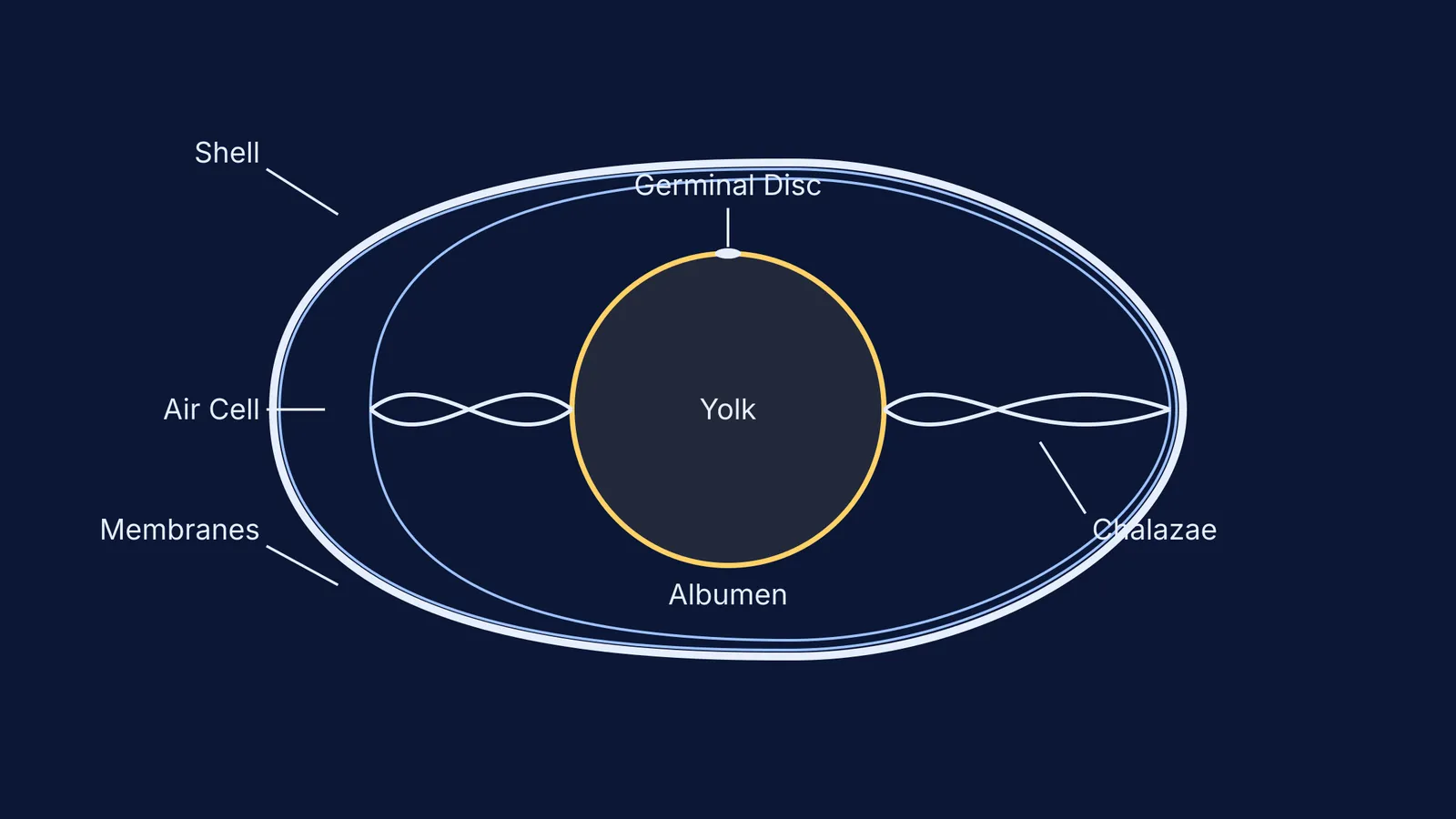
The outer shell provides physical protection and controls the movement of gases. According to the USDA Food Safety and Inspection Service, the eggshell contains thousands of tiny pores. These microscopic holes allow oxygen to enter the egg, while letting carbon dioxide and moisture escape. The shell is made of approximately 95% calcium carbonate crystals, giving it the strength to withstand the weight of an incubating hen, as noted by Wikipedia.
Just inside the shell lie two thin layers known as the inner and outer shell membranes. These protein barriers help defend the embryo against bacterial infections. At the blunt end of the egg, these two membranes separate to form the air space (or air cell). The air cell develops as the freshly laid egg cools and its internal contents shrink. This pocket of air provides the chick with its first breath before it hatches.
How do the albumen and chalazae protect the embryo?
The albumen, commonly known as the egg white, surrounds the yolk. It is largely composed of water and proteins such as ovalbumin. The albumen acts as a shock absorber, protecting the delicate embryo from mechanical damage. It also supplies a vital source of hydration and additional protein during development.
Within the albumen are the chalazae. The USDA describes the chalazae as twisted, cord-like strands of egg white. These spiral ropes extend from the yolk to the ends of the egg, anchoring the yolk securely in the centre. By holding the yolk in place, the chalazae prevent the growing embryo from knocking against the hard shell.
Where is the germinal disc on the yolk?
The yolk is the dense, nutrient-rich yellow core of the egg. It supplies the growing embryo with essential fats, vitamins, minerals and most of the calories required for development. A clear casing called the vitelline membrane surrounds the yolk to hold it together.
On the surface of the yolk sits the germinal disc (also called the blastodisc). This small, circular white spot is where the female's genetic material is stored. If the egg is fertilised by sperm, the germinal disc is the precise site where embryonic development begins.
As birds are uricotelic, they convert nitrogenous waste into uric acid, which is stored safely inside the egg without poisoning the embryo. For more on this, see our guide on Ammonotelic, ureotelic and uricotelic animals: why waste differs. The enclosed nature of the egg requires all parts to work together flawlessly.
Revision Checklist: Functions of Egg Parts
Shell: Gas exchange through pores and physical protection.
Shell Membranes: Secondary barrier against bacteria.
Air Space: First breath of air for the hatching chick.
Albumen: Shock absorption and water supply.
Chalazae: Anchoring the yolk in the centre.
Yolk: Primary source of nutrients (fats, vitamins, minerals).
Germinal Disc: The site of fertilisation and embryonic growth.
If you want to review similar biological structures or test your understanding, the Concept Library has every concept in physics, chemistry, biology, mathematics and computing, each with its own lesson and its place in the map. And if you are comparing avian development to mammals, our article From fertilisation to implantation: the first week of pregnancy covers the early stages of human development.


