

On this page
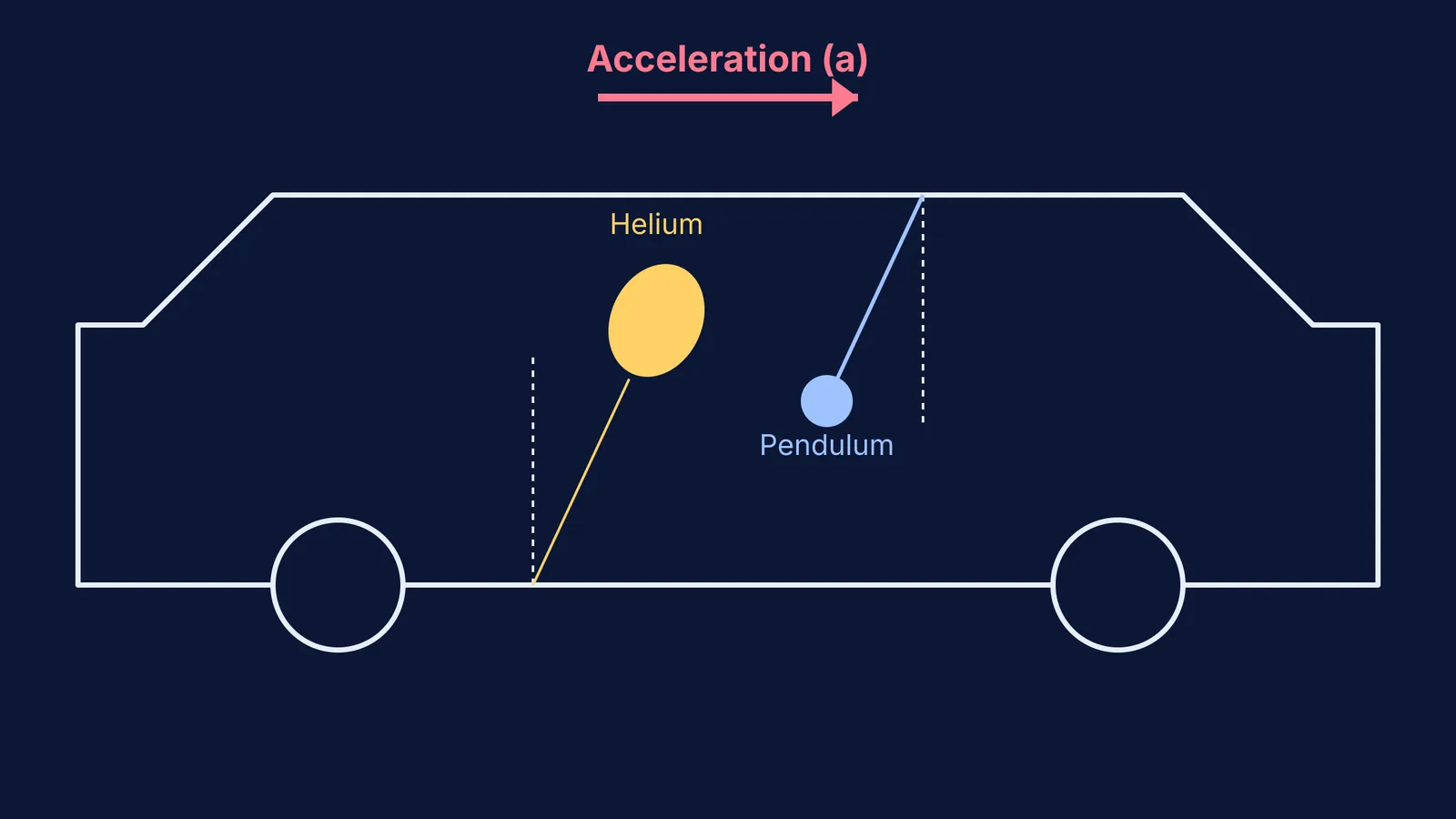
When a car accelerates forward, everything inside seems to be pushed backward. You feel pressed into your seat, and a pendulum hanging from the roof swings toward the rear window.
But if you hold the string of a floating helium balloon, it does something entirely different. When you step on the gas, the helium balloon tilts forward, in the same direction the car is accelerating.
Why does it break the rules of inertia? The answer lies in the air around it.
Why does the balloon move forward?
The key to this puzzle is that the balloon is not in a vacuum. The car cabin is full of air molecules, and those molecules have mass.
When the car accelerates, the air molecules resist the change in motion due to inertia. They "slosh" toward the back of the cabin. This creates a horizontal pressure gradient: the air pressure at the rear of the car becomes slightly higher than the air pressure at the dashboard.
Just like in the atmosphere, buoyancy pushes objects from areas of high pressure to areas of low pressure. Because the helium inside the balloon is less dense than the air around it, the high-pressure air at the back of the car pushes the lighter balloon toward the low-pressure zone at the front. A 1963 study published in the *American Journal of Physics* by Hans G. Graetzer and P. W. Williams (doi.org/10.1119/1.1969452) documented this exact behaviour, confirming the forward motion of the balloon.
What happens to a candle flame in an accelerating car?
The same physics applies to a candle flame in a sealed container inside the car. A candle flame is composed of hot gases, which are significantly less dense than the cool room-temperature air surrounding it.
When the car accelerates forward, the denser, cooler air moves to the back. The resulting pressure gradient pushes the less dense hot gases of the flame toward the front. Instead of leaning backward like you might expect from wind resistance, the flame leans forward in the direction of acceleration.
The equivalence principle: a new "down"
There is a second way to understand this, using Albert Einstein’s Equivalence Principle. This principle states that the physical effects of being in an accelerating frame are indistinguishable from being in a gravitational field.
When the car accelerates forward at a rate a, it feels exactly as if a new gravitational pull has been added, pointing horizontally to the rear. The "effective gravity" inside the car is the vector sum of this new backward pull and the Earth's normal downward gravity (g).
This means the new "down" direction inside the car is tilted toward the bottom-rear corner.
Gravity normally pulls denser objects down, and buoyancy pushes lighter objects *opposite* to gravity. Since "down" is now tilted back, a heavy pendulum points down and back. The lighter helium balloon and candle flame must point "up" in this new field—which means they tilt up and forward.
How to solve these problems in exams
In JEE and NEET, you will often need to calculate the exact angle of this tilt. The most reliable method is to use the concept of effective gravity.
Find the effective gravity vector. The horizontal acceleration is a and vertical gravity is g.
Calculate the angle. The new vertical tilts by an angle θ, given by tan θ = a/g.
Apply it to the object. A dense object like a bob hangs parallel to the new vertical, tilted backward by θ. A buoyant object like a helium balloon aligns with the new "up", tilted forward by θ.
This approach is identical to how you would solve for a pendulum in an electric field, where the electric force provides the horizontal component instead of physical acceleration. If you find these non-inertial reference frames hard to picture, you can try working through a few variations in the Fermi Problem Library. Fermi's AI tutor works out what you already know and builds a plan for the session, helping you master the reasoning rather than just jumping to the formula. Just as you must adjust your thinking for the normal force on a car moving over a hump, understanding effective gravity gives you a reliable tool for any acceleration problem.


