

On this page
Every molecule of a given alkane isomer—whether it is a long, floppy straight chain or a compact, heavily branched one—contains the exact same number of carbon and hydrogen atoms. When burned completely in an excess of oxygen, all isomers of that formula produce the exact same amount of carbon dioxide and water. But they do not release the same amount of heat.
Measuring the heat of combustion in a laboratory, typically using a bomb calorimeter, is a classic way to work out which isomer is most stable. The rule is simple: the more stable the isomer, the less energy it releases.
Why do branched alkanes have a lower heat of combustion?
Think of chemical bonds as compressed springs. A highly strained, unstable molecule holds more potential energy in its structure. When it burns, it falls all the way down to the low-energy state of CO₂ and H₂O, releasing all that stored energy as heat. A stable molecule starts closer to the bottom, so its "fall" is shorter and it gives off less heat.
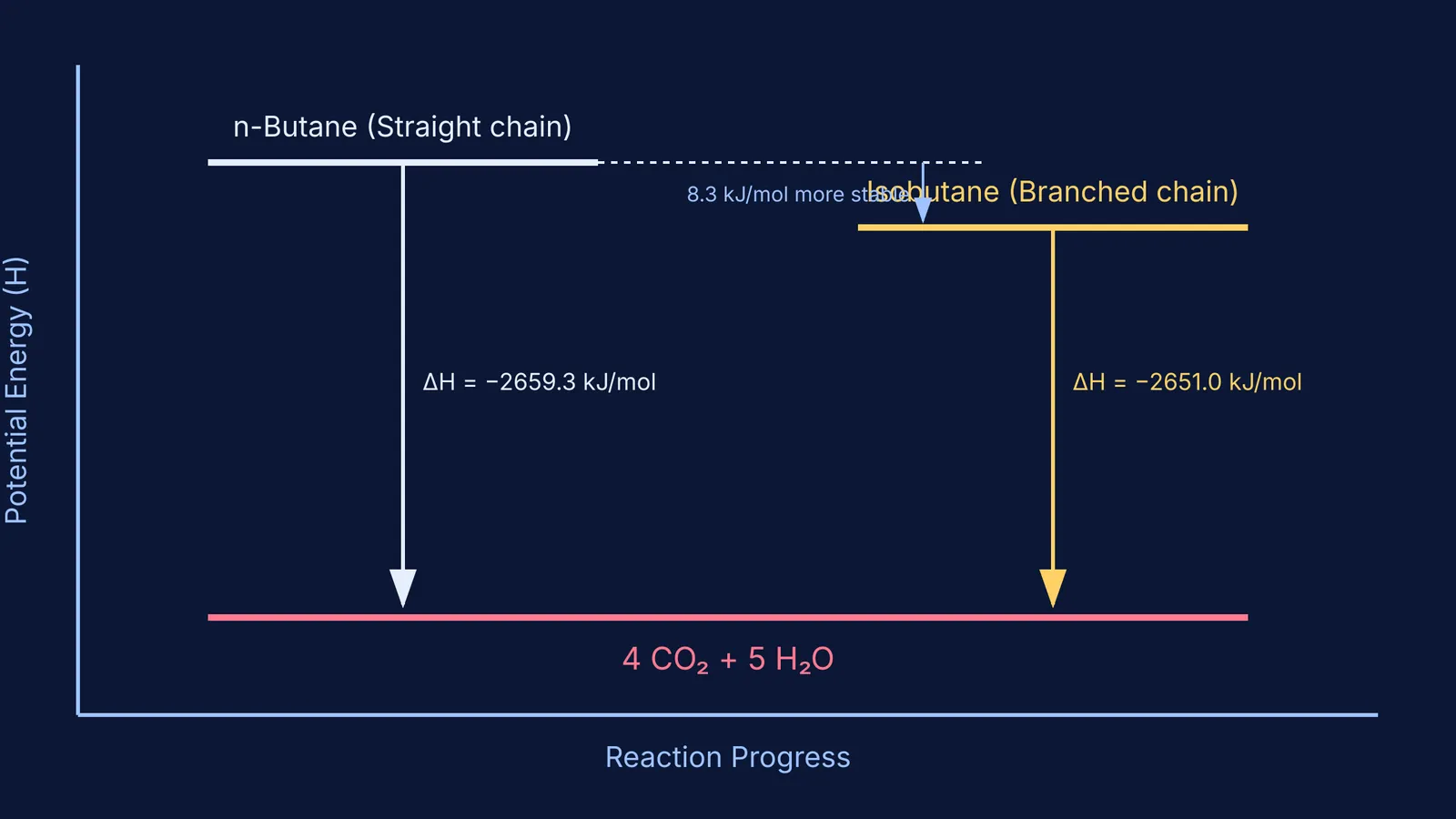
For alkanes, a branched chain is more stable than a straight chain. While the exact quantum mechanical reasons are still debated by chemists—often attributed to better electron correlation or stabilizing interactions called "protobranching" between nearby alkyl groups—the thermodynamic result is clear. According to the Lower Heating Values listed on Wikipedia, straight-chain n-butane releases 2659.3 kJ/mol when burned. Its branched isomer, isobutane, releases slightly less at 2651.0 kJ/mol.
Because both reactions end with the exact same products, that 8.3 kJ/mol difference must come from the starting state. Isobutane was already 8.3 kJ/mol lower in energy before the reaction even began. You can see this same pattern when drawing structural isomers: the more branches you add to the carbon skeleton, the more the heat of combustion drops.
Which is more stable: cis or trans alkenes?
The same principle applies to alkenes with a carbon-carbon double bond, where the fixed layout of the groups attached to the double bond creates different geometric isomers.
In a *cis* alkene, the bulky alkyl groups are forced onto the same side of the double bond. Their electron clouds push against each other, creating a repulsive force known as steric strain that raises the molecule's potential energy. In a *trans* alkene, those same groups are locked on opposite sides, safely out of each other's way.
Because the *trans* isomer is under less strain, it is more stable. When burned, Wikipedia data shows *trans*-2-butene releases 45.124 MJ/kg, while the more strained *cis*-2-butene releases 45.194 MJ/kg. Since they have identical molar masses, the lower mass-based heating value directly translates to less energy per mole. Just like with alkanes, the lower heat of combustion proves the higher stability of the *trans* layout.
What about ring strain in cyclic isomers?
Cycloalkanes provide another perfect example of how heat of combustion reveals stability. If you compare cyclic isomers or look at the heat of combustion per CH₂ unit across different ring sizes, you are measuring ring strain.
Small rings like cyclopropane are forced into tight internal angles, far smaller than the ideal tetrahedral angle. This creates severe angle strain. They also suffer from torsional strain because all their hydrogen atoms eclipse each other. Because of this massive built-up energy, cyclopropane has a very high heat of combustion per carbon atom. In contrast, a six-membered cyclohexane ring can pucker into a chair shape that completely eliminates both angle and torsional strain, giving it the lowest heat of combustion per CH₂ unit of any common cycloalkane.
How does the heat of combustion of isomers branched vs straight chain stability help in exams?
In JEE and NEET organic chemistry, questions frequently ask you to rank the stability of isomers without giving you any numbers. You have to predict the heat of combustion from the structure alone.
If you are struggling to picture why one isomer is more branched than another, or where the steric clashes happen in a *cis* alkene, the Concept Library maps out every concept in chemistry. It gives you a place to review the shapes and 3D arrangements before you tackle the thermodynamics.
Here is a practical checklist for ranking heats of combustion:
Count the carbons first. A molecule with more carbon atoms will always have a higher total heat of combustion, regardless of its branching. Hexane will always release more heat than pentane.
Look for branching. If the molecules are true isomers (they have the exact same number of carbons), the straight-chain isomer will release the most heat. The highly branched isomer will release the least.
Check cis/trans. For alkenes, the *cis* isomer is more strained and releases more heat than the *trans* isomer.
Check ring strain. For cycloalkanes, highly strained small rings release more energy per carbon than unstrained rings like cyclohexane.
If you ever get stuck ranking complex isomers, bring the structures to Fermi's AI tutor. Instead of just printing the final ranking, it will draw the molecules on a board and walk you through the branching and strain step-by-step until you can rank them by sight.


