

On this page
When you slide a textbook across a table, it skids forward, decelerates, and eventually grinds to a complete stop. Its initial bulk motion vanishes, but the mechanical energy that propelled it has not disappeared. Instead, every joule of initial kinetic energy transforms into thermal internal energy distributed between the sliding block and the surface.
Why does friction convert all kinetic energy into heat?
The relationship between motion and thermal dissipation begins with the work-energy theorem. When an object of mass m slides horizontally with initial velocity v₀ across a stationary surface, kinetic friction provides the net retarding force opposing displacement. By the work-energy theorem, the net work done on the block equals its change in kinetic energy: W_net = ΔK = 0 − ½ m v₀² = −½ m v₀².
On a microscopic scale, surfaces are never perfectly smooth. As Bruce Arne Sherwood and W. H. Bernard demonstrated in the American Journal of Physics, macroscopic friction arises from microscopic asperities colliding, shearing, and deforming. These interactions do not store recoverable elastic energy. Instead, they agitate the crystal lattices of the contacting bodies, transforming coordinated mechanical motion into random molecular vibrations. This equivalence between mechanical work and thermal energy builds on the quantitative baseline measured by James Prescott Joule in his 1850 Royal Society study and early observations by Count Rumford in his 1798 friction inquiry. For broader exam applications of work and kinetic energy, review our guide to work-energy theorem problem strategies.
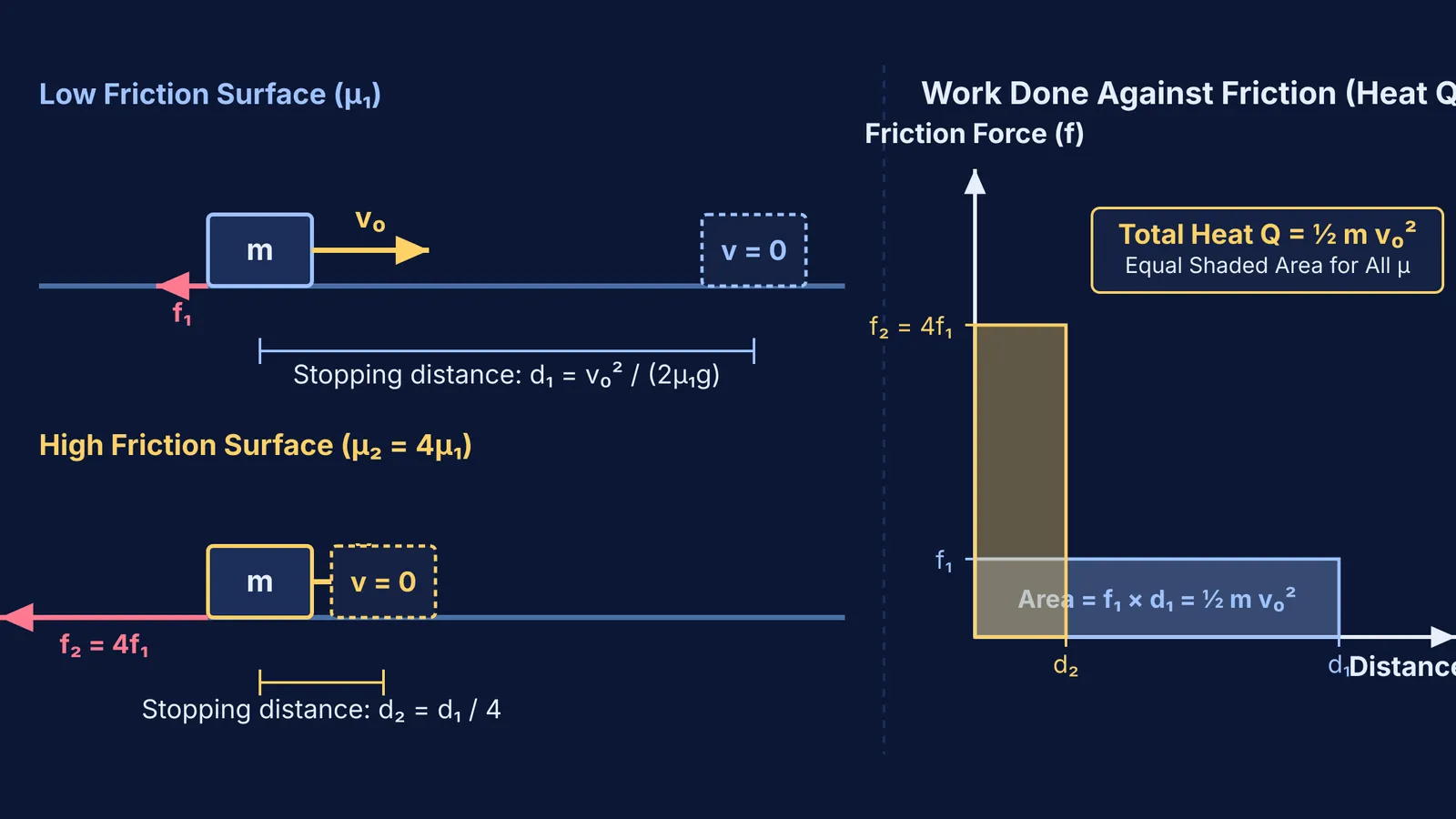
Does a higher friction coefficient create more heat?
In competitive exams like JEE Main and NEET-UG, questions frequently test whether a rougher floor generates more heat than a smoother one when stopping an identical sliding object. Intuition tempts students to say yes because rougher surfaces exert larger frictional forces.
The mathematics proves that intuition false. Consider a block of mass m moving with initial velocity v₀ across a horizontal floor with kinetic friction coefficient μ. The normal force is N = m g, creating a frictional retarding force f = μ m g. By Newton's second law, deceleration is a = f / m = μ g. Using kinematics with final velocity v = 0, the stopping distance d satisfies 0 = v₀² − 2 a d, which gives d = v₀² / (2 μ g).
To find total heat Q, we calculate the mechanical work done against friction:
Q = f × d = (μ m g) × [v₀² / (2 μ g)] = ½ m v₀².
The friction coefficient μ appears in the numerator of the retarding force and the denominator of the stopping distance, cancelling out completely. As Carl E. Mungan showed in The Physics Teacher, total energy dissipated into internal thermal energy depends solely on initial kinetic energy. For more practice resolving contact forces, see our walkthrough of static and kinetic friction problem breakdowns.
How do smooth and rough surfaces compare in practice?
To see why two different surfaces generate the same total heat, consider a worked comparison modeled after the sliding block thermodynamics analyzed in The Physics Teacher.
Suppose a block with mass m = 2 kg slides across a horizontal plane at an initial speed v₀ = 6 m/s, using gravitational acceleration g = 10 m/s². The initial kinetic energy is K₀ = ½ × 2 kg × (6 m/s)² = 36 J.
Polished surface (μ = 0.10): Friction force is f₁ = 0.10 × 2 kg × 10 m/s² = 2 N. Deceleration is a₁ = 1 m/s², giving stopping distance d₁ = (6 m/s)² / (2 × 1 m/s²) = 18 m and stopping time 6 s. Total heat generated is Q₁ = 2 N × 18 m = 36 J.
Rough surface (μ = 0.60): Friction force is f₂ = 0.60 × 2 kg × 10 m/s² = 12 N (6 times larger). Deceleration is a₂ = 6 m/s², cutting stopping distance to d₂ = (6 m/s)² / (2 × 6 m/s²) = 3 m and stopping time to 1 s. Total heat generated is Q₂ = 12 N × 3 m = 36 J.
Why does rough concrete feel much hotter immediately after stopping? The difference lies in power dissipation rather than total energy:
The rough surface dissipates 36 J in 1 s over 3 m, with initial peak power f₂ × v₀ = 72 W.
The smooth surface spreads 36 J over 6 s along 18 m, with initial peak power of 12 W.
Because the rough surface delivers energy 6 times faster into a smaller contact zone, localized transient heating is much sharper before heat conduction cools the contact patch.
Where does the dissipated heat go?
Students often wonder whether all 36 J remains inside the moving block. As John W. Jewett Jr. emphasized in The Physics Teacher, energy conservation applies to the chosen system. When defining the system as the block plus floor, friction is an internal interaction and no external work crosses the boundary. The total internal energy increase equals initial kinetic energy: ΔU_block + ΔU_floor = ½ m v₀².
How thermal energy divides between block and floor depends on thermal conductivities, densities, and heat capacities, but their sum is fixed. For related mechanics transfers, see our breakdown of energy conservation in spring-block systems.
How should students approach energy problems in exams?
When solving mechanics questions under timed exam conditions, bypass tedious kinematics by following three systematic steps:
Identify system boundaries: Decide whether friction acts as an external retarding force on a single body or an internal interaction within a multi-body system.
Compare initial and final states: If an object begins with kinetic energy and comes to rest on a level plane, all mechanical energy converts into non-mechanical forms like thermal internal energy.
Check for parameter cancellations: Look for variables like friction coefficients that scale force up while scaling displacement down proportionally.
When practicing mechanics problems, the Fermi Problem Library provides worked problems with a step-by-step solver that explains the reasoning rather than printing an answer. To explore how mechanical work connects to internal energy across different topics, the Fermi Concept Library covers every concept in physics, each with its own lesson and its place in the map. For ideas that are easier to see than to read, the Fermi Simulation Lab offers interactive simulations that let you explore physical models directly. Approaching friction through energy conservation turns common exam traps into quick, dependable marks.


