

On this page
A standard problem in introductory mechanics asks: a stone is dropped from the top of a tower and covers half of its total height in the final second of its fall. How high is the tower, and how long does the fall last? This problem frequently appears in school boards and national entrance exams because it looks deceptively difficult at first glance, yet collapses neatly once you choose the right reference frame.
How do you set up the two equations of motion for this fall?
To model the vertical descent of a body released from rest under constant gravitational acceleration g, we apply the standard kinematic equations from NCERT Class 11 Physics. Let the total height of the tower be H and the total duration of the fall be t seconds. Because the stone is released from rest, its initial velocity is u = 0.
Taking the downward direction as positive and assuming constant downward acceleration due to gravity g, we use the standard kinematic displacement formula:
s = ut + (1/2)gt²
For the complete fall of height H over time t, this gives our first fundamental relation:
H = (1/2)gt²
Now consider what happens immediately before the final second begins. The stone has already been falling for exactly (t − 1) seconds. Its displacement h₁ during this preliminary interval is:
h₁ = (1/2)g(t − 1)²
The problem states that the stone travels the remaining half of the tower's height, H / 2, during the last second. That means it must have traversed the first half of the tower, also H / 2, during those first (t − 1) seconds:
h₁ = H / 2
This observation avoids finding the stone's velocity at the start of the final second. Instead of splitting the motion into two intervals with different initial velocities, you directly equate two displacements from rest. When encountering kinematics puzzles that involve non-obvious algebraic setups, the Fermi Problem Library offers a step-by-step solver that explains the reasoning rather than simply printing an answer.
Why is the total time of flight equal to 2 + √2 seconds?
To solve for the total time t, substitute the expression for total height into the condition for the first half of the descent:
(1/2)g(t − 1)² = (1/2) × [(1/2)gt²]
Dividing both sides by (1/2)g eliminates gravitational acceleration entirely, as confirmed by uniform acceleration mechanics in OpenStax University Physics Volume 1:
(t − 1)² = t² / 2
Taking the positive square root on both sides provides an immediate solution:
t − 1 = t / √2
Rearranging to collect terms in t:
t − t / √2 = 1
t(1 − 1 / √2) = 1
t[(√2 − 1) / √2] = 1
t = √2 / (√2 − 1)
Rationalising the denominator by multiplying numerator and denominator by (√2 + 1) produces:
t = √2(√2 + 1) / [(√2 − 1)(√2 + 1)] = (2 + √2) / 1 = 2 + √2 seconds
Using √2 ≈ 1.4142, the total duration of the fall is:
t ≈ 3.414 seconds
Alternatively, expanding (t − 1)² = t² / 2 yields the quadratic equation t² − 4t + 2 = 0, whose roots are t = 2 ± √2. Working through the quadratic form demonstrates how selecting standard equations of motion transforms physical constraints into symmetric algebraic roots.
How do you calculate the total height from the time of fall?
Now that the total time of flight is known, substituting t = 2 + √2 seconds into the kinematic displacement formula H = (1/2)gt² from NCERT Class 11 Physics gives the tower's height.
First expand the squared time:
(2 + √2)² = 4 + 4√2 + 2 = 6 + 4√2 ≈ 11.65685
The analytical height formula is:
H = (1/2)g(6 + 4√2) = g(3 + 2√2)
The numerical height depends on the value assigned to g:
Under standard school curriculum gravity g = 9.8 m/s² from NCERT Class 11 Physics: H = 4.9 × 11.65685 ≈ 57.12 metres.
Using the international standard acceleration of gravity gn = 9.80665 m/s² defined by the NIST Reference on Constants, Units, and Uncertainty: H = 0.5 × 9.80665 × 11.65685 ≈ 57.16 metres.
Taking g = 10 m/s², often specified on competitive exam papers for clean arithmetic: H = 5 × 11.65685 ≈ 58.28 metres.
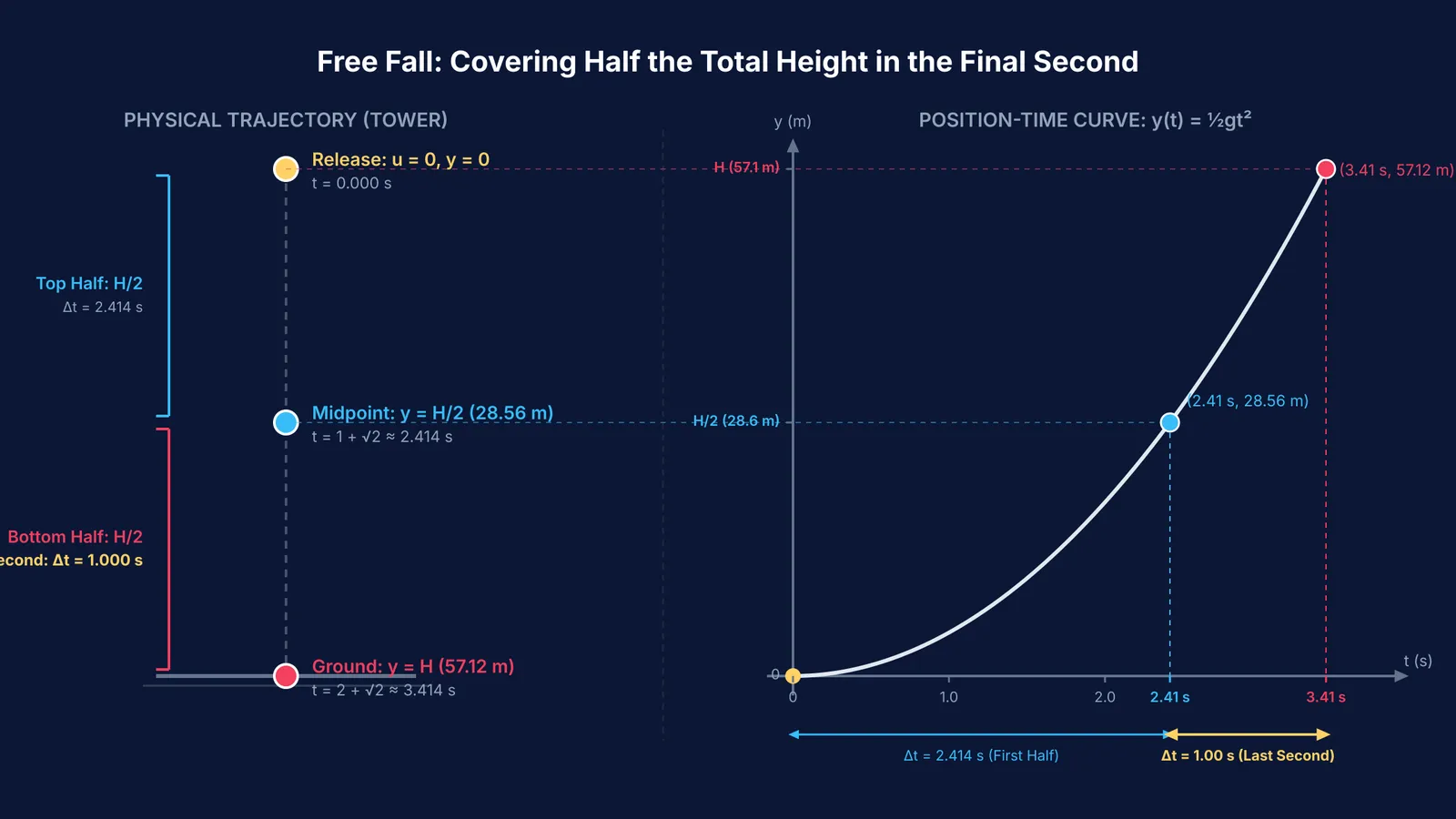
We can verify this result by evaluating the distance fallen in the first (t − 1) = 1 + √2 ≈ 2.414 seconds: h₁ = 0.5 × 9.8 × (2.4142)² ≈ 28.56 metres, which is exactly half of 57.12 metres.
Why is the second mathematical root discarded?
Solving the quadratic equation t² − 4t + 2 = 0 yielded two real roots: t₁ = 2 + √2 ≈ 3.414 seconds and t₂ = 2 − √2 ≈ 0.586 seconds, evaluated under free-fall principles in OpenStax University Physics Volume 1.
The smaller root t₂ = 0.586 seconds must be rejected on physical grounds. The problem explicitly states that the object has a "last second" of motion. For an object to spend a full 1.0 second during its final phase, the total time of flight must be strictly greater than 1 second (t > 1).
If t were 0.586 seconds, the interval (t − 1) would equal −0.414 seconds. Negative elapsed time violates causality in free fall from rest. Formally, the parabolic function y(t) = (1/2)gt² passes through the required algebraic points if extended into negative time, but the physical experiment begins strictly at t = 0.
Testing boundary conditions against real-world constraints is essential when solving problems in vertical motion under gravity. Exploring how mathematical solutions map to physical trajectories in the Fermi Concept Library helps make these boundary restrictions second nature.
What does Galileo's law of odd numbers tell us about the fall?
Under the acceleration principles illustrated by Galileo's law of odd numbers, why does the stone take 2.414 seconds to fall through the top half of the tower, but only 1.000 second to plunge through the bottom half?
The explanation lies in how falling bodies accelerate. Under constant acceleration, downward speed grows linearly with time (v = gt), so an object released from rest traverses distances proportional to consecutive odd numbers (1 : 3 : 5 : 7 : 9) over successive equal time intervals.
While our two intervals are not whole integer multiples, the underlying quadratic relationship s ∝ t² operates identically. At the tower's midpoint (y = H / 2), the stone has already reached a speed of v₁ = √(gH) ≈ 23.66 m/s (using g = 9.8 m/s²). Because it enters the final second with this high velocity, it covers 28.56 metres in just 1.000 second, whereas starting from zero speed required 2.414 seconds to cover that same distance.
This principle is identical to analysing distance in the nth second, where the velocity accumulated prior to an interval governs the total displacement achieved during it.
A 4-step checklist for two-stage free-fall problems:
Fix the origin at the release point with downward as positive, so initial velocity u = 0 and acceleration a = +g.
Express total displacement H using the overall flight time t via H = (1/2)gt².
Relate the intermediate stage (t − Δt) directly to H, canceling (1/2)g early to avoid solving for intermediate speeds.
Solve the remaining relation for t, verify that t exceeds the interval duration Δt, and substitute back to find H.


