

On this page
The natural world is incredibly diverse, with organisms thriving in environments from freezing mountains to scorching deserts. In Class 6 science, you learn that every organism has a specific home and unique features that allow it to survive there.
Understanding these ideas helps explain why a camel cannot live in a pond and why a fish cannot survive in a desert.
What is a habitat and adaptation in Class 6?
A habitat is the natural environment or dwelling place where an organism lives, finds food, water, air and shelter. Habitats are made up of biotic components (living things like plants and animals) and abiotic components (non-living things like sunlight, soil and temperature). For example, plants respond to abiotic components like sunlight, which you can see in phototropism and other tropic movements in Class 10.
Adaptation refers to the specific physical features or habits that allow a plant or animal to live naturally in its habitat. These changes take place over thousands of years. This is different from acclimatisation, which is a short-term adjustment (like a human breathing faster when travelling to high altitudes).
If you are struggling to keep track of these biological terms, the Fermi Concept Library covers every concept in physics, chemistry, biology, mathematics and computing, each with its own lesson and its place in the map.
What are examples of terrestrial habitats?
Terrestrial habitats are land-based environments such as forests, grasslands, mountains and deserts. Animals in these habitats face challenges like extreme temperatures and limited water.
The Desert and the Camel
Deserts are dry and hot during the day but can be freezing at night. A camel's body is built entirely around water conservation and temperature control. According to Wikipedia, a camel can lose up to 30% of its body mass due to dehydration—a level that would cause cardiac failure in most other mammals, who can typically only withstand 12–14%.
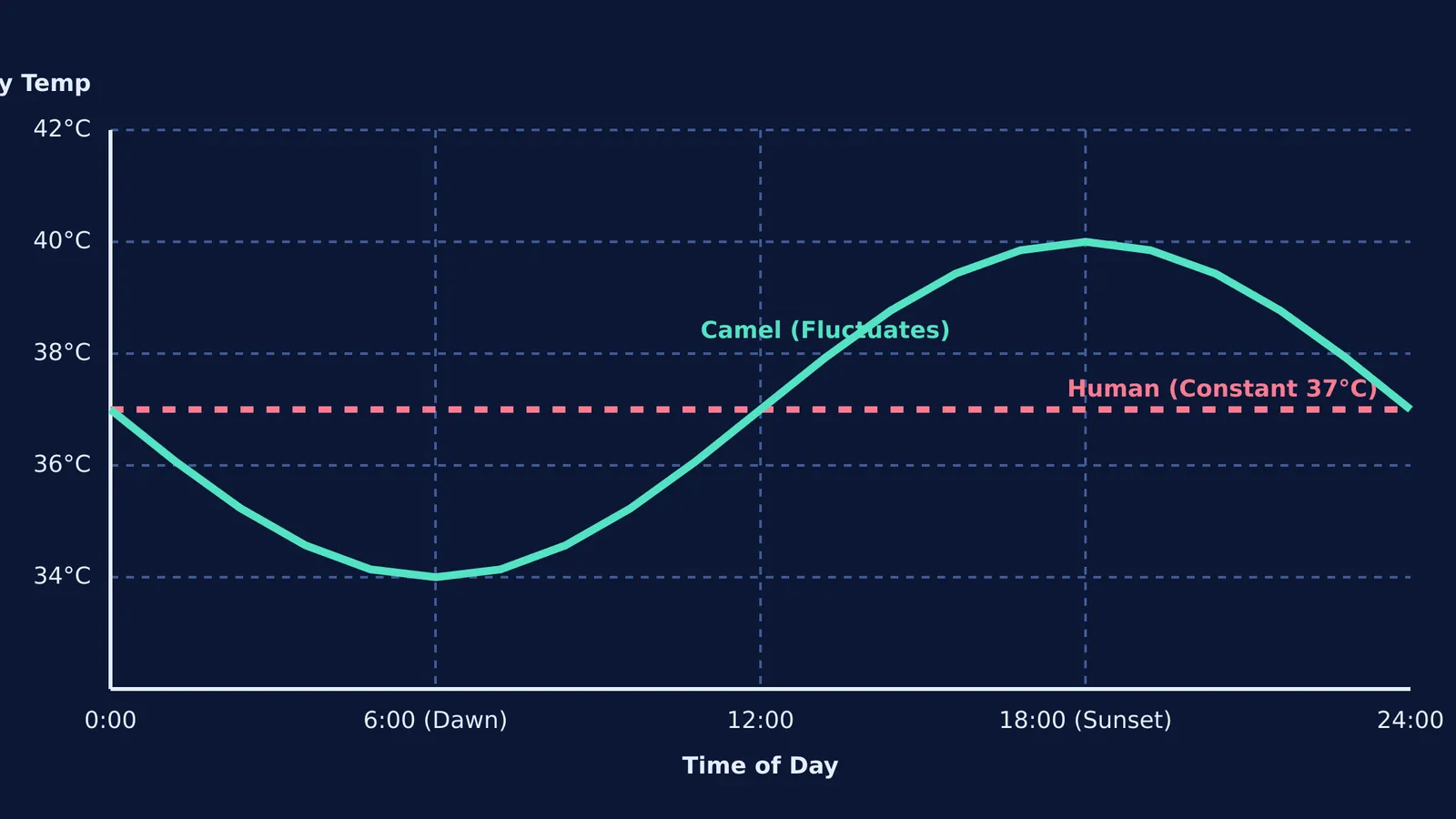
Many people believe a camel's hump stores liquid water, but it actually stores fatty tissue. When food is scarce, the camel breaks down this fat for energy. To conserve water, a camel also changes its body temperature. Instead of sweating to cool down, its body temperature fluctuates from 34 °C (93 °F) at dawn to 40 °C (104 °F) by sunset (Source). This reduces the need to sweat. Furthermore, camels excrete urine as a thick syrup, and like ammonotelic, ureotelic and uricotelic animals, their waste management is perfectly suited to their environment.
Mountain Regions and the Mountain Goat
Mountain habitats are cold, windy and steep. The mountain goat (*Oreamnos americanus*) is an exceptional climber capable of navigating sheer rock faces with pitches exceeding 60° (Source). Their secret lies in their specialised cloven hooves (split into two toes). The hooves have a hard outer shell for edging on tiny rocks and soft inner pads that provide traction. They also have sharp dewclaws at the tips of their feet to prevent slipping during steep descents.
How do fish adapt to aquatic habitats?
Aquatic habitats include oceans, lakes and ponds. Animals living entirely in water face the physical challenge of moving through a dense liquid and extracting dissolved oxygen.
The Ocean and the Fish
A fish must move efficiently through water. Most fish have a streamlined body, shaped like a spindle—narrow at both ends and wider in the middle. This hydrodynamic shape minimises fluid friction, or drag, allowing the fish to swim faster while using less energy. Fast swimmers like tuna are highly streamlined and can cover 10 to 20 body lengths per second (Source).
To breathe underwater, fish use gills located on either side of the pharynx. Gills are made of thread-like filaments that contain a network of capillaries. Fish pump water through their mouths and over these gills. The blood flows in the opposite direction to the water—a mechanism called countercurrent exchange—which maximises the amount of oxygen the fish can extract (Source).
How to study adaptations for exams?
When preparing for your Class 6 science exams or future biology competitions, do not just memorise the physical features. Use this three-step framework to understand any new organism:
Identify the habitat's challenge: Ask yourself what makes this environment hard to survive in (e.g. "The desert has very little water").
Find the physical change: Look at the animal's body shape or organs (e.g. "The camel has highly efficient kidneys and oval red blood cells").
Connect feature to survival: Explain exactly how the feature solves the challenge (e.g. "The kidneys produce thick urine to prevent water loss").


