

On this page
If you have ever boiled an egg a few minutes too long, you have probably seen it: a distinct, greenish-grey ring hugging the outside of the yolk. While it looks unappetising, this ring is entirely safe to eat. It is the result of a classic chemical reaction happening right inside the shell.
When you heat an egg, you are supplying energy that breaks and reshapes its proteins. Push this process too far by overcooking, and you trigger a reaction between the egg white and the yolk, producing a new compound called ferrous sulphide.
What causes the green ring on a boiled egg yolk?
An egg white is primarily composed of water and proteins, particularly one called ovalbumin. These proteins are packed with amino acids that contain sulphur. When the egg is heated, these proteins begin to denature—their tightly coiled structures unfold and change shape, forming new bonds that solidify the egg white. If the temperature gets too high or the egg cooks for too long, this aggressive breakdown releases hydrogen sulphide gas, or H₂S (University of Nebraska–Lincoln).
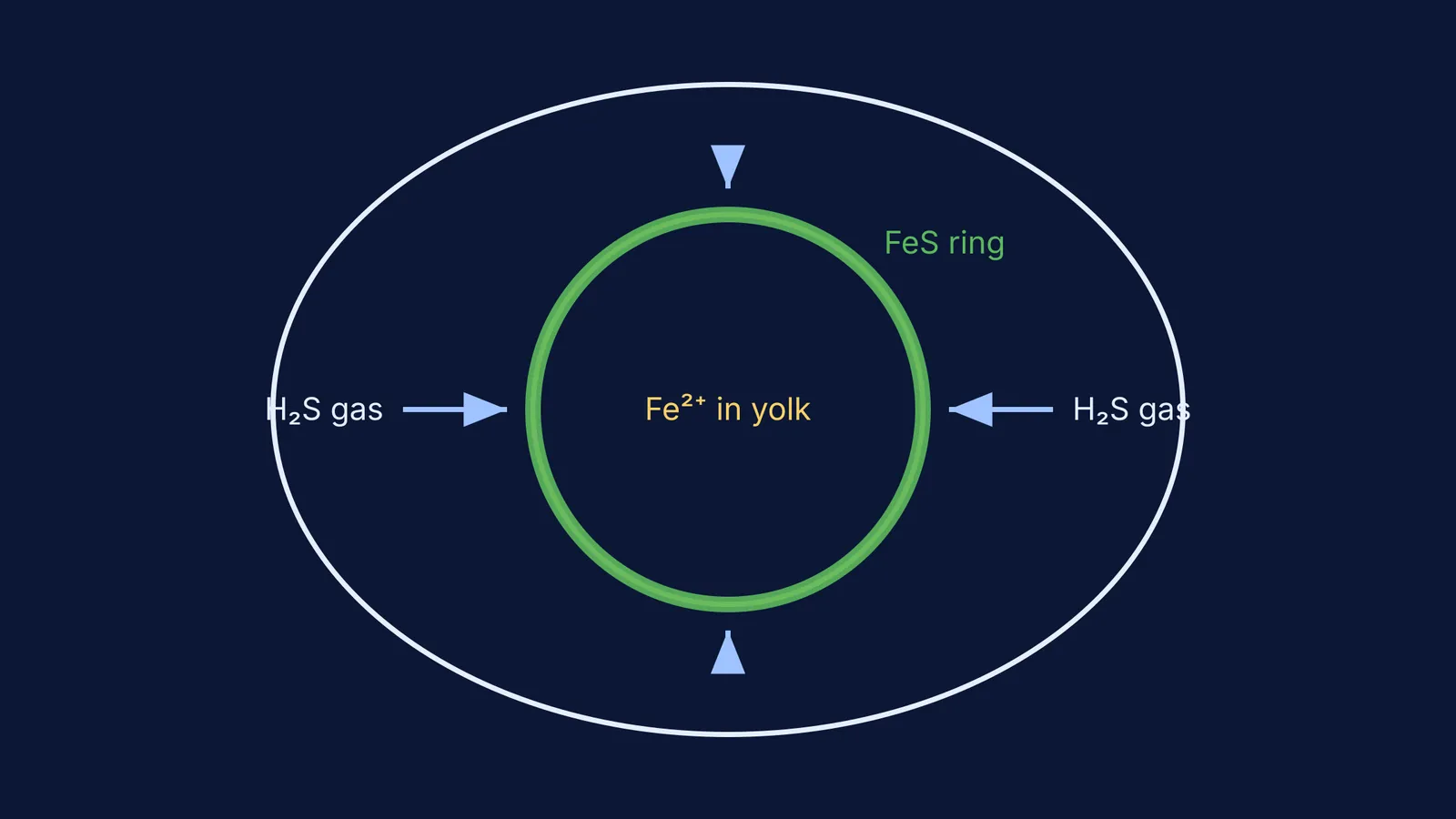
As the egg cooks from the outside in, the outer layers of the white heat up faster than the centre. This temperature difference drives the hydrogen sulphide gas inwards toward the cooler centre of the egg, rather than outwards through the shell. Meanwhile, the yolk contains significant amounts of iron (Fe²⁺), which is naturally bound to a transport protein called phosvitin. When the migrating hydrogen sulphide gas meets the iron at the boundary between the white and the yolk, they undergo a chemical reaction.
The product of this reaction is ferrous sulphide (FeS), a compound with a greenish-grey colour. The chemical equation for this is simple:
Fe²⁺ + H₂S → FeS + 2H⁺
The longer the egg is kept hot, the more hydrogen sulphide is produced, and the thicker and darker the green ring becomes. (If you are studying reaction rates, this is a great real-world example of how time and temperature drive chemical changes, much like the temperature coefficient of rate you learn about in kinetics).
Is the green ring safe to eat?
Yes. The green ring is purely a cosmetic change and is perfectly harmless. While a heavily overcooked egg might have a slightly rubbery texture or a more pronounced sulphur smell, the ferrous sulphide itself does not alter the nutritional value of the egg or pose any health risk.
Visualising how elements like iron and sulphur interact helps make abstract chemistry concrete. If you want to explore how atoms exchange electrons and form new compounds, the Fermi Simulation Lab lets you watch these interactions play out.
Why do older eggs turn green faster?
As eggs age, they naturally lose carbon dioxide through the microscopic pores in their shell. This gradual loss causes the egg white to become more alkaline, raising its pH level. This shift in pH is important because alkaline conditions create an ideal environment for the sulphur in the egg white to break down more rapidly when exposed to heat.
Because older eggs have this higher pH, the chemical reaction that produces hydrogen sulphide gas accelerates. Consequently, the ferrous sulphide ring forms much faster in an older egg than in a freshly laid one. If you are boiling eggs that have been sitting in the fridge for a few weeks, you have a much narrower window of time before that grey-green discoloration appears.
How do you prevent the green ring on a boiled egg?
Preventing the green ring comes down to controlling the chemical reaction by managing heat and time.
Do not overcook: Boil large eggs for no more than 10 to 12 minutes (University of Nebraska–Lincoln). Instead of keeping the pan at a rolling boil, bring the water to a boil, turn off the heat, cover the pan, and let the eggs sit in the hot water.
Cool rapidly: The moment your timer goes off, transfer the eggs immediately into an ice-water bath. This sudden drop in temperature stops the cooking process instantly. It also lowers the pressure inside the egg, which pulls the hydrogen sulphide gas back toward the shell and away from the iron-rich yolk.
Use fresh eggs: As mentioned, fresh eggs have a lower pH, making them naturally more resistant to developing the green ring during normal cooking times.
Understanding the chemistry of everyday things—from cooking an egg to calculating oxidation numbers from structure—turns the kitchen into a laboratory. Next time you boil an egg, you will know exactly how to keep the yolk bright yellow. If you get stuck applying these concepts to your textbook problems, Fermi's AI tutor can work out what you already know and build a plan for the session, guiding you through the reasoning step by step.


