

On this page
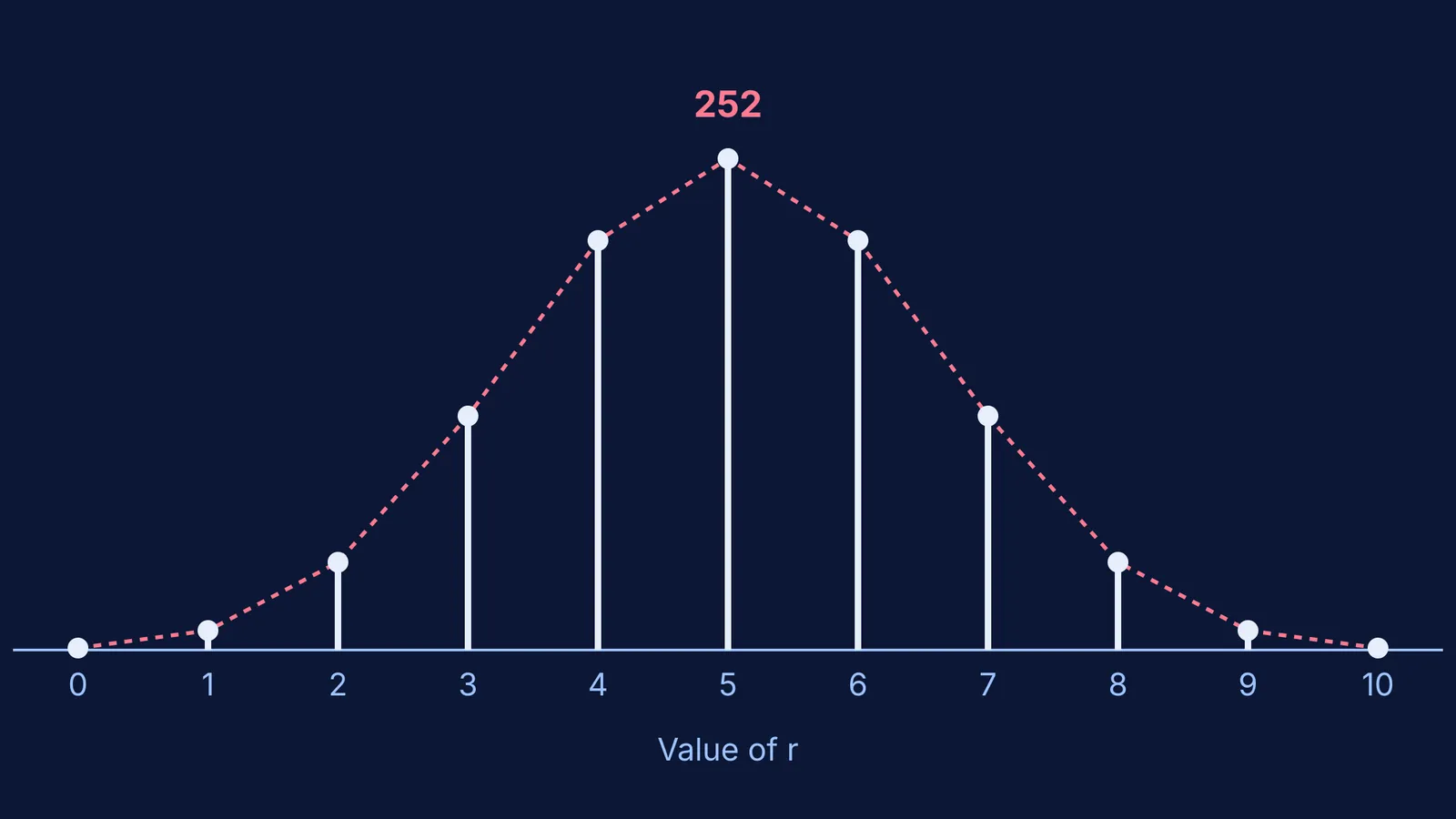
When you write out the values of nCr (or "n choose r") for a fixed n, you find they start small, rise to a peak in the middle, and then fall back down. If you look at the 10th row of Pascal's triangle, the numbers are 1, 10, 45, 120, 210, 252, 210, 120, 45, 10, 1. The maximum is 252, sitting precisely at the centre. This unimodal behaviour — increasing to a single peak or a double peak, and then decreasing symmetrically — is a fundamental property of combinations.
This phenomenon is not just an abstract algebraic rule; it is instantly visible in Pascal's triangle. Each row of the triangle corresponds to the binomial coefficients for a specific n. As you read across any row from left to right, the numbers steadily climb, hit a maximum in the dead centre, and then descend in a perfect mirror image of their ascent. The symmetry is guaranteed because choosing r items to keep is mathematically identical to choosing (n − r) items to leave behind, meaning nCr always equals nC(n−r).
For which r is nCr greatest?
The position of the greatest value depends entirely on whether the total number of items, n, is an even or an odd number. According to the mathematical properties of the binomial coefficient, the maximum value is always found at the central index of its range.
When n is even, the sequence of binomial coefficients has a single peak at the exact middle. The maximum value of nCr occurs when r = n/2.
When n is odd, there is no single middle integer. Because the sequence is perfectly symmetrical, there are two equal maximums side by side. These occur at r = (n−1)/2 and r = (n+1)/2.
For example, if you are working with n = 10 (an even number), the peak is at r = 10/2 = 5, which gives the calculation 10C5 = 252. If you look at the terms on either side, 10C4 and 10C6, they both evaluate to 210, confirming that the central term is indeed the maximum.
If you take n = 11 (an odd number), the two central peaks are found at r = 5 and r = 6. Both calculations yield 11C5 = 11C6 = 462. Whether you are dealing with a small set or expanding a massive binomial expression, this rule always tells you exactly where the largest term lies.
Why does the ratio prove the peak?
Why does nCr always peak in the middle? Instead of computing every single factorial, we can prove it efficiently by comparing adjacent terms in the sequence. By examining the ratio of a term to the one immediately before it, we can see exactly when the values stop growing.
The ratio of the r-th term to the (r−1)-th term simplifies beautifully to: nCr / nCr−1 = (n − r + 1) / r
This simple fraction tells us whether the sequence of coefficients is currently increasing, decreasing, or stationary. As long as this ratio is strictly greater than 1, the next term nCr is larger than the previous term nCr−1.
Let us set the ratio greater than 1 to see where the values continue to rise: (n − r + 1) / r > 1 n − r + 1 > r n + 1 > 2r r < (n + 1) / 2
This inequality is the key. It means the values keep increasing as long as r is less than (n + 1)/2. Once your chosen r goes past this midpoint, the ratio drops below 1, meaning you are now multiplying the previous term by a fraction smaller than a whole. The values must therefore start decreasing. At the exact middle, the curve reaches its crest.
Let us test this ratio with n = 4. The midpoint rule tells us the maximum should be at r = 2. If we move from r = 1 to r = 2, the ratio is (4 − 2 + 1) / 2 = 3/2, which is 1.5. Since 1.5 > 1, 4C2 is indeed larger than 4C1 (6 is larger than 4). If we then step from r = 2 to r = 3, the ratio is (4 − 3 + 1) / 3 = 2/3. Since this is less than 1, the sequence shrinks, giving 4C3 = 4. The mathematics perfectly mirrors the logic of the curve.
How does this help in selection problems?
Understanding this central peak is highly practical when answering questions about maximum possible selections in probability and combinatorics. If you are asked to pick a team of r members from a 20-person club, there are 20Cr different ways to do it. To maximise the total number of distinct committees you could possibly form from those 20 people, you should choose a committee of exactly 10 people, because 20C10 represents the absolute greatest value for n = 20.
If you struggle to remember combinatorial formulas or how to prove them, you can explore the Fermi Concept Library to see how these mathematical ideas fit together in a broader context. A solid visual intuition for how functions behave often outlasts pure memorisation of their algebraic properties. When you hit a wall on a specific probability or selection problem, you can bring it to Fermi. The AI tutor does not just print the final answer; it builds a plan for the session, highlights where your reasoning might have slipped, and helps you verify each step of the calculation yourself.


