

On this page
The Great Indian Bustard (*Ardeotis nigriceps*), locally called the *Godawan*, faces imminent extinction in the wild. Once widespread across eleven Indian states, fewer than 150 individuals survive today, with over 90% confined to Rajasthan's Thar Desert according to the Convention on the Conservation of Migratory Species. The bird is classified as Critically Endangered on the IUCN Red List and receives highest legal protection under Schedule I of India's Wildlife (Protection) Act, 1972. Understanding its collapse requires examining how modern energy infrastructure, grassland loss, and slow reproductive biology combine into an extinction vortex.
Why is the Great Indian Bustard vulnerable to power lines?
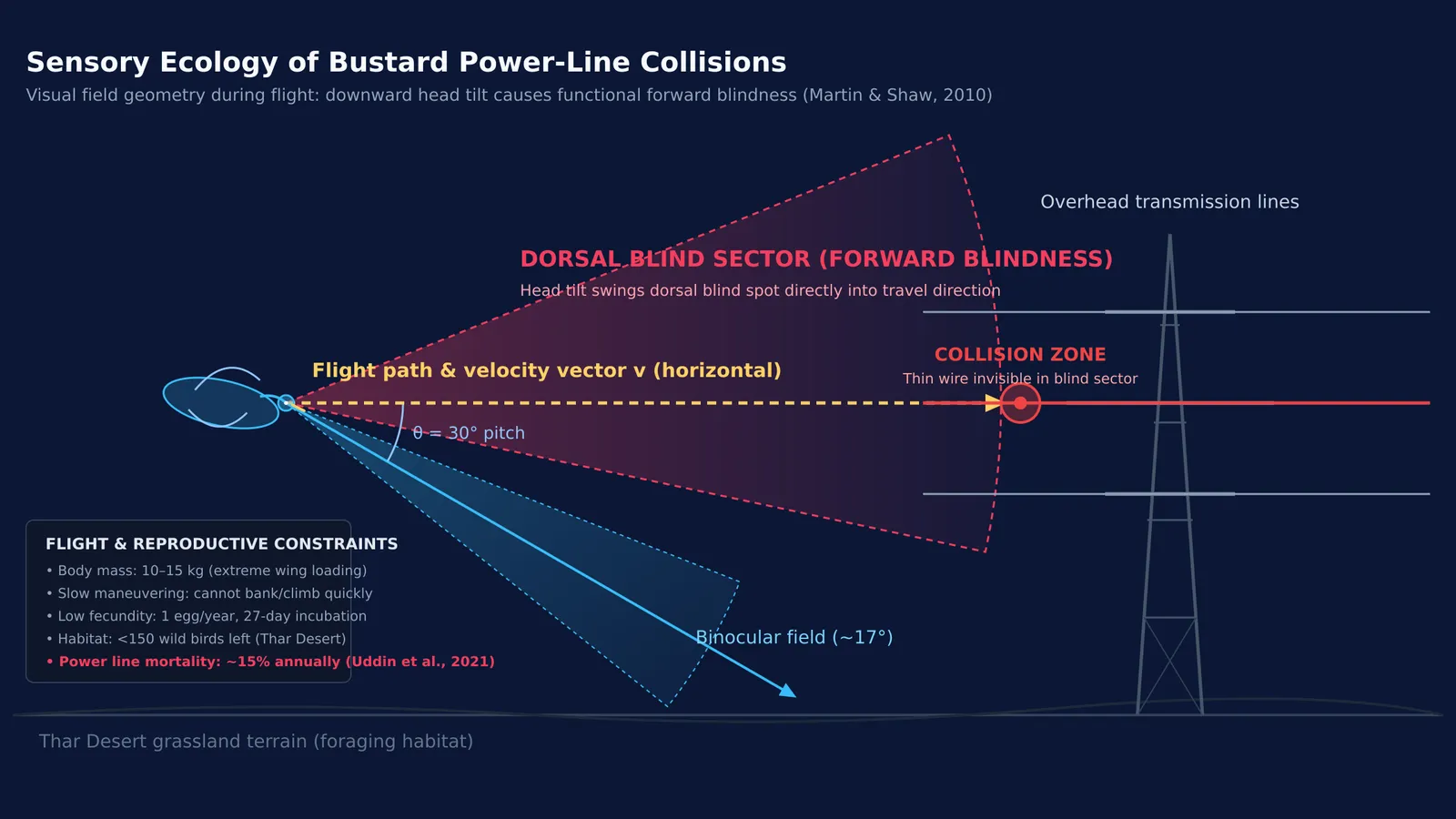
Overhead electricity transmission lines are the leading direct killer of adult bustards. Adult males weigh between 10 to 15 kg as documented by the Wildlife Institute of India. Due to their high wing loading, they cannot execute rapid turns or quick altitude changes in flight.
Visual physiology compounds this danger. In *Biological Conservation*, Graham R. Martin and Jessica M. Shaw (Martin and Shaw, 2010) showed that bustards have narrow binocular vision and extensive blind sectors above and below their horizontal eye line. When flying, bustards pitch their heads downward by 25° to 35° to inspect the ground for foraging sites. This downward tilt swings their dorsal blind spot directly into their flight path, leaving them blind to obstacles ahead.
In Rajasthan's Thar Desert, this blind spot meets an expanding grid of transmission cables from solar and wind parks. A study in *Biological Conservation* led by Mohib Uddin and Sutirtha Dutta (Uddin et al., 2021) across a 4,200 km² area estimated that roughly 84,000 birds die annually from power line collisions and electrocutions. For the bustard, researchers calculated an annual mortality rate of approximately 15% from power lines alone—far exceeding the species' replacement rate.
How do habitat loss and slow breeding accelerate the decline?
Bustards also face severe reproductive bottlenecks documented by the Convention on the Conservation of Migratory Species. As an extreme K-selected species, they have low fecundity:
Females lay just 1 egg per year on the bare ground in a shallow scrape.
Incubation takes roughly 27 days, leaving eggs vulnerable to extreme heat and predators.
Females mature at 2 to 3 years, while males mature at 5 to 6 years.
This reproductive strategy evolved in expansive, undisturbed grasslands. Over recent decades, grasslands were diverted to agriculture, irrigation canals, and industry, shrinking the bustard's Thar habitat to 16% of its potential range according to the Wildlife Institute of India. Feral dogs and foxes also destroy ground nests. You can review how reproductive rates dictate carrying capacity in population growth models and carrying capacity and see how small populations experience Sewall Wright's genetic drift in small populations.
The Fermi Concept Library covers every concept in physics, chemistry, biology, mathematics and computing, each with its own lesson and its place in the map, helping students understand population ecology and carrying capacity.
What conservation steps are underway in Rajasthan?
Conservation efforts in Rajasthan combine legal action, habitat protection, and captive breeding:
Power line undergrounding: In *M.K. Ranjitsinh v. Union of India*, the Supreme Court of India mandated undergrounding power lines in priority habitats. In 2024, the Court demarcated roughly 13,000 km² of priority habitat for underground cables and bird diverters, balancing wildlife protection with renewable energy.
Protected enclosures: The Rajasthan Forest Department fenced roughly 200 km² inside Desert National Park to exclude grazing livestock and stray dogs from nesting grounds.
Captive breeding and rewilding: Facilities at Sam and Ramdevra built a founder population of 97 birds by late 2026 through wild egg incubation and captive breeding, supplemented by breakthrough artificial insemination in 2024. In October 2026, wildlife officials carried out the first soft release of captive-bred males at Desert National Park.
For more on how habitat zoning protects ecosystems, read our analysis of species-area relationships and conservation strategies.
How should students model extinction risk in ecology?
In *Biological Conservation*, demographic viability analysis (Uddin et al., 2021) models how additive adult mortality triggers population collapse. Students can calculate this using a simple three-step demographic framework:
Baseline net reproduction (R₀): With 1 egg per female annually, a 50% hatch rate, and 0.5 female sex ratio, annual output is 0.25 juvenile females per adult female.
Total adult mortality (m_total): Natural adult mortality (m_nat ≈ 5%) plus power-line mortality (m_ext ≈ 15%) gives m_total ≈ 20%.
Replacement threshold: Adults must survive an average of 1 / m_total = 5 years to achieve lifetime replacement (5 × 0.25 = 1.25 > 1.0). When wire mortality pushes m_total above 25%, the population enters an irreversible extinction vortex.
The Fermi Problem Library has worked problems with a step-by-step solver that explains the reasoning rather than printing an answer.


