

On this page
Gravity behaves differently once you cross the surface of a planet. For an object outside a uniform solid sphere, the sphere pulls exactly as if all its mass were concentrated at a single point in the centre. But if you tunnel inside, the mass "above" you cancels out, and only the mass closer to the centre than you pulls you downwards.
This changes the work required to move an object, which changes the gravitational potential.
What is the gravitational potential inside a solid sphere formula?
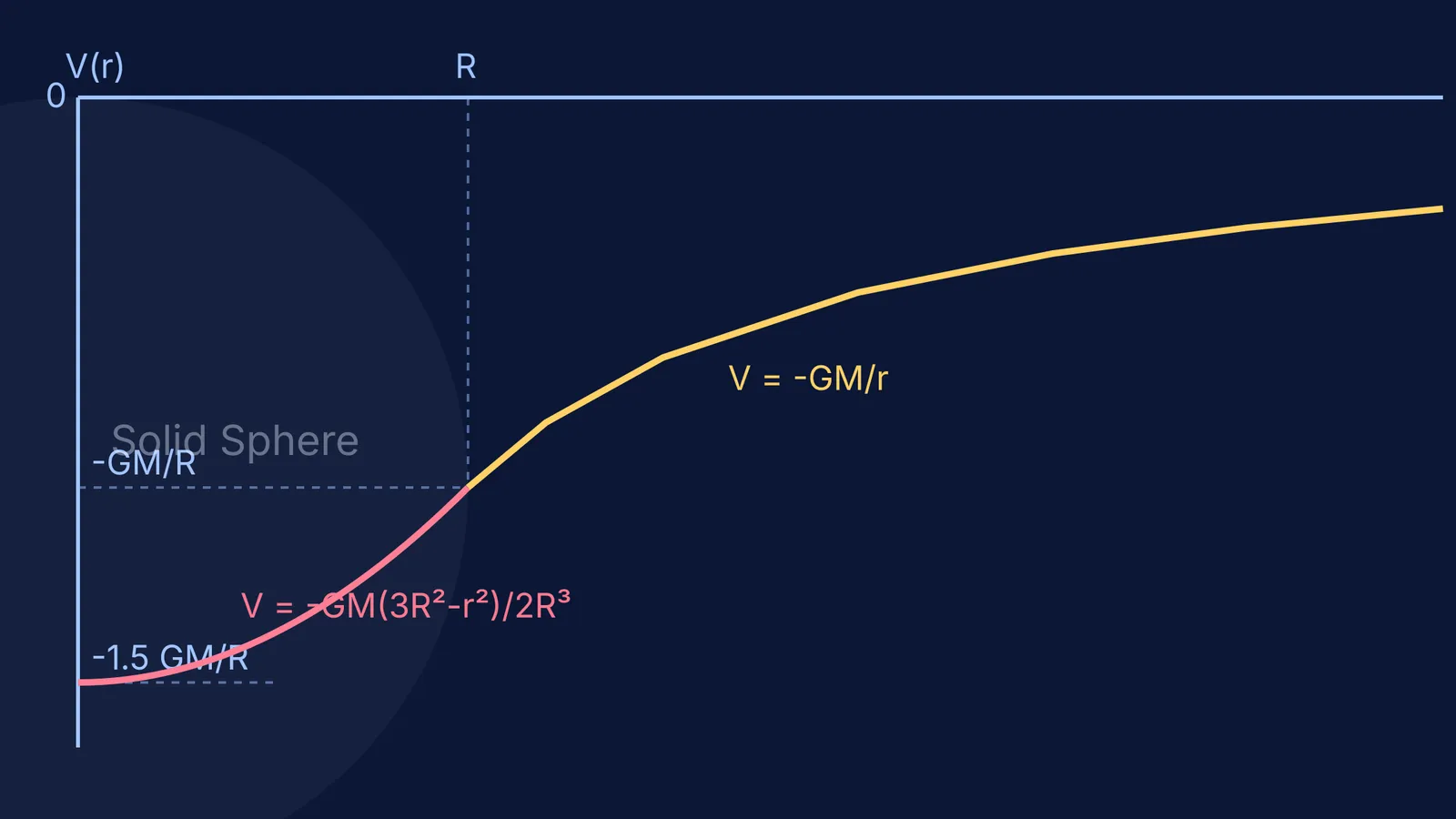
The gravitational potential (V) at a distance r from the centre of a uniform solid sphere of mass M and radius R is given by the formula:
V = −GM(3R² − r²) / 2R³
Here is what the terms mean:
G: the universal gravitational constant.
M: the total mass of the solid sphere.
R: the radius of the solid sphere.
r: the distance from the centre (where r ≤ R).
This formula tells us that the potential inside the sphere varies quadratically with the distance from the centre. It is a parabola that opens downwards, reaching its lowest (most negative) point at the exact centre of the sphere.
Outside the sphere (where r ≥ R), the potential returns to the standard inverse-distance formula: V = −GM / r.
Why is the potential at the centre 1.5 times the surface potential?
A common question in JEE Main and NEET-UG physics is comparing the potential at the centre to the potential at the surface.
If you put r = R (the surface) into the inside formula, you get: V = −GM(3R² − R²) / 2R³ = −2GMR² / 2R³ = −GM / R.
If you put r = 0 (the centre) into the same formula, you get: V = −GM(3R² − 0) / 2R³ = −3GM / 2R.
This means the potential at the centre (−1.5 GM/R) is exactly 1.5 times the potential at the surface (−1.0 GM/R) (as shown on Wikipedia).
Why is it more negative? Gravitational potential is defined as the work done by an external force to bring a unit mass from infinity to a point. By the time you reach the surface, you have done −GM/R work. To go further down into the centre, gravity continues to pull you inwards, meaning the external force must do even more negative work. Because gravity gets weaker as you approach the centre (falling to zero at r = 0), the extra potential added is exactly half the surface potential, giving the 1.5 factor.
How to derive the formula
The potential difference between two points is the negative integral of the gravitational field (E) with respect to distance.
Find the field inside: By Gauss's law for gravity, the field at distance r inside a uniform sphere depends only on the enclosed mass. E = −GMr / R³.
Set up the integral: We know the potential at the surface is V(R) = −GM/R. To find V(r), we integrate the field from the surface R down to our position r.
Integrate:
V(r) − V(R) = −∫(from R to r) (−GMr / R³) dr V(r) − (−GM/R) = (GM/R³) [r²/2 − R²/2] V(r) + GM/R = GM(r² − R²) / 2R³
Simplify: Multiply the GM/R term by 2R²/2R² to get a common denominator, then move it to the other side:
V(r) = GM(r² − R²) / 2R³ − 2GMR² / 2R³ V(r) = GM(r² − 3R²) / 2R³ = −GM(3R² − r²) / 2R³
This integration shows exactly why the r² term appears. If you are preparing for exams and need to see how such derivations connect to electrostatics, the Fermi Concept Library contains mapped lessons comparing gravitational and electric fields. The maths for a solid sphere of charge is identical.
Mastering potential with an AI tutor
Formulae like this are easy to memorise but hard to apply when the sphere is hollowed out or its density is not uniform. If you are stuck on a variable-density problem, Fermi's AI tutor can work out what you already know and build a plan for the session. Rather than just handing you the final integral, it holds a line of reasoning, checking your understanding as it goes and drawing the figure so you can see why the limits of integration change.
If you want to practice finding the work done moving masses between shells and spheres, try these related ideas:


