

On this page
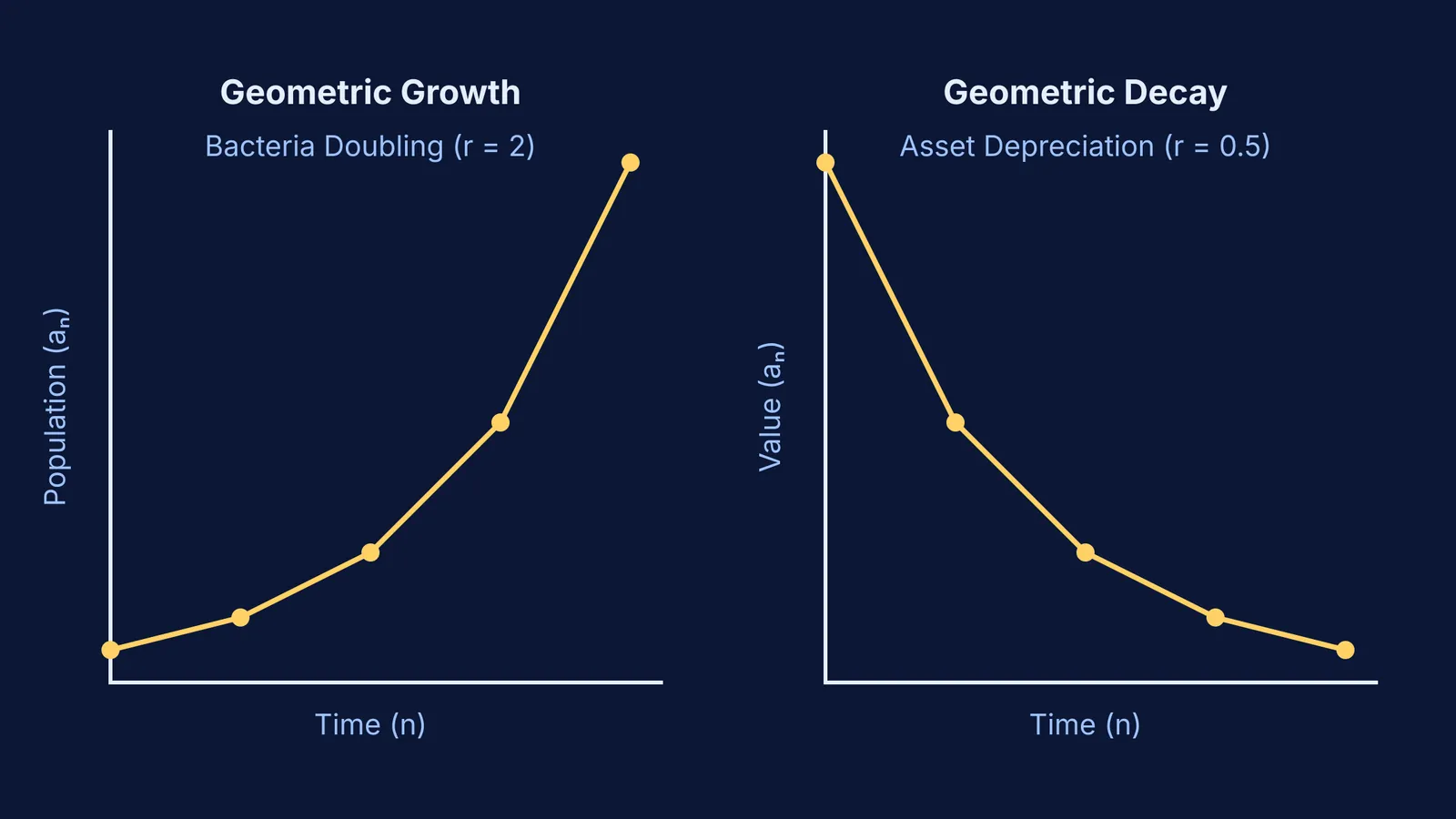
In a geometric progression (GP), every term is formed by multiplying the previous term by a fixed number called the common ratio (r). When something doubles repeatedly, r = 2. When something loses a fixed percentage of its value, r is a fraction less than 1.
These problems test whether you can translate a physical situation into the math variables a (the first term), r (the common ratio), and n (the number of terms).
Is bacteria doubling a geometric sequence?
Yes. When a population of cells reproduces by dividing in half, it forms a geometric progression. Under optimal laboratory conditions, the doubling time of *Escherichia coli* is 20 minutes (Sezonov et al., Journal of Bacteriology, 2007).
If you start with 100 bacteria in a dish, the sequence of the population at the end of each 20-minute interval looks like this: 100, 200, 400, 800, 1600...
Here, the common ratio r is 2. The population grows exponentially, which is simply a geometric progression with a ratio greater than 1. This is the same mathematical model used to describe arithmetic vs geometric growth in plants.
How to calculate fixed-percentage depreciation?
When a car, a machine or a laptop depreciates by a fixed percentage each year, it is also a geometric progression. According to Carfax, new cars can lose more than 10% of their value in the first month alone. Instead of adding a fixed amount of decay, you subtract a percentage of the *current* value.
If a vehicle loses 20% of its value every year, it retains 80% of its value. To find the value for the next year, you multiply the current value by 0.80.
Initial value: 20,000 dollars
Year 1 value: 20,000 dollars × 0.80 = 16,000 dollars
Year 2 value: 16,000 dollars × 0.80 = 12,800 dollars
The common ratio r is 1 − depreciation rate. Because r is between 0 and 1, the terms get smaller. This is geometric decay, a discrete version of continuous population growth and cooling models.
If you buy a car for 20,000 dollars and it depreciates by 20% a year, the common ratio is 1 − 0.20 = 0.80. To find the value after 5 years, you calculate the 5th step in the sequence: Value = 20,000 × (0.80)⁵ Value = 20,000 × 0.32768 = 6,553.60 dollars. The car retains about 32.7% of its original value. This fixed-percentage loss creates a curve that drops sharply at first and then flattens out.
Do you use the nth term or the sum?
A frequent hurdle in geometric word problems is deciding which formula to use.
Use the nth term (aₙ = a × rⁿ⁻¹) when the question asks for the amount *at a specific point in time*.
"How many bacteria are in the dish after several hours?"
"What is the value of the car after several years?"
You only care about the final number, not the history of what came before.
Use the sum (Sₙ = a(rⁿ − 1) / (r − 1)) when the question asks for an *accumulated total* over a period.
"If a company produces a certain number of parts in the first period, and production increases by a fixed fraction each period, how many total parts did they make over the entire cycle?"
"If you collect a quantity on the first step, double it on the second step, and double it again on the third step, what is your total collection?"
Here, you need to add all the terms together.
What is the most common mistake when setting up the formula?
The most common trap in a GP word problem is getting the index n wrong. The standard formula for the nth term is aₙ = a × rⁿ⁻¹, where a is the first term in the sequence.
Suppose a bacterial culture starts with 50 cells and doubles every hour (Sezonov et al., 2007). How many are there after 4 hours?
At hour 0 (the start), the population is 50.
At hour 1, the population is 50 × 2.
At hour 2, the population is 50 × 2².
At hour 4, the population is 50 × 2⁴ = 800.
Notice that the exponent is 4, not 4 − 1. If you blindly plug 4 into aₙ = a × rⁿ⁻¹, you might write 50 × 2³ = 400, which is completely wrong. The discrepancy happens because your "starting amount" occurs at time zero. If you rigidly define the initial population as a₁ (the first term), then the population after one hour is actually a₂ (the second term). Therefore, the population after 4 hours is the fifth term in the sequence (a₅), which correctly gives a₁ × r⁴.
To avoid this headache, it is usually safer to write the formula as Nₜ = N₀ × rᵗ, where t is the number of time intervals that have passed. Map out the first two steps before choosing your exponent to ensure you are not off by a factor of r. If you are getting stuck on off-by-one index errors or confusing the nth term with the sum, the Fermi Problem Library has worked problems with a step-by-step solver that explains the reasoning rather than printing an answer.
How do you solve GP word problems step by step?
Identify the ratio: Is it doubling (r = 2), halving (r = 0.5), or changing by a percentage (r = 1 ± percentage)?
Choose the formula: Do you need the state at the end (nth term) or an accumulated total (sum)?
Align the periods: Make sure your time units match. If bacteria double every 20 minutes (Sezonov et al., 2007), 3 hours means 9 doubling periods.
Check the index: Write out the t=0 and t=1 terms manually to make sure your exponent matches the timeline.
This structured approach makes it easier to set up the equation safely and avoid dropping a power of r.


