

On this page
The Golgi apparatus operates much like a busy factory with a clear directional flow, defined by two opposing sides: the cis face and the trans face. First discovered in 1898 by Italian physician Camillo Golgi, this organelle is a central hub for cellular logistics. It consists of a stack of flattened, membrane-bound sacs called cisternae, which process, modify, and package cellular materials. Found in almost all eukaryotic cells, this organelle is essential for modifying proteins and lipids synthesised elsewhere and dispatching them to their correct final destinations. Unlike animal cells, which typically have a single large Golgi complex near the nucleus, plant cells often contain hundreds of smaller, independent Golgi stacks scattered throughout the cytoplasm.
What is the cis face of the Golgi apparatus?
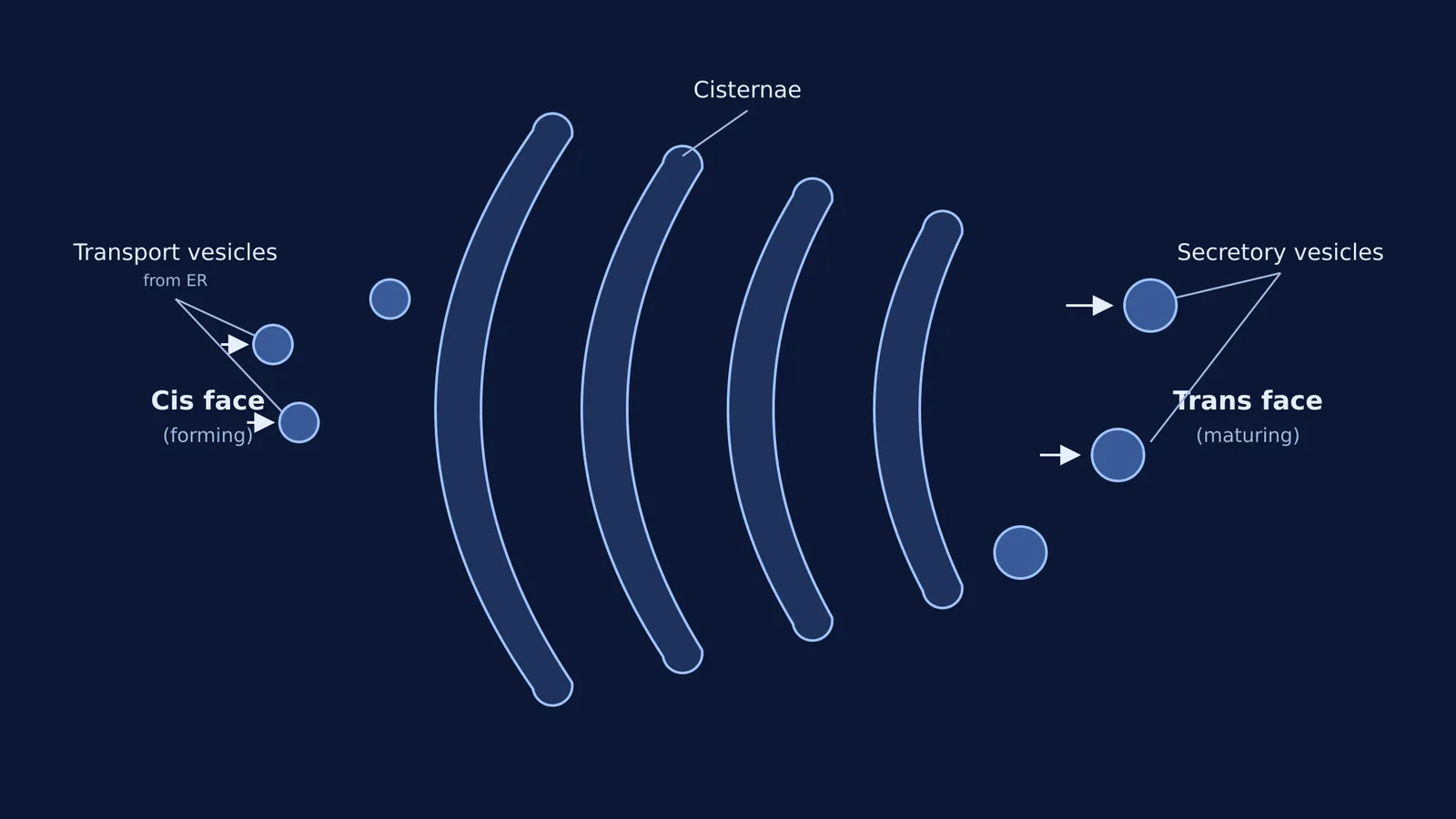
The cis face is the convex side of the Golgi stack that points toward the endoplasmic reticulum (ER) and the nucleus. It is commonly referred to as the forming face or the entry face.
This face acts as the receiving point for the organelle. Transport vesicles carrying newly synthesised proteins and lipids bud off from the ER and travel to the cis face. They fuse with the Golgi membrane, emptying their raw cargo into the Golgi's internal space for processing. The continuous fusion of these incoming vesicles contributes to the formation of new cis cisternae, replacing those that have moved forward in the stack.
What is the difference between the cis and trans face?
The two faces differ fundamentally in shape, position, enzyme content and function within the cell's secretory pathway.
Shape and position: The cis face is convex and oriented toward the cell's interior (the ER), while the trans face is concave and oriented toward the cell's outer boundary (the plasma membrane).
Function: While the cis face receives raw materials, the trans face is the exit point. After the cargo is modified in the medial cisternae, it reaches the trans Golgi network. Here, the finished products are sorted and packaged into secretory vesicles that bud off the concave surface to travel to lysosomes, the plasma membrane, or the cell exterior. The trans face is therefore known as the maturing face or exit face.
Enzyme content: The cis cisternae are rich in enzymes that perform early modifications, such as removing mannose, while the trans cisternae contain enzymes that act later, such as those that add galactose and sialic acid. This spatial separation ensures that biochemical reactions happen in the correct sequence.
If you find it hard to picture how vesicles navigate the 3D space of a cell, interactive simulations in the Fermi Simulation Lab make these ideas easier to see than to read.
How does the Golgi make glycoproteins and glycolipids?
As proteins and lipids travel from the cis face to the trans face, they undergo extensive chemical modifications. A major process is glycosylation, where carbohydrate chains are added, removed or altered by resident enzymes.
Proteins are initially modified in the ER by the addition of an oligosaccharide consisting of 14 sugar residues, but before they arrive at the Golgi, three glucose and one mannose residues are removed (NCBI Bookshelf). As these proteins move through the Golgi stacks, specific enzymes further trim away mannose sugars and add new sugars like galactose to create mature glycoproteins. The Golgi is also the primary site where glycolipids and sphingomyelin are synthesised from ceramide.
If you want to trace these biochemical pathways, the Fermi Concept Library holds a lesson for every concept in biology, each with its place in the map so you can see exactly where glycoprotein synthesis fits into the cell.
The Golgi's workload changes depending on what the cell needs to do. In plant cells, the Golgi apparatus manufactures complex polysaccharides like pectins and hemicelluloses for the cell wall. As much as 80% of the metabolic activity of the Golgi apparatus in a plant cell can be devoted to synthesising these cell wall components (NCBI Bookshelf).
How are proteins transported through the Golgi cisternae?
Biologists have proposed different models for how cargo moves from the cis face to the trans face. The most widely accepted model is the cisternal maturation model.
In this model, the cisternae themselves move. A new cisterna forms at the cis face when transport vesicles fuse together. This cisterna then physically moves through the stack, maturing as it goes. It becomes a medial cisterna and eventually a trans cisterna. Along the way, the enzymes inside the cisterna change, allowing different modifications to occur in sequence. Once the cisterna reaches the trans face, it breaks apart into secretory vesicles.
This directional flow ensures that proteins and lipids are modified in a specific order, much like an assembly line. Each step builds upon the last, resulting in fully functional molecules ready for secretion or cellular use.
Related reading
Checklist: Answering Golgi apparatus exam questions
Examiners often test the polarity and function of the Golgi apparatus in biology papers. Use this checklist to structure a complete answer:
Identify the faces: State that the cis face is convex (the forming face) and the trans face is concave (the maturing face).
Trace the direction: Describe the one-way flow of transport vesicles from the ER into the cis face, through the medial cisternae, and out of the trans face.
Name the products: Mention that the Golgi modifies proteins into glycoproteins and lipids into glycolipids by altering their sugar chains.
Specify the destination: Conclude by noting that secretory vesicles leaving the trans face are sorted and shipped to lysosomes, the plasma membrane, or secreted outside the cell.


