

On this page
The Genetic Engineering Appraisal Committee (GEAC) is the apex statutory body in India responsible for regulating the environmental release of genetically modified organisms. It evaluates the safety and ecological impact of genetically engineered (GE) crops and hazardous microorganisms before they can be utilized in research, industrial production, or public agriculture.
What is the GEAC (Genetic Engineering Appraisal Committee)?
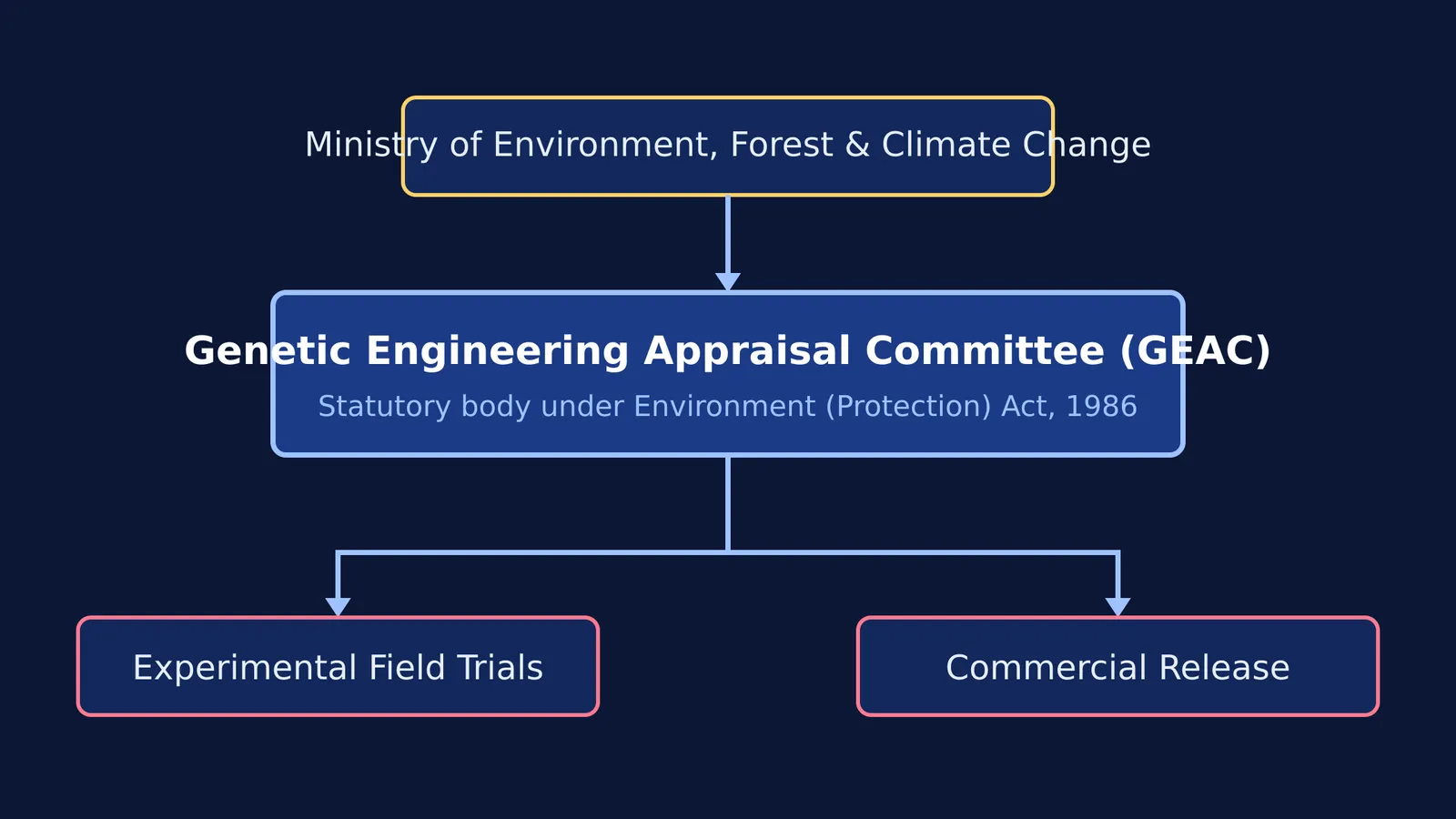
The GEAC was constituted under the "Rules for the Manufacture, Use/Import/Export and Storage of Hazardous Microorganisms/Genetically Engineered Organisms or Cells, 1989". These critical rules were framed under the Environment (Protection) Act, 1986, which serves as the overarching environmental law in India. Operationally, the committee functions directly within the Ministry of Environment, Forest and Climate Change (MoEF&CC).
While various other biosafety committees exist in India, the GEAC is the ultimate national authority that decides whether a GM product is safe enough to leave the controlled environment of a laboratory and enter the open ecosystem.
The history of GEAC: from Approval to Appraisal
If you are reading older textbooks, you might see the GEAC referred to as the "Genetic Engineering Approval Committee." However, in 2010, the Ministry officially renamed it to the Genetic Engineering Appraisal Committee.
This was not merely a cosmetic change in vocabulary. The shift from "Approval" to "Appraisal" was designed to better reflect the committee's true mandate. The new name emphasizes that the GEAC is a rigorous evaluating and appraising scientific body tasked with risk assessment, rather than an administrative desk that simply rubber-stamps approvals for commercial agricultural entities.
Who sits on the Genetic Engineering Appraisal Committee?
Because genetic engineering impacts everything from human health to soil ecology, the GEAC is structured to include a broad spectrum of scientific and administrative expertise. The committee consists of 24 members who meet on a monthly basis to review pending proposals.
At the helm, the committee is chaired by the Special Secretary or Additional Secretary of the MoEF&CC. To ensure a deep institutional understanding of biotechnology, a representative from the Department of Biotechnology (DBT) serves as the co-chair.
The remaining committee members are carefully selected from India's premier scientific institutions. This includes leading experts from the Indian Council of Agricultural Research (ICAR), the Indian Council of Medical Research (ICMR), and the Centre for Cellular and Molecular Biology (CCMB). By bringing together agricultural scientists, medical researchers, and ecologists, the GEAC ensures that every GM proposal is scrutinized from multiple safety angles.
How does GEAC evaluate genetically modified organisms?
When researchers or agricultural companies want to introduce a new genetically modified crop, they cannot simply plant it in an open field. They must pass through a strict, multi-tiered regulatory pipeline. GEAC clearance is mandatory before any GM crop can be released into the Indian environment.
The evaluation process ensures that introduced transgenes do not disrupt local food webs or lead to ecological issues, a preventative measure that stops cascading problems like biological magnification before they can begin.
Specifically, the GEAC appraises proposals for:
The large-scale use of hazardous microorganisms and recombinants in research and industrial production.
Experimental field trials of new genetically engineered crops.
The final commercial release of GM organisms into the public domain.
If a researcher or organization violates these strict biosafety norms, the GEAC is not powerless; it has the authority to take punitive action under the Environment (Protection) Act.
Why is GEAC important for biology and environmental science students?
If you are preparing for biology board exams or competitive tests like NEET-UG and the UPSC, understanding regulatory bodies like the GEAC connects theoretical biotechnology to real-world policy.
When you study recombinant DNA technology—such as Making human insulin by rDNA or Transgenic animals and molecular diagnosis—you learn the mechanics of how genes are spliced and inserted into host organisms. The GEAC is the real-world checkpoint that decides if those laboratory creations are actually safe for the broader ecosystem.
Visualizing how plasmids, restriction enzymes, and molecular scissors work can often be challenging. The Fermi Concept Library gives every concept in biology its own lesson and its place in the map, helping you clearly understand the underlying science that bodies like the GEAC are built to assess.
A step-by-step framework for answering GEAC questions in exams
To structure a high-scoring, comprehensive answer about the GEAC in a biology or environmental science exam, you can use this four-point framework to ensure you hit every marking criterion:
Define the body: State its full name accurately. Remember that it changed from the "Approval Committee" to the "Appraisal Committee" in 2010 to reflect its evaluative role.
Cite the parent law: Always explicitly mention that it was constituted under the Environment (Protection) Act, 1986.
State the nodal ministry: Note that it falls under the jurisdiction of the Ministry of Environment, Forest and Climate Change (MoEF&CC).
List the primary function: Emphasize that it is the mandatory clearinghouse for the environmental release of GM crops and the large-scale industrial use of recombinants.


