

On this page
Gauss's law is one of the four foundational Maxwell's equations that govern classical electromagnetism. It states that the total electric flux through any closed surface is strictly proportional to the electric charge enclosed within it, regardless of the surface's size or shape. If you draw a small, tight sphere around a point charge, or a massive sphere the size of the Earth around that same charge, the total flux crossing the boundary is completely identical.
But why does the size of the sphere not matter? Why does the flux remain completely unaffected by how far away the surface is from the source charge? The answer lies entirely in the inverse square nature of the electric field.
How do the r² terms cancel out?
Electric flux is defined as the electric field multiplied by the area it passes through. For a point charge Q at the centre of a spherical Gaussian surface of radius r, the electric field E at the surface is given by Coulomb's law:
E = 1/(4πε₀) × Q/r²
Meanwhile, the total surface area A of that imaginary sphere is:
A = 4πr²
To find the total flux (Φ) passing through the sphere, we multiply the field strength by the area:
Φ = E × A = [1/(4πε₀) × Q/r²] × [4πr²]
The r² in the denominator of the electric field exactly cancels the r² in the numerator of the surface area. The 4π terms also cancel each other out, leaving just Q/ε₀. Because the radius r has completely vanished from the final equation, the flux is entirely independent of the distance.
What if Coulomb's law had a different exponent?
If the electric field fell off at any rate other than 1/r², Gauss's law would simply not work.
Imagine a hypothetical universe where Coulomb's law was an inverse cube law, meaning the electric field fell as 1/r³. The flux through our spherical surface would then be proportional to (1/r³) × r² = 1/r. In this scenario, drawing a larger sphere would result in less total flux, even though no charge had been added or removed from the inside. The law would collapse.
Because Gauss's law relies on this perfect mathematical cancellation, testing the validity of Gauss's law is one of the most rigorous ways to verify Coulomb's law. In a landmark 1971 experiment published in Physical Review Letters, E. R. Williams, J. E. Faller and H. A. Hill measured any deviation from 2 in the exponent of Coulomb's law to be (2.7 ± 3.1) × 10⁻¹⁶. If the exponent had deviated by even that microscopic fraction, Gauss's law would eventually fail at large enough distances.
How does the field line picture explain this?
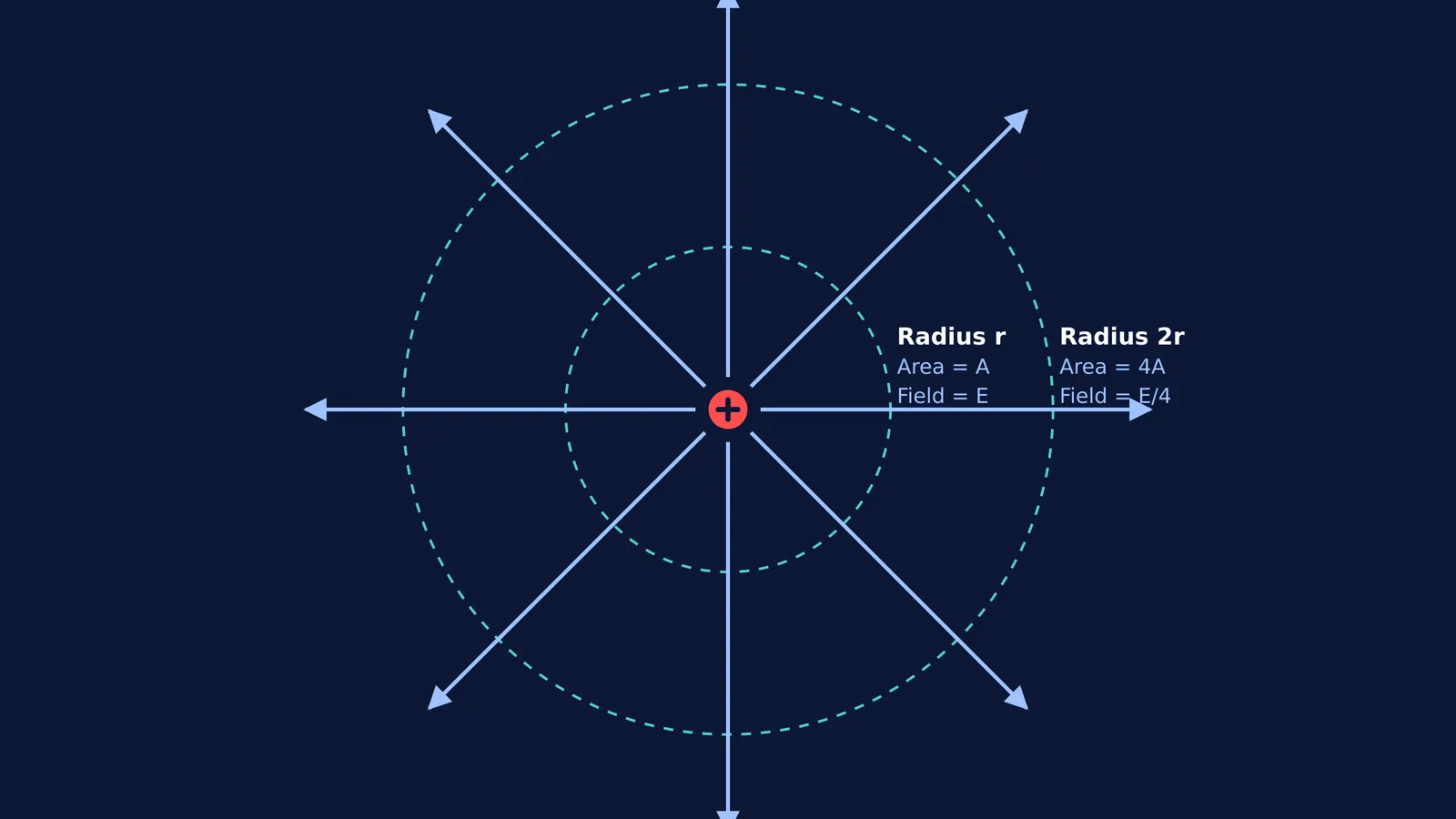
We can also visualise this elegant cancellation using electric field lines. A positive point charge emits a continuous, fixed number of field lines spreading outward in all directions through space.
If you draw a sphere around the charge, every single field line must puncture that surface to escape. If you then double the radius of the sphere, the surface area becomes exactly four times larger. However, the exact same number of lines still passes through it. Because the same number of lines is now spread over four times the area, the density of the lines—which represents the electric field strength—must be exactly one-fourth as much.
This geometric principle isn't limited to electric fields. Gravity and the intensity of light also follow inverse square laws for exactly the same reason: they are conserved quantities spreading uniformly out into three-dimensional space.
How does this help in physics exams?
In exams like JEE Main and NEET-UG, examiners test your understanding of this conceptual link to see if you can avoid messy calculus. When asked for the flux through a complex surface—such as an irregular balloon or an off-centre cube—enclosing a point charge, you do not need to calculate the surface area or integrate a constantly varying electric field. Because the field obeys the inverse square law, every field line that leaves the charge must eventually exit the surface. The total flux is therefore always Q/ε₀.
Furthermore, examiners sometimes introduce hypothetical scenarios. If a question proposes a theoretical universe where the electric field of a point charge falls off as 1/r³ instead of 1/r², you must immediately recognise that Gauss's law no longer applies. You cannot use ∮ E · dA = Q/ε₀ to find the electric field of a charged sphere in that universe; you would have to fall back to first principles and sum the contributions from every individual piece of charge.
If you are solving advanced problems involving Gauss's law for a sphere with non-uniform charge density or finding E from V, getting the conceptual foundation right is absolutely essential. When you hit a concept gap like this, the Fermi Concept Library has a lesson for every idea in physics. Fermi's AI tutor teaches through it by holding a line of reasoning across a whole session. It notices where you are stuck and decides whether to explain, ask, or show, ensuring you actually master the principles behind the formulas.


