

On this page
Ethylene glycol (ethane-1,2-diol) has the chemical formula HO–CH₂–CH₂–OH. Like butane, it can rotate around its central carbon-carbon single bond, creating different 3D arrangements called conformations.
What Are the Conformations of Ethylene Glycol?
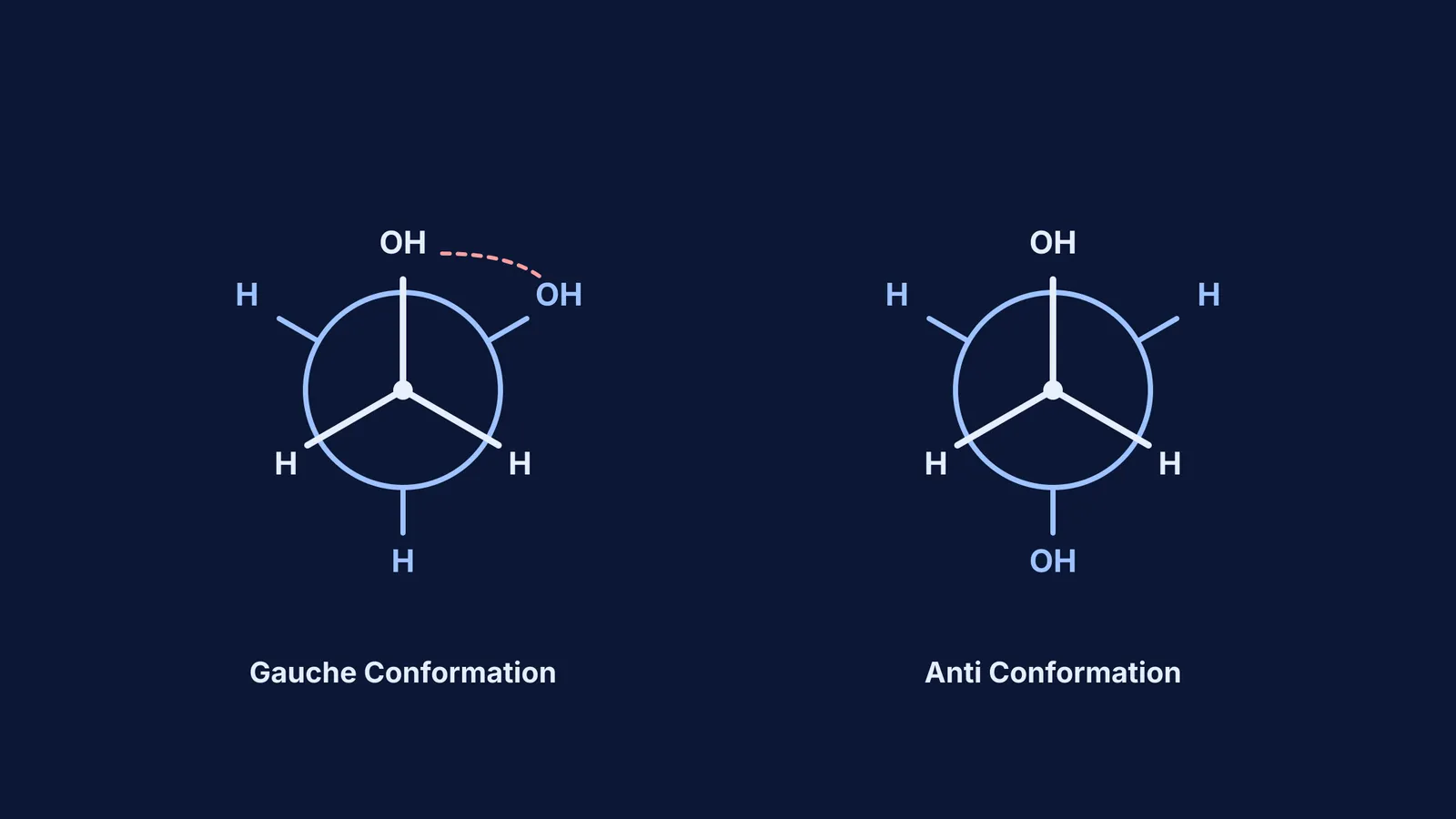
When you look down the carbon-carbon bond using a Newman projection, you can see how the groups on the front carbon sit relative to the groups on the back carbon. The two most important conformations are:
Gauche conformation: The two hydroxyl (–OH) groups are separated by a dihedral angle of roughly 60°.
Anti conformation: The two –OH groups are directly opposite each other, with a dihedral angle of 180°.
If you look at the structural isomers in Class 10, you learn that butane prefers the anti conformation to keep its bulky methyl groups as far apart as possible. However, ethylene glycol breaks this rule.
Why Is Gauche More Stable Than Anti?
In ethylene glycol, the gauche conformation is more stable than the anti conformation by about 1.4 kcal/mol in the gas phase (Kazerouni et al., 1997).
The primary reason is the intramolecular hydrogen bond. When the two –OH groups are 60° apart in the gauche position, they are close enough for the hydrogen atom of one hydroxyl group to interact with the lone pairs on the oxygen atom of the other. This internal hydrogen bond releases energy, stabilizing the molecule. The energy gained from this bond significantly outweighs the minor steric repulsion between the groups. This is a classic example of intramolecular hydrogen bonding overpowering steric strain.
What Is the Gauche Effect?
Beyond hydrogen bonding, a quantum mechanical phenomenon known as the gauche effect also contributes to this stability. In molecules with highly electronegative substituents like oxygen or fluorine, the gauche arrangement allows for a special type of electron sharing.
Specifically, electron density from the filled bonding orbitals (like the C–H bonds) can partially transfer or overlap with the empty anti-bonding orbitals of the adjacent highly polar carbon-oxygen bonds (C–O). This hyperconjugation effectively lowers the molecule's overall energy and provides a stabilising effect that is maximised when the electronegative groups are oriented gauche to one another. The combination of this orbital overlap and the intramolecular hydrogen bond makes the gauche form the definitive energy minimum for ethylene glycol in isolation.
Does This Hold True in Water?
The 1.4 kcal/mol energy difference is measured for isolated molecules in a gas. However, when ethylene glycol is dissolved in a solvent like water, the stability gap shrinks significantly. The surrounding water molecules form strong intermolecular hydrogen bonds with the –OH groups, which compete with and often disrupt the internal hydrogen bond of the solute. Even with this intense competition from the solvent, the gauche form remains the dominant conformation in the liquid state at room temperature, though a much more noticeable fraction of molecules will adopt the anti form as they interact with the surrounding water network.
How Do You Apply This to Your Studies?
When facing conformation questions in exams, a systematic approach helps you avoid traps. If you are not sure where to start on a complex molecule, Fermi's AI tutor can work out what you already know and build a plan for the session, guiding you through the Newman projections step by step.
Here is a checklist for comparing stabilities:
Draw the Newman projection for both the gauche and anti forms.
Identify the bulky groups and note the steric strain.
Check for potential hydrogen bond donors (–OH, –NH) and acceptors (O, N, F).
If a hydrogen bond can form in the gauche position, it will usually outcompete the steric strain.
You can explore these structures and forces in 3D using the Fermi Concept Library, which makes it easier to picture how these internal bonds hold the molecule together.


