

On this page
Why does stopping a moving container increase gas temperature?
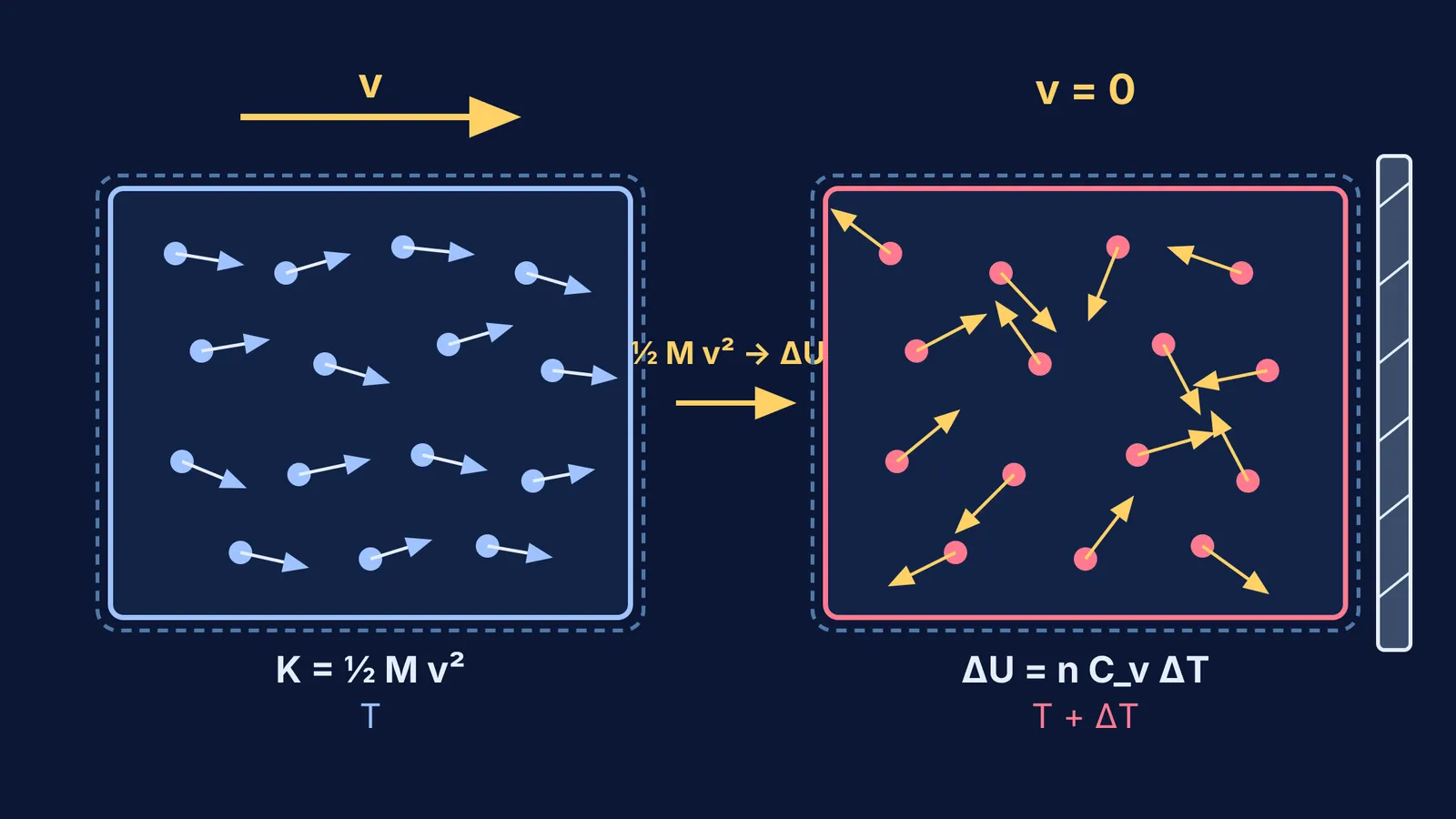
Imagine an insulated cylinder filled with gas riding inside a high-speed vehicle. From the ground frame, the container and every molecule inside it travel forward together at speed v. Yet if a thermometer sits inside the moving cylinder, it records no extra temperature merely because the container moves. As established in NCERT Class 11 Physics Chapter 11, thermodynamic internal energy explicitly excludes the bulk kinetic energy of a system as a whole. Internal energy accounts solely for the disordered kinetic and potential energies measured in the center-of-mass frame of reference.
What happens when the container strikes a rigid barrier and halts abruptly? Because the container walls are rigid and insulated, the gas performs zero external work on the surroundings, and zero heat escapes through the boundary. The macroscopic kinetic energy of the gas cannot vanish into thin air. Instead, the leading molecules slam against the decelerating wall, rebounding into incoming layers. Compression shock pulses and turbulent eddies scatter the directed stream into chaotic collisions. Within fractions of a second, the collective velocity averages to zero in the laboratory frame, and every joule of lost bulk kinetic energy redistributes among the random thermal degrees of freedom of the molecules. The macroscopic motion transforms into microscopic heat, driving an immediate rise in temperature.
How do you derive the temperature rise formula?
The quantitative derivation relies on the First Law of Thermodynamics, which states that the change in internal energy equals heat supplied minus work done, ΔU = Q − W. As detailed in OpenStax University Physics, when a system is thermally insulated (Q = 0) and enclosed by rigid boundaries (W = 0), the total energy of the closed system remains conserved.
Consider a gas of total mass M_total and molar mass M_0 contained in a vessel moving at velocity v. The total mechanical kinetic energy carried by the bulk motion of the gas before deceleration is:
K_bulk = ½ M_total v²
When the vessel stops, this bulk kinetic energy completely dissipates into internal thermal energy, meaning ΔU = K_bulk = ½ M_total v². For an ideal gas, internal energy depends strictly on temperature. The change in internal energy for n moles of gas is given by:
ΔU = n C_v ΔT
Here, C_v represents the molar heat capacity at constant volume, and the number of moles is n = M_total / M_0. Equating the two expressions for ΔU yields:
½ M_total v² = (M_total / M_0) C_v ΔT
Because the total mass M_total appears on both sides of the equation, it cancels out completely. Solving for the temperature change produces:
ΔT = (M_0 v²) / (2 C_v)
This fundamental equation demonstrates that the rise in temperature is entirely independent of the volume of the container and the total mass of gas enclosed. Using the relationship C_v = R / (γ − 1), where γ is the adiabatic exponent and R is the universal molar gas constant—defined as exactly 8.314462618 J/(mol·K) by the NIST Reference on Constants, Units, and Uncertainty—the formula can also be written as:
ΔT = (γ − 1) M_0 v² / (2 R)
Alternatively, expressing C_v in terms of the molecular degrees of freedom f, where C_v = (f / 2) R according to NCERT Class 11 Physics Chapter 12, gives ΔT = (M_0 v²) / (f R).
What happens to different gases at identical speeds?
Because the temperature increment depends on both the molar mass M_0 and the degrees of freedom f, different gases moving at the exact same velocity experience markedly different heating upon stopping. According to NCERT Class 11 Physics Chapter 12, a monatomic gas possesses 3 translational degrees of freedom (f = 3, C_v = 1.5 R), while a rigid diatomic gas possesses 5 degrees of freedom (f = 5, C_v = 2.5 R) at room temperature.
To see this in action, evaluate three distinct gases moving at an identical speed of 100 m/s:
Monatomic helium: With a molar mass of 0.004 kg/mol and f = 3, the temperature rise is (0.004 × 10,000) / (3 × 8.314462618) ≈ 1.60 K.
Monatomic argon: With a molar mass of 0.040 kg/mol and f = 3, the temperature rise is (0.040 × 10,000) / (3 × 8.314462618) ≈ 16.04 K.
Diatomic oxygen: With a molar mass of 0.032 kg/mol and f = 5, the temperature rise is (0.032 × 10,000) / (5 × 8.314462618) ≈ 7.70 K.
Notice the ten-fold difference between helium and argon. Even though both are noble gases sharing the identical molar heat capacity of 1.5 R, argon atoms are 10 times heavier. At 100 m/s, one mole of argon carries ten times more bulk kinetic energy than one mole of helium, but requires the exact same energy input to warm up by 1 Kelvin. If the cylinder instead contains a blend of gases, you can determine the overall temperature jump by calculating the average molar mass and weighted Cv of the gas mixture before applying the conservation formula, just as you would when evaluating heat in isobaric and isochoric processes.
How should students approach sudden-stop thermodynamics problems?
Competitive exams such as JEE Main and JEE Advanced frequently test this concept to see whether students understand the boundary between mechanics and thermodynamics. To solve these problems accurately under exam conditions, apply this systematic sequence:
Audit boundary conditions: Confirm whether the vessel is thermally insulated (Q = 0) and rigid (W = 0). If the gas expands freely into an evacuated compartment rather than stopping against a wall, remember that free expansion of an ideal gas involves zero temperature change because no ordered energy converts into thermal agitation.
Check vessel heat capacity: Standard problems assume the container walls have negligible heat capacity. If the vessel has mass M_v and specific heat c_v, its thermal absorption must be added to the denominator: ΔT = ½ (M_total + M_v) v² / (n C_v + M_v c_v).
Convert units rigorously: Ensure velocity is in meters per second and molar mass is in kilograms per mole so that kinetic energy in joules matches thermal energy in joules.
Select the correct atomicity: Match degrees of freedom to the gas structure, accounting for vibrational modes only when explicitly stated at elevated temperatures.
When multi-step questions combine center-of-mass motion with adiabatic gas transformations, students often struggle to isolate the relevant reference frames. The Fermi Concept Library has every concept in physics, chemistry, biology, mathematics and computing, each with its own lesson and its place in the map. Furthermore, the Fermi Simulation Lab offers interactive simulations for the ideas that are easier to see than to read, helping you visualize how molecular stream velocity randomizes into isotropic thermal speed.


