

On this page
When an electrical circuit carries more current than it is designed to handle, the wires overheat. Without protection, this can melt the insulation and start a fire. A fuse acts as a deliberate weak link to prevent this. To do its job effectively, a fuse wire relies on two physical properties: high resistance and a low melting point.
Why does a fuse wire need high resistance?
The heat generated by an electrical current is described by Joule's law of heating. This principle governs how electrical energy converts into thermal energy as electrons collide with the atoms of a conductor.
Because the fuse wire is connected in series with the main circuit, the exact same current flows through both the fuse and the household wiring. However, the heat produced is directly proportional to the resistance. A standard copper wire is an excellent conductor with very low electrical resistance, meaning it produces minimal heat under normal conditions. The fuse wire is deliberately chosen to be a poorer conductor, giving it a much higher electrical resistance.
As a result, when a power surge or a short circuit sends a massive current through the system, the high resistance of the fuse wire causes it to generate heat rapidly. It instantly becomes the hottest point in the circuit, absorbing the brunt of the overload energy while the copper wires remain relatively cool.
Why does a fuse wire have a low melting point?
Generating heat is only half the job; the wire must also break the circuit before the copper wiring gets dangerously hot. Pure copper melts at 1084 °C. This is a temperature that would easily ignite surrounding plastics, wood, and other building materials if the copper wiring were allowed to reach it.
A fuse wire needs to melt at a much lower threshold. By melting early, it physically snaps and leaves a gap in the circuit, cutting off the current entirely. If the fuse had a high melting point, it would just glow white-hot during an overload and fail to protect the appliances downstream. The ideal fuse material acts as an automatic switch that sacrifices itself to stop the flow of electricity at a safe temperature.
The tin-lead eutectic alloy
To achieve both high resistance and a low melting point, standard household fuse wires are typically made of an alloy of tin and lead. A common mixture is 63% tin and 37% lead. This specific proportion is known as a eutectic alloy, which means it melts sharply at a single temperature of just 183 °C, rather than turning into a paste over a range of temperatures. This temperature is low enough to snap the circuit quickly during an overload, but high enough that the fuse will not melt during normal, everyday use.
The tin-lead alloy also solves the resistance requirement perfectly. Its electrical resistivity is roughly 1.45 × 10⁻⁷ Ω·m, which makes it about 8.6 times more resistive than pure copper at 1.68 × 10⁻⁸ Ω·m.
When a short circuit occurs, the fuse wire produces nearly nine times as much heat per centimetre as the copper wire next to it. Because it is generating far more heat, and only needs to reach 183 °C instead of 1084 °C, it melts almost instantly. This rapid melting is why a blown fuse often leaves a small splatter of metal on the inside of its glass casing.
Comparing the heating rates
We can understand exactly how much faster a fuse wire heats up compared to copper by looking at their physical properties. The rate at which a wire's temperature rises depends on the heat generated (driven by its electrical resistivity) divided by how much energy it takes to warm up the metal (its volumetric heat capacity).
Copper has a low resistivity and a high volumetric heat capacity, meaning it generates little heat and absorbs what it does generate with only a slow rise in temperature. In contrast, the tin-lead alloy has nearly nine times the resistivity of copper, but it also has a significantly lower heat capacity.
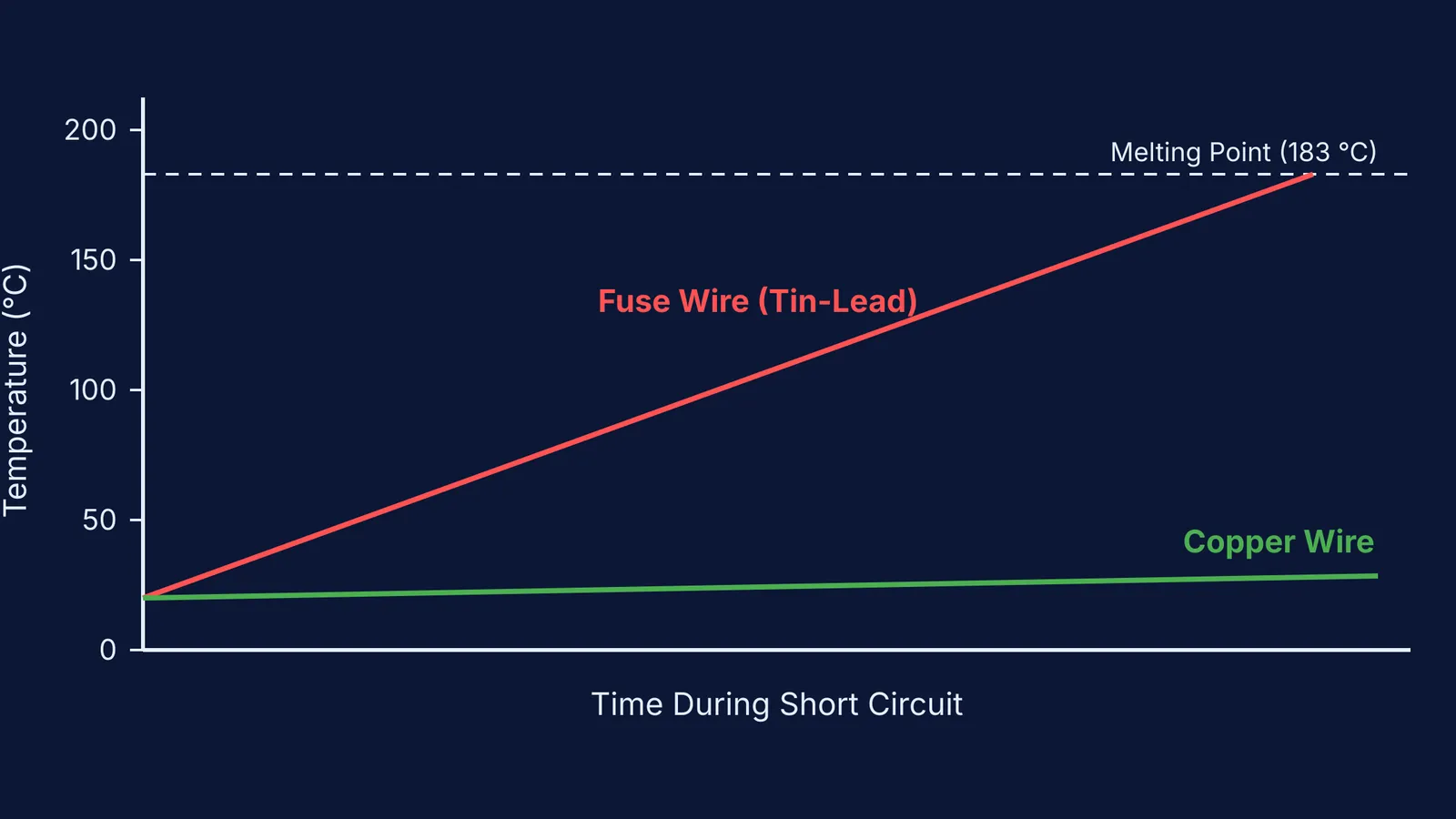
When you divide the resistivity by the heat capacity for both metals, the physics shows that a tin-lead fuse wire will heat up approximately 20 times faster than a copper wire of the exact same thickness carrying the same current.
In a severe short circuit, the temperature of the fuse wire spikes on a steep curve, hitting its 183 °C melting point very quickly. By the time the fuse breaks the circuit, the main copper wiring has barely warmed up. The circuit breaks safely, the current stops entirely, and the copper never gets close to dangerous temperatures.
For students encountering circuit safety and Joule heating questions, checking how resistance scales with a wire's material and thickness is a frequent requirement. You can review Resistance of a tapered conductor: setting up the integral or explore Stretching a wire: how its resistance changes with length. If you need to work through electrical physics, the Fermi Problem Library has worked problems with a step-by-step solver that explains the reasoning rather than printing an answer.


