

On this page
When studying furan and thiophene, students often count every electron pair on the heteroatom. Because oxygen and sulfur sit in Group 16, standard Lewis formulas show two ring bonds and two lone pairs. Adding four pi electrons from the two double bonds to four lone-pair electrons yields eight electrons, prompting the mistaken conclusion that both rings are antiaromatic.
In reality, both rings are aromatic. Understanding why requires looking at orbital geometry in three dimensions.
How do furan and thiophene satisfy Hückel's rule?
Under the IUPAC definition, a monocyclic molecule is aromatic if it is planar, possesses a continuous ring of p orbitals, and contains 4n + 2 delocalised pi electrons, where n is a non-negative integer.
In both furan and thiophene, the four ring carbons are sp² hybridised:
Each carbon forms three in-plane sigma bonds: two to adjacent ring atoms and one to hydrogen.
Each carbon retains an unhybridised 2p orbital perpendicular to the ring with 1 electron.
The two conjugated double bonds supply 4 pi electrons.
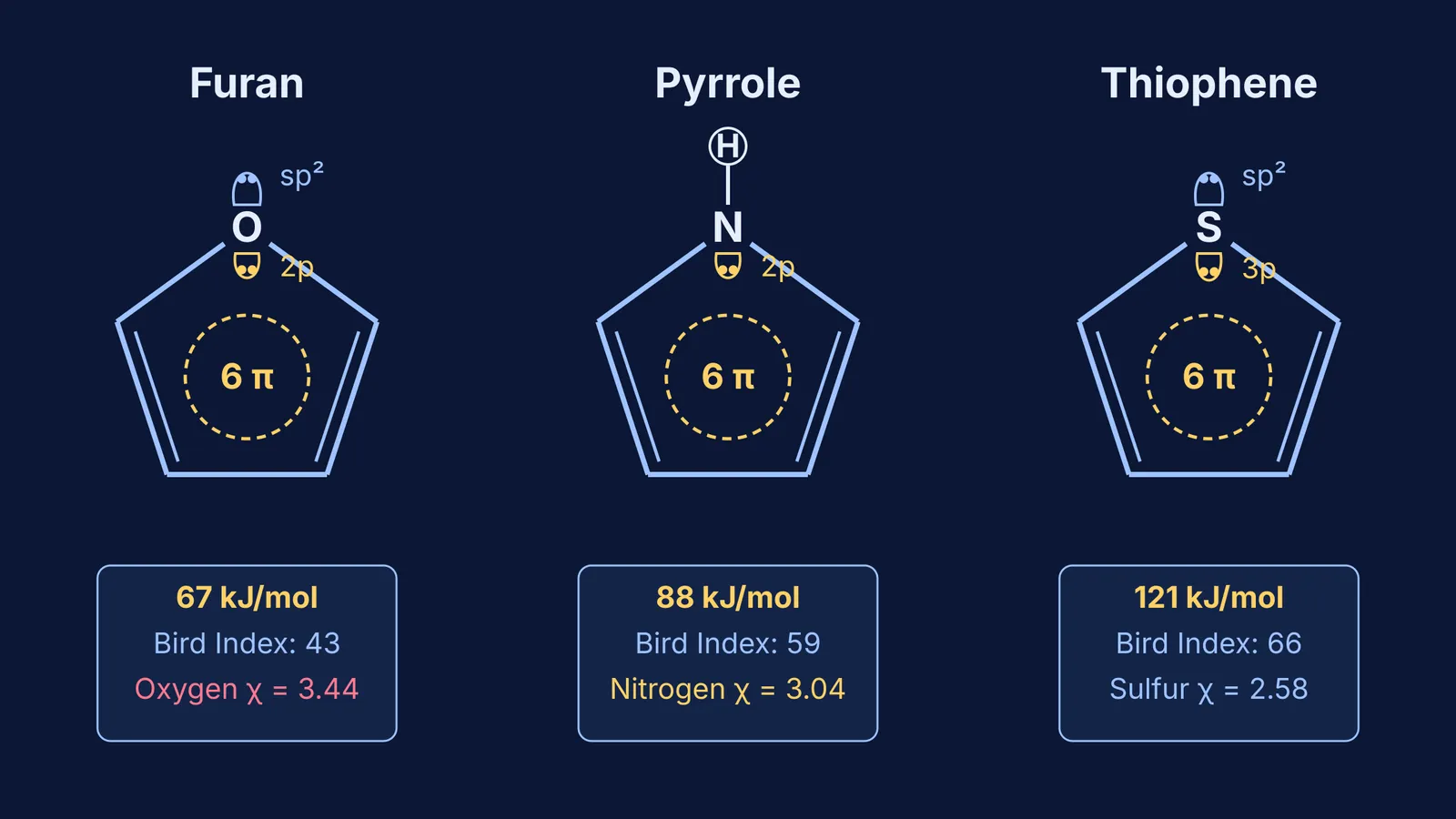
To achieve aromatic stability, the heteroatom donates one lone pair (2 electrons) from a perpendicular p orbital into the ring. Adding these 2 electrons to the 4 carbon electrons produces 6 pi electrons. Setting 4n + 2 = 6 gives n = 1, satisfying Hückel's rule. For a broader framework, see our guide on the four-check method for aromaticity.
Which lone pair enters the aromatic ring?
The resolution to the eight-electron trap lies in orbital geometry. An atom in a planar ring cannot orient two orbitals perpendicular to the ring plane simultaneously.
Oxygen in furan and sulfur in thiophene adopt sp²-like geometry:
Two sp² orbitals form sigma bonds with adjacent ring carbons.
The third sp² orbital points outward in the ring plane, holding one unshared lone pair.
The remaining unhybridised p orbital (2p in oxygen, 3p in sulfur) aligns perpendicular to the ring, parallel to the carbon 2p orbitals.
Because the outward sp² orbital lies at 90° to the pi system, its overlap with the carbon p orbitals is zero. Only the perpendicular lone pair delocalises into the ring. To review orbital mixing in planar systems, see our explainer on hybridisation of atomic orbitals and the rules for ranking resonance structures.
Why is thiophene more aromatic than furan?
Although furan, pyrrole, and thiophene each possess 6 pi electrons, their aromatic stabilisation differs markedly. Quantitative resonance energies compiled by Balaban, Oniciu, and Katritzky (2004) establish the experimental hierarchy:
Benzene: ~150 kJ/mol (36 kcal/mol)
Thiophene: ~121 kJ/mol (29 kcal/mol)
Pyrrole: ~88 kJ/mol (21 kcal/mol)
Furan: ~67 kJ/mol (16 kcal/mol)
The Bird aromaticity index developed by Bird (1985)96543-3) measures bond-length uniformity on a scale where benzene is 100. Thiophene scores 66, pyrrole scores 59, and furan scores 43.
Why does thiophene have a substantially higher resonance energy than furan? The difference stems from electronegativity:
Oxygen has a Pauling electronegativity of 3.44, compared to 2.55 for carbon. Oxygen holds its valence electrons tightly and resists delocalising them into the ring, leaving furan with pronounced diene character.
Sulfur has an electronegativity of 2.58, nearly matching carbon. Sulfur shares its electron pair far more readily across the ring.
Although sulfur's 3p orbital is larger than carbon's 2p orbital, sulfur's lower electronegativity and higher polarisability compensate for the size mismatch, producing greater bond equalisation.
The Fermi Concept Library maps every concept in physics, chemistry, biology, mathematics and computing, each with its own lesson and its place in the map, showing how orbital geometry and electronegativity dictate ring stability.
How does pyrrole compare with furan and thiophene?
In pyrrole (C4H5N), nitrogen forms three in-plane sigma bonds to two ring carbons and one hydrogen using its three sp² hybrid orbitals.
Its single lone pair resides in an unhybridised 2p orbital perpendicular to the ring, delocalising into the pi cloud. As compiled by Balaban, Oniciu, and Katritzky (2004), pyrrole's resonance energy (~88 kJ/mol) sits between furan and thiophene, reflecting nitrogen's intermediate Pauling electronegativity of 3.04.
This orbital arrangement creates two distinctive properties:
Pyrrole is non-basic compared to aliphatic amines. Protonation on nitrogen disrupts the aromatic sextet, meaning the ring resists adding a proton.
The N–H hydrogen is acidic for a neutral amine because deprotonation yields the aromatic pyrrolide anion, which preserves the 6 pi electron ring.
Why does substitution reactivity reverse the aromaticity order?
In exams like JEE Main and NEET-UG, students frequently confuse thermodynamic aromaticity with electrophilic aromatic substitution (EAS) reactivity. While aromatic stability follows Thiophene > Pyrrole > Furan, EAS reactivity follows the opposite trend:
Pyrrole > Furan > Thiophene > Benzene
This divergence occurs because EAS rates depend on intermediate carbocation stability:
Nitrogen in pyrrole donates electron density most effectively to stabilise the positive charge.
Thiophene, having higher aromatic resonance energy, loses more stability upon forming the intermediate, creating a higher activation barrier.
Furan is sufficiently diene-like that it undergoes Diels-Alder [4+2] cycloadditions, which thiophene and benzene resist under ordinary conditions.
When practicing heterocyclic mechanisms and predicting substitution positions, the step-by-step solver in the Fermi Problem Library explains the underlying reasoning rather than just printing an answer.


