

On this page
When an expression has an n → ∞ limit in its exponent, its behaviour depends entirely on whether the base is less than 1, exactly 1, or greater than 1. This split naturally forces a single algebraic rule to behave differently across intervals, creating a piecewise function.
A 2010 study in the *International Electronic Journal of Mathematics Education* found that students taught functions purely as rules were three times more likely to incorrectly believe every function must have a continuous graph, compared to students taught the underlying concepts (IEJME). Functions built from limits like x²ⁿ expose this gap because they generate sudden jumps in value.
Let's evaluate the function f(x) = lim (x²ⁿ − 1)/(x²ⁿ + 1) as n → ∞ for different intervals of x. Since n is approaching infinity, we are effectively looking at the behaviour of (x²)ⁿ.
What is the function value when |x| < 1?
When the absolute value of x is strictly less than 1 (meaning x is between −1 and 1), its square x² is a fraction less than 1.
If you multiply a fraction by itself infinitely many times, it shrinks towards zero. Therefore, for |x| < 1: lim x²ⁿ = 0 as n → ∞
Substitute this back into the original expression: f(x) = (0 − 1) / (0 + 1) = −1
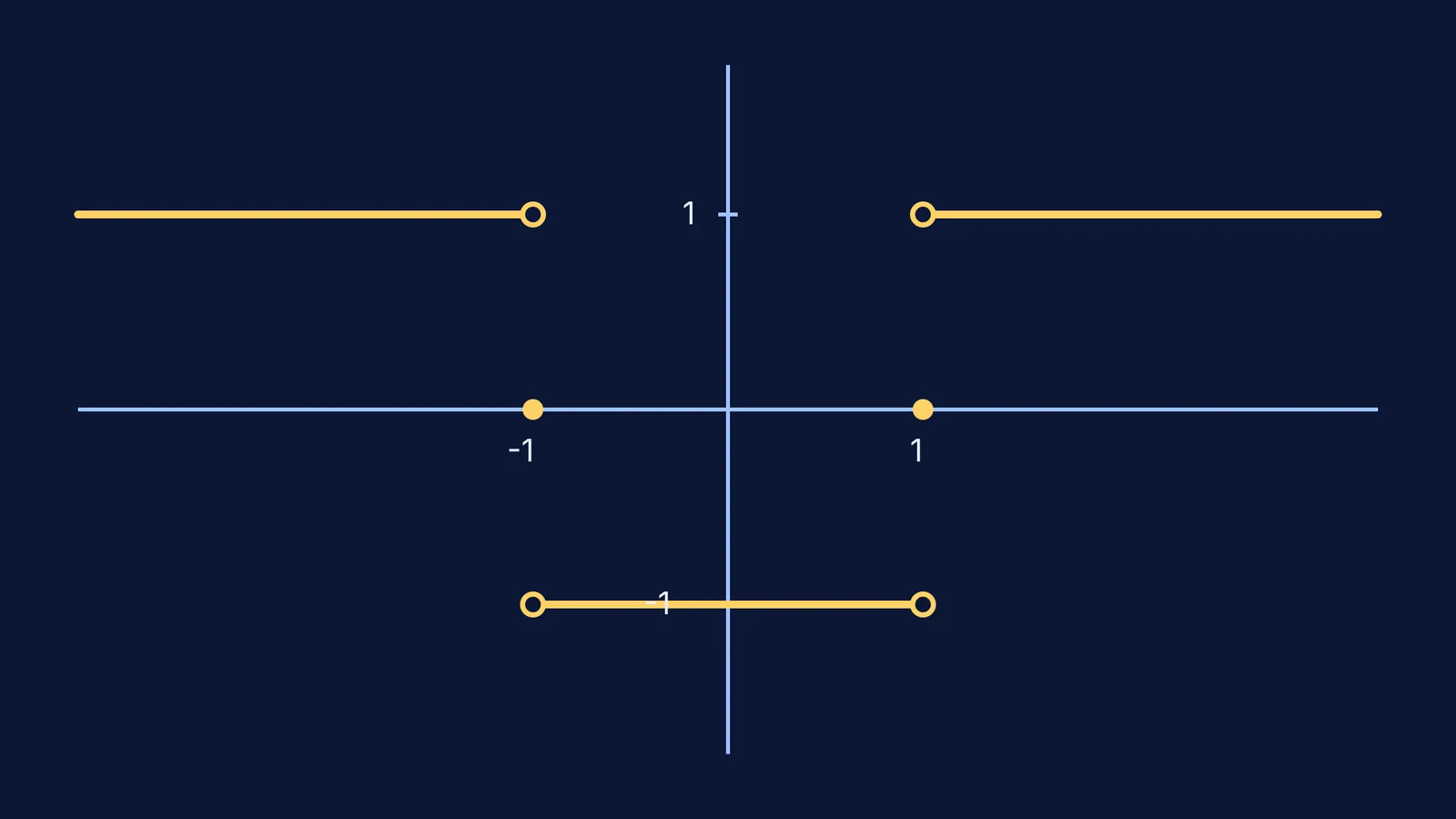
So, the first piece of our function is a flat horizontal line at y = −1 for the interval (−1, 1).
What is the function value when |x| = 1?
At the exact boundary points x = 1 and x = −1, the square x² is exactly 1.
The number 1 raised to any power remains 1. Therefore, for |x| = 1: lim x²ⁿ = 1 as n → ∞
Substitute this into the original expression: f(x) = (1 − 1) / (1 + 1) = 0 / 2 = 0
At exactly x = 1 and x = −1, the function's value drops to a single point at y = 0.
What happens to the function when |x| > 1?
When x is greater than 1 or less than −1, its square x² is strictly greater than 1.
Raising a number larger than 1 to an infinite power causes it to grow without bound. This means lim x²ⁿ = ∞ as n → ∞.
We cannot simply plug infinity into the expression, because we would get the indeterminate form ∞/∞. Instead, divide the numerator and the denominator by the highest power of x, which is x²ⁿ. When determining what happens as n → ∞, dividing by the highest power is the standard technique, similar to finding limits at infinity of rational functions.
f(x) = lim [ (x²ⁿ/x²ⁿ) − (1/x²ⁿ) ] / [ (x²ⁿ/x²ⁿ) + (1/x²ⁿ) ] as n → ∞ f(x) = lim (1 − 1/x²ⁿ) / (1 + 1/x²ⁿ) as n → ∞
Since x²ⁿ grows to infinity, the term 1/x²ⁿ shrinks to zero: f(x) = (1 − 0) / (1 + 0) = 1
The final piece of our function is a flat horizontal line at y = 1 for intervals (−∞, −1) and (1, ∞).
If calculating limits manually leaves you unsure about domain splits, the Fermi Problem Library has worked calculus problems with a step-by-step solver that explains the reasoning rather than printing an answer.
How do you test the piecewise function for continuity?
We now have the complete piecewise definition of f(x):
f(x) = 1 for x < −1
f(x) = 0 for x = −1
f(x) = −1 for −1 < x < 1
f(x) = 0 for x = 1
f(x) = 1 for x > 1
To test for continuity at x = 1, we evaluate the left-hand limit (LHL), the right-hand limit (RHL), and the exact function value.
LHL: As x approaches 1 from the left (x < 1), the rule is f(x) = −1. So, lim f(x) = −1 as x → 1⁻.
RHL: As x approaches 1 from the right (x > 1), the rule is f(x) = 1. So, lim f(x) = 1 as x → 1⁺.
Function value: f(1) = 0.
For a function to be continuous at a point, the LHL, RHL and function value must all be equal. Here, −1 ≠ 1 ≠ 0. Therefore, f(x) has a jump discontinuity at x = 1.
By applying the same logic at x = −1, the LHL is 1 and the RHL is −1, meaning the function is also discontinuous at x = −1. Rather than being a continuous curve, the graph of this function steps from a height of 1 down to −1 and back up to 1, with isolated points sitting on the x-axis at the boundaries.
For more practice with how functions jump across intervals, exploring how to solve modulus equations and inequalities will build your confidence in the case-split method used here.


