

On this page
If you are preparing for competitive exams like JEE Main or NEET-UG, the Fries rearrangement is a perfect example of why memorising a chemical equation is never enough. The conditions matter just as much as the reactants.
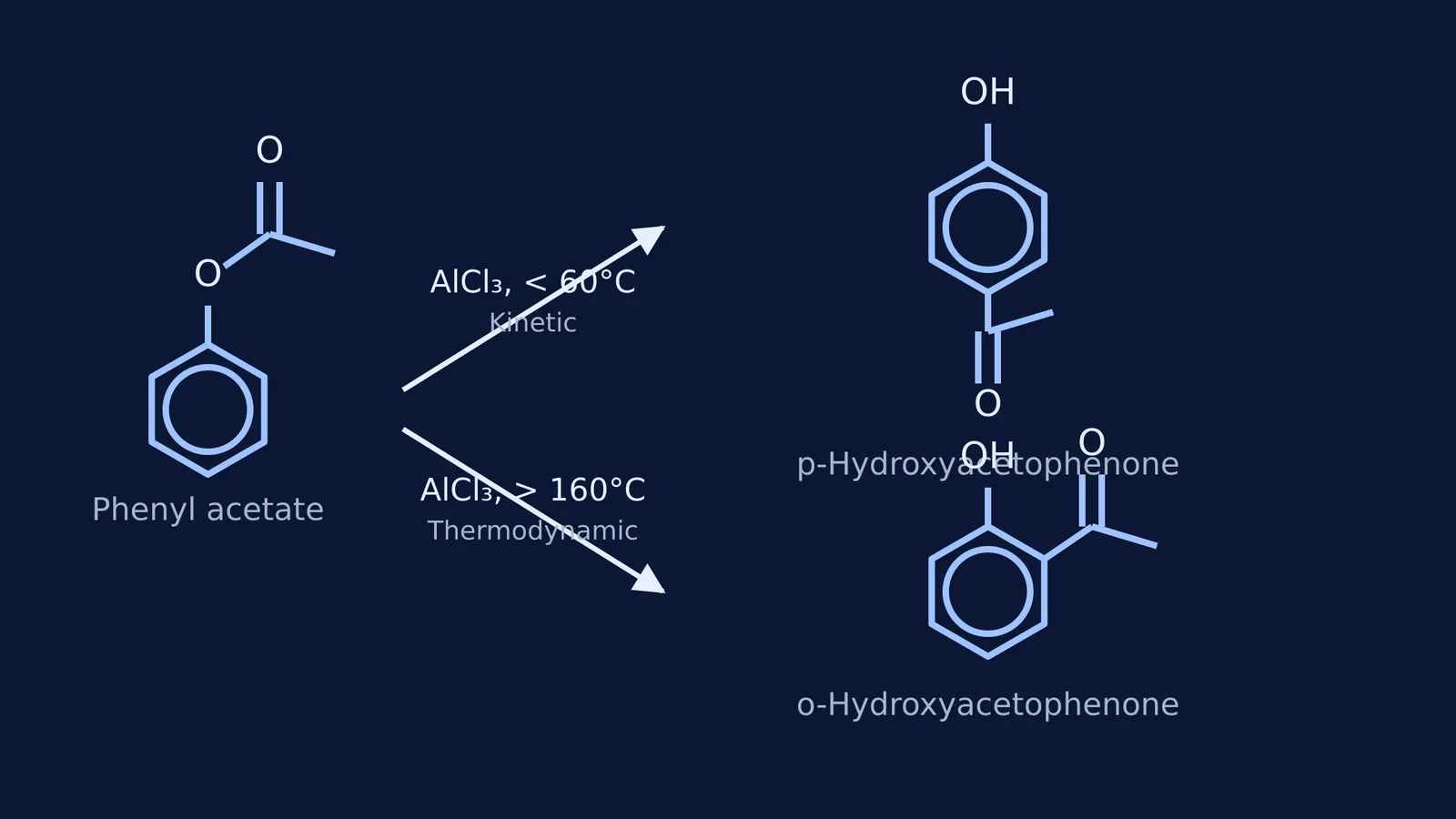
When you treat phenyl acetate with an anhydrous Lewis acid like aluminum chloride (AlCl₃), the acyl group migrates from the oxygen atom to the benzene ring. But where does it land? The answer depends entirely on the thermometer.
First reported in 1908 by Karl Theophil Fries, this reaction is a textbook demonstration of competing kinetic and thermodynamic control. Source: *Berichte der deutschen chemischen Gesellschaft*, 1908.
The mechanism: creating the electrophile
Before the acyl group can migrate, the aluminum chloride must activate the ester. AlCl₃ is a strong Lewis acid, meaning it is hungry for electrons. It coordinates tightly with the lone pair of electrons on the carbonyl oxygen of phenyl acetate.
This coordination drains electron density and severely weakens the bond between the phenolic oxygen and the acyl group, eventually causing the bond to cleave. This cleavage generates an acylium ion (CH₃C⁺=O) and a phenoxide-aluminum complex.
The acylium ion is a highly reactive electrophile. Following the rules of electrophilic aromatic substitution, it attacks the electron-rich benzene ring. Because the oxygen attached to the ring is strongly activating, it directs the incoming acylium ion to the *ortho* and *para* positions.
Why does low temperature favour the para product?
If you keep the reaction mixture cool—typically below 60°C—the major product is *p*-hydroxyacetophenone. Source: *Organic Reactions*, 1942.
This pathway is a kinetically controlled process. The *para* position is physically located on the opposite side of the ring from the bulky oxygen-aluminum complex. Because there is significantly less steric hindrance, the acylium ion can attack the *para* carbon much faster than it can squeeze into the *ortho* position. At low temperatures, the molecules do not possess enough thermal energy to reverse the reaction. Therefore, the product that forms the fastest is the one that accumulates.
Why does high temperature favour the ortho product?
Turn the heat up above 160°C, and the outcome flips. The major product becomes *o*-hydroxyacetophenone. Source: *Organic Reactions*, 1942.
At these higher temperatures, the reaction becomes reversible. The acyl group has enough energy to attach to the ring, detach, and reattach somewhere else. This brings thermodynamic control into play. While the *ortho* product is harder to form initially due to steric crowding, it is ultimately much more stable.
This stability comes from two factors. First, during the reaction, the *ortho* isomer forms a stable, six-membered chelate ring with the aluminum catalyst. Second, once the reaction is quenched with acid, the *ortho* product exhibits strong intramolecular hydrogen bonding between the new hydroxyl (-OH) group and the adjacent carbonyl (C=O) group. Given enough heat and time, the system naturally settles into this most stable state.
Mastering mechanisms with Fermi
It is easy to mix up whether heat leads to the *ortho* or *para* product under exam pressure. If you are struggling to picture why steric hindrance and hydrogen bonding change the reaction's outcome, the Fermi Concept Library can help. It covers every concept in physics, chemistry, biology, mathematics and computing, each with its own lesson and its place in the map.
Fermi's AI tutor teaches—it holds a line of reasoning across a whole session. You can ask it to walk you through the acylium ion mechanism, and it will help by writing on a board and drawing the figure for each intermediate structure, so you can see exactly how the aluminum chloride dictates the ester's behaviour.
A checklist for Fries rearrangement questions
When you spot a phenolic ester and a Lewis acid in a practice paper, run through this checklist before writing down your final product, using established conditions Source: *Organic Reactions*, 1942:
Identify the catalyst: Is there at least one full equivalent of anhydrous AlCl₃? The reaction requires it because the catalyst is chemically consumed by complexing with the carbonyl oxygen, rather than just speeding up the process.
Check the temperature: Look for specific numbers or heating symbols. "Heat" or a delta symbol (Δ) usually implies temperatures > 160°C, meaning thermodynamic control and an *ortho* product. "Ice bath", "room temperature", or < 60°C implies kinetic control and a *para* product.
Look at the solvent: If the temperature is omitted, solvent polarity is your next best clue. Non-polar solvents (like nitrobenzene or chlorobenzene) often favour the *ortho* product. Highly polar solvents push the equilibrium toward the *para* product.
Identify the migrating group: The Fries rearrangement is not limited to the acetyl group found in phenyl acetate. Any acyl group—such as a benzoyl group from phenyl benzoate—will undergo this exact same migration, strictly following the same temperature rules.
By understanding the fundamental physical chemistry behind the temperature dependence, you never have to guess the major product again.


