

On this page
When a flat, uniform disc of mass m and radius R spins about its central axis on a rough horizontal table, kinetic friction acts to slow it down. This is a common real-world scenario, whether you are spinning a coin, a heavy plate, or a mechanical component. But unlike a sliding block where friction acts as a single force vector at the point of contact, the friction under a spinning disc is distributed over the entire circular contact area.
Finding the total frictional torque is a classic problem in rotational mechanics, often encountered when preparing for competitive exams like JEE Main.
Why doesn't friction just act at the edge?
The friction force on the disc is caused by its weight pressing against the rough surface. Let the coefficient of kinetic friction be μ. If the disc's weight mg is distributed uniformly, the normal force per unit area (the pressure) is constant everywhere under the disc.
Every part of the disc is sliding against the table, so every part experiences kinetic friction. Even though the points near the edge are moving faster (v = rω) than the points near the centre, kinetic friction does not depend on speed. It only depends on the normal force. Because the friction force is continuously distributed across the disc, we cannot simply multiply the total force by the full radius. We must sum up the infinitesimal torque contributed by each small piece of the disc.
How to set up the integral for frictional torque?
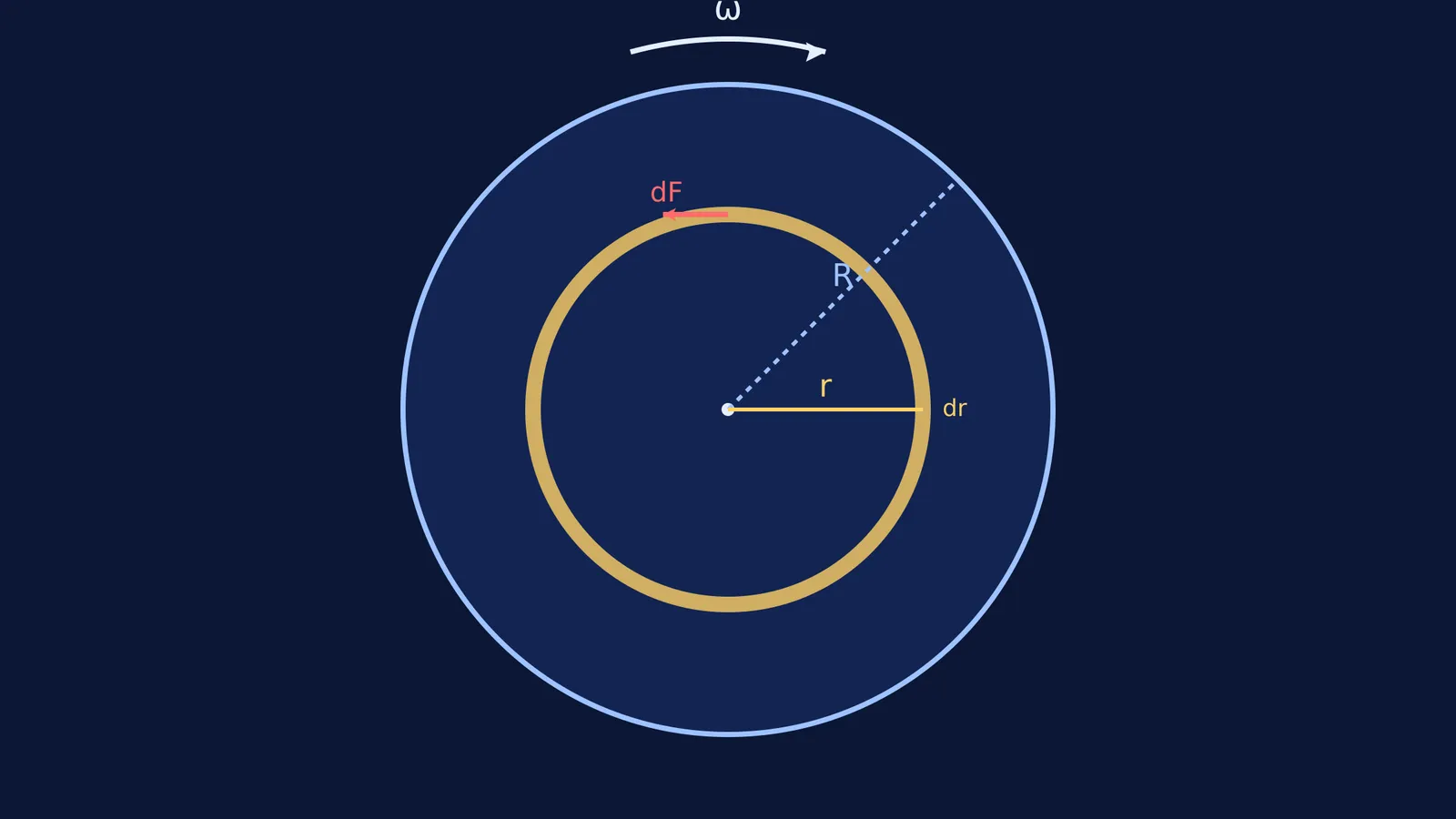
To find the total torque, we divide the disc into thin concentric rings.
Consider a thin ring of radius r and width dr.
The area of the entire disc is πR². The area of this thin ring is its circumference multiplied by its width: dA = 2πr dr.
The fraction of the total mass that lies in this ring is dm = m(2πr dr / πR²) = (2mr/R²) dr.
The normal force on this ring is dN = (dm)g = (2mgr/R²) dr.
The kinetic friction force on the ring is dF = μ dN = (2μmgr/R²) dr.
This friction force acts tangentially, opposing the rotation. Since it acts at a distance r from the centre, the infinitesimal torque dτ from this ring is: dτ = r × dF = (2μmgr²/R²) dr
To find the total torque τ, we integrate this expression from the centre (r = 0) to the edge (r = R): τ = ∫ (2μmgr²/R²) dr = (2μmg/R²) [r³/3]
Evaluating from 0 to R gives the final formula: τ = (2/3) μmgR
This result tells us that the "effective radius" at which the total friction acts is 2/3 of the disc's full radius.
How long does it take to stop?
Once we have the torque, we can find out how quickly the disc slows down.
According to Newton's second law for rotation, τ = Iα, where I is the moment of inertia and α is the angular acceleration. For a uniform solid disc, I = (1/2)mR².
Since friction opposes the motion, the angular acceleration is: α = τ / I = ((2/3)μmgR) / ((1/2)mR²) = (4/3) μg/R
If the disc starts with an initial angular velocity ω₀, we can use the kinematic equation ω = ω₀ - αt to find the time t it takes to stop (when ω = 0): t = ω₀ / α = 3ω₀R / (4μg)
We can also find the total angle θ it turns before stopping using ω² = ω₀² - 2αθ: θ = ω₀² / (2α) = 3ω₀²R / (8μg)
This gives us the total angular displacement in radians. Divide θ by 2π to find the exact number of full revolutions the disc makes before finally coming to a halt.
When a problem requires setting up an integral over a physical body—whether it's finding the resistance of a tapered conductor or the magnetic moment of a spinning charged ring—drawing a diagram of the differential element is half the battle. If you get stuck on exactly how to define your variables, the Fermi Concept Library maps out every core derivation step by step so you can see where the geometry meets the physics, and you can brush up on the radius of gyration along the way.


