

On this page
Imagine you have a mixture of table salt (NaCl) and saltpetre (KNO₃) accidentally mixed together. Because both dissolve easily in water, a simple filter will not separate them. To recover the pure chemicals, chemists rely on the fractional crystallisation principle.
How does the separation principle work?
Fractional crystallisation is a technique that fractionates multi-component mixtures based on differences in their crystallization temperatures Wikipedia).
When you heat a solvent, it can usually hold more dissolved solid. If you saturate a boiling solution with two different salts and then cool it down, the salt whose solubility drops the most will be forced out of the solution first, forming pure solid crystals. The salt whose solubility is less affected by the temperature drop remains dissolved in the remaining liquid, known as the mother liquor.
What is the solubility difference between KNO₃ and NaCl?
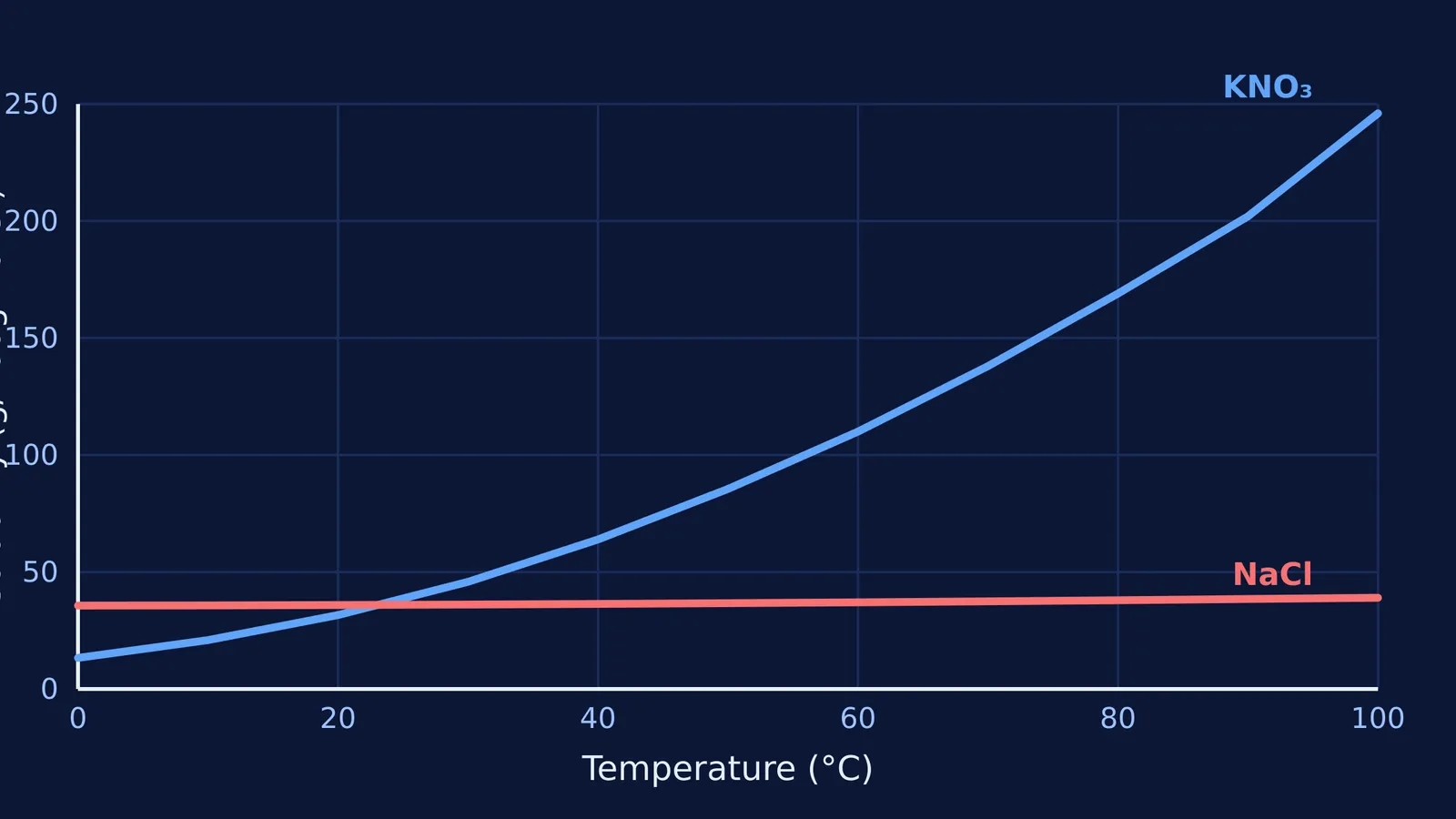
The classic demonstration of this principle uses potassium nitrate and sodium chloride because their solubility curves look completely different.
Potassium nitrate's solubility is highly temperature-dependent. At 0°C, 100 g of water dissolves only 13.3 g of KNO₃, but at 100°C, it can hold 246 g Solubility Table.
Sodium chloride's solubility remains mostly flat across the same temperature range. It dissolves 35.7 g at 0°C and increases only slightly to 39.0 g at 100°C Solubility Table.
Because of this massive difference in slopes, cooling a boiling mixture causes the KNO₃ to crash out as solid crystals, while the NaCl stays comfortably dissolved in the water.
How do you calculate a separation yield?
Let's walk through the math of a typical separation, which often appears as a numerical problem in chemistry exams.
Imagine a solid mixture containing 50 g of KNO₃ and 10 g of NaCl. You want to extract pure KNO₃ using standard limits Solubility Table.
Dissolution: You add the 60 g mixture to 50 g of boiling water (100°C). At this temperature, 50 g of water can hold up to 123 g of KNO₃ (half of 246 g) and 19.5 g of NaCl (half of 39.0 g). Since you only have 50 g and 10 g respectively, the entire mixture dissolves completely into a clear liquid.
Cooling: You place the beaker in an ice bath to cool the solution down to 0°C.
Crystallisation: At 0°C, your 50 g of water can only hold 6.65 g of KNO₃ (half of 13.3 g). The water can no longer hold the other 43.35 g of KNO₃, so it precipitates out as pure, solid crystals.
Remaining solvent: At 0°C, the same 50 g of water can hold up to 17.85 g of NaCl (half of 35.7 g). Since you only had 10 g to begin with, all of the NaCl remains dissolved.
You pour the cold mixture through filter paper. The 43.35 g of pure KNO₃ stays on the paper, while the NaCl washes through with the water.
What happens if you evaporate the water instead?
Fractional crystallisation can also work in reverse by removing the solvent rather than dropping the temperature. This is how you would recover the remaining NaCl from the mother liquor after filtering out the KNO₃.
When you boil the remaining cold solution, the water begins to evaporate. As the volume of water decreases, there is less solvent available to keep the NaCl dissolved. Because sodium chloride's solubility is relatively unaffected by the heat of the boiling water, its concentration climbs steadily as the water escapes.
Eventually, the volume of water becomes so small that the solution exceeds its saturation limit for NaCl. At this point, pure sodium chloride crystals begin to form. You must stop the evaporation before all the water is gone, otherwise, the small amount of KNO₃ still dissolved in the water will crystallise and contaminate your newly purified salt.
How to master separation techniques for exams?
Many students memorise the general shape of the curves but stumble on the numerical applications because they mix up the solute and solvent masses during the cooling steps of a calculation. Phase diagrams and solubility limits can feel abstract until you trace the mass balance step by step.
If you find yourself confused by saturation limits, you can look them up in the Fermi Concept Library, which contains every concept in physics, chemistry, biology, mathematics and computing, each with its own lesson and its place in the map.
When you get stuck on the calculations, having a structured approach to problem-solving helps find the missing link. The Fermi Problem Library has worked problems with a step-by-step solver that explains the reasoning rather than printing an answer, helping you trace exactly where your mass balance went wrong.


