

On this page
A classic question in school mathematics asks: consider the number 4ⁿ, where n is a natural number. Can 4ⁿ ever end with the digit zero?
The short answer is no. To prove it, you do not need to calculate large powers of 4. Instead, you can solve it quickly by looking at the building blocks of the number: its prime factors. This approach is a core part of learning about real numbers in Class 10.
Here is the step-by-step mathematical reasoning.
Why do numbers end in zero?
Before checking 4ⁿ, we need to know what makes any number end in the digit 0.
Any integer that ends in zero (such as 10, 40, or 350) is a multiple of 10. The standard rule for divisibility by 10 states that a number is divisible by 10 if and only if it is divisible by both 2 and 5.
This means that if you break a number ending in zero down into its prime factors, that list of factors must contain at least one 2 and at least one 5. If either of these primes is missing, the number cannot end in zero.
What is the prime factorization of 4ⁿ?
Next, let us break down the number 4ⁿ into its prime factors. The base of the expression is 4, which is a composite number.
We know that 4 = 2 × 2, or 2².
Substituting this into our expression gives: 4ⁿ = (2²)ⁿ = 2²ⁿ
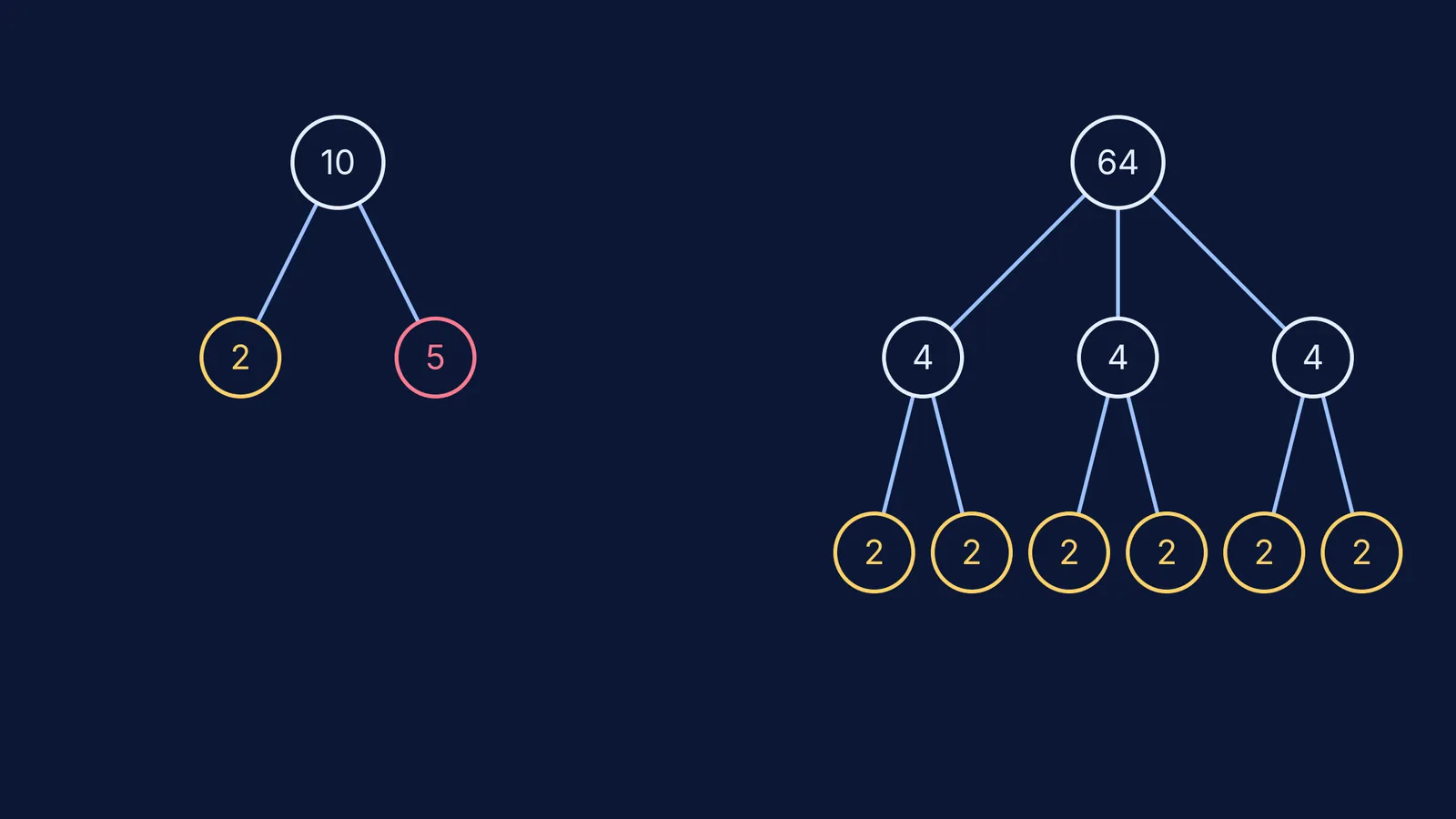
This tells us that 4ⁿ is just a long string of 2s multiplied together. For example, if n = 3, then 4³ = 2⁶ = 64. The only prime factor present is 2. The prime factor 5 is completely missing.
How does the Fundamental Theorem of Arithmetic help?
You might wonder: could a 5 somehow appear in the factorization if n becomes a very large number? We know it will not, thanks to a rule called the Fundamental Theorem of Arithmetic.
As defined by mathematicians, the Fundamental Theorem of Arithmetic states that every integer greater than 1 can be represented as a unique product of prime numbers, regardless of the order in which they are written. This concept is introduced early when students first meet primes and co-primes.
Because prime factorizations are unique, the list of prime factors for 4ⁿ is locked in. It is uniquely 2²ⁿ. No other primes can sneak in, so the factor 5 will never be part of the product.
How do you write this proof in an exam?
If you face this question in a board exam, you need to lay out the logic clearly. Examiners look for specific steps. Here is a reliable script of what to write:
State the condition: "If the number 4ⁿ, for any n, were to end with the digit zero, then it would be divisible by 5."
Show the prime factorization: "However, the prime factorization of 4ⁿ is (2²)ⁿ = 2²ⁿ."
Cite the theorem: "By the Fundamental Theorem of Arithmetic, this factorization is unique. The only prime in the factorization of 4ⁿ is 2."
Conclude: "So, 5 does not occur in the prime factorization of 4ⁿ. Therefore, 4ⁿ cannot end with the digit zero for any natural number n."
If you find it hard to write out proofs or you get stuck on the logical leaps, the Fermi Problem Library has worked problems with a step-by-step solver that explains the reasoning rather than printing an answer. To review the underlying rules, the Concept Library contains every concept in physics, chemistry, biology, mathematics and computing, each with its own lesson and its place in the map. You can apply the same logic to more advanced ideas, such as finding the number of divisors and their sum.


