

On this page
A family of curves is one equation with free parameters in it, and each choice of values gives one curve. Forming its differential equation removes the parameters. What remains is a rule about slopes that every curve in the family obeys.
First, check whether your exam asks for this directly. The current NCERT Class 12 chapter (Differential Equations, reprint 2026-27) moves from general and particular solutions (section 9.3) straight to methods of solving (section 9.4). It has no formation section, but its exercises still ask how many arbitrary constants the general solution of a fourth-order equation has. The JEE Main 2027 syllabus posted by NTA lists order and degree, separation of variables, and homogeneous and linear equations, with no separate line for formation. CBSE's Applied Mathematics support material does teach it as a learning outcome: "Form differential equation by eliminating arbitrary constants". Check your own board's current syllabus. Even where formation isn't examined, it is how you read the order of an equation and check a general solution.
How do you form a differential equation from a family of curves?
The CBSE material gives the rule in one line: if a family has n parameters, you differentiate it n times to eliminate them and get an nth-order differential equation (CBSE Applied Mathematics, section 3.11.1). In practice:
Write the family and count its essential arbitrary constants. Call that n.
Differentiate n times with respect to x. With the original equation, you now have n + 1 equations.
Use them to eliminate every constant. Solve the simplest equation for one constant and substitute it into the others.
Check the result: the order should be n, no constants should remain, and one member of the family should satisfy the equation.
The simplest case is in section 3.11 of the same CBSE material. For the lines y = mx + c (two constants), differentiating once gives y′ = m, and again gives y″ = 0. That is a second-order equation with no m or c left.
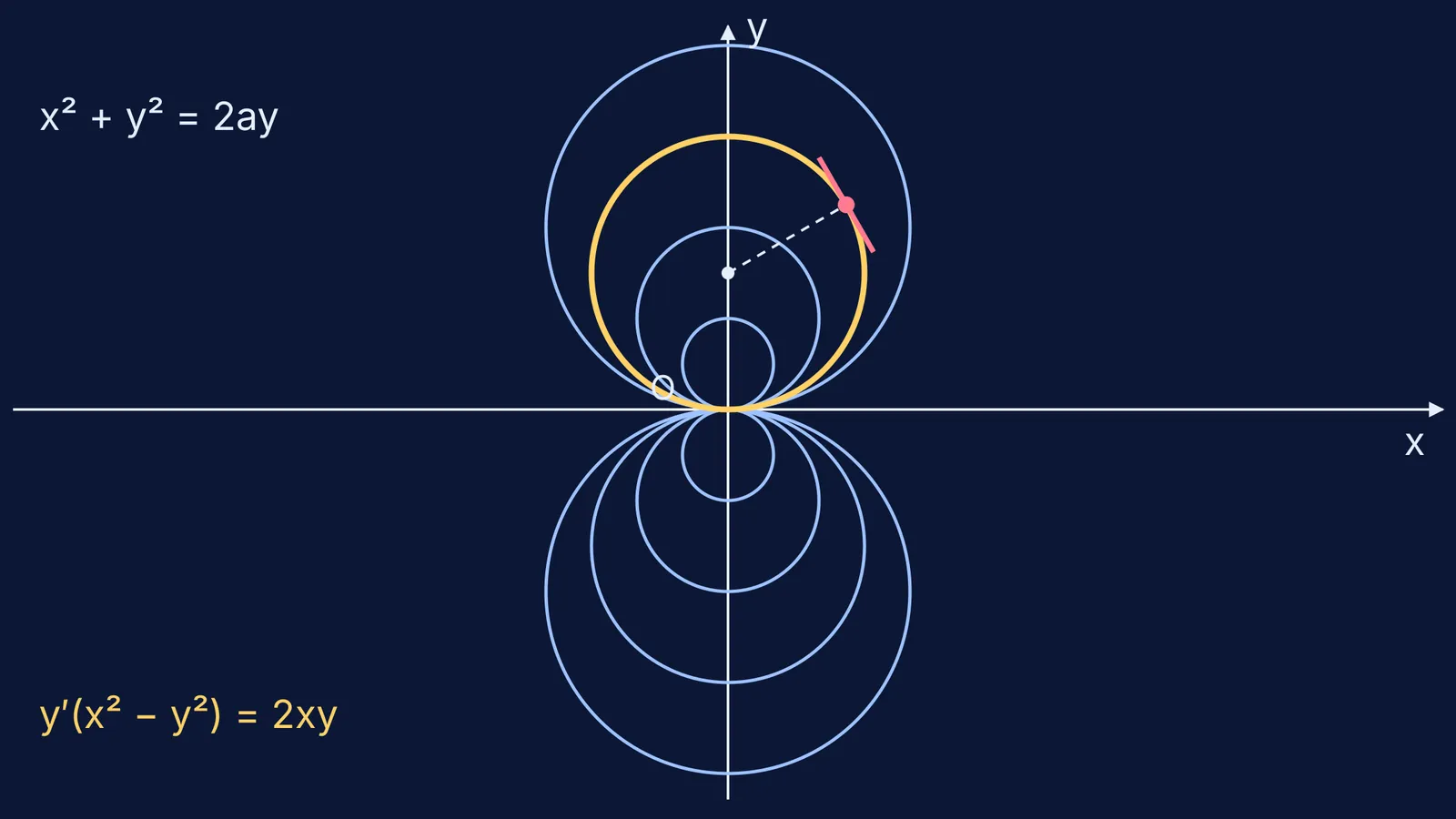
Worked example 1: circles that touch the x-axis at the origin
These circles have centre (0, a) and radius a, so the family is x² + y² = 2ay. There is one constant, so you differentiate once.
Differentiate: 2x + 2yy′ = 2ay′.
From the family, 2a = (x² + y²)/y. Substitute it.
2x + 2yy′ = y′(x² + y²)/y. Multiply by y: 2xy + 2y²y′ = y′(x² + y²).
Rearrange: y′(x² − y²) = 2xy.
The result is first order, as expected. It is also homogeneous, so you can check it by solving it back with the y = vx substitution for homogeneous equations.
Worked example 2: two exponentials
Take y = Ae^(2x) + Be^(−x), which has two constants.
y′ = 2Ae^(2x) − Be^(−x)
y″ = 4Ae^(2x) + Be^(−x)
Subtracting gives y″ − y′ = 2Ae^(2x) + 2Be^(−x) = 2y.
So y″ − y′ − 2y = 0 is second order, the same equation the CBSE material reaches. Physics has the same pattern: x = A cos(ωt + φ), with amplitude A and phase φ free, gives d²x/dt² = −ω²x. ω is fixed by the spring and mass, so it stays in the equation.
Why does the order come out lower than the number of letters?
Only essential constants count. Letters that can be merged into one are a single constant.
y = Ae^(x + B) looks like two constants. But Ae^B is one number, so y = Ce^x, and the equation is y′ = y, which is first order.
y = (A + B)x² has one essential constant, not two.
y = A cos²x + B sin²x + C looks like three. Since sin²x = 1 − cos²x, it is (A − B)cos²x + (B + C), so it has two essential constants and gives a second-order equation.
Fixed numbers are not arbitrary constants. If a question fixes the radius, the value of g or the frequency, that number stays in your equation.
If your equation comes out an order too low, look for constants that merge. If it comes out too high, check whether you treated a fixed number as free. For reading order and degree once you have the equation, see order and degree of a differential equation.
How do you check your answer in an exam?
Count the constants, merging any that combine.
Differentiate exactly that many times. One fewer leaves a constant behind.
Eliminate, then scan the answer for leftover letters.
Substitute one simple member (a = 1, or A = 1 and B = 0) and confirm both sides match.
If an elimination goes wrong and you can't see where, the Fermi Problem Library has worked problems with a step-by-step solver that explains the reasoning, so you can compare each line with yours. Once you can form these equations, the next step is choosing a method to solve them: see how to spot the type of a differential equation for JEE.


