

On this page
Why is subtraction order reversed in word problems?
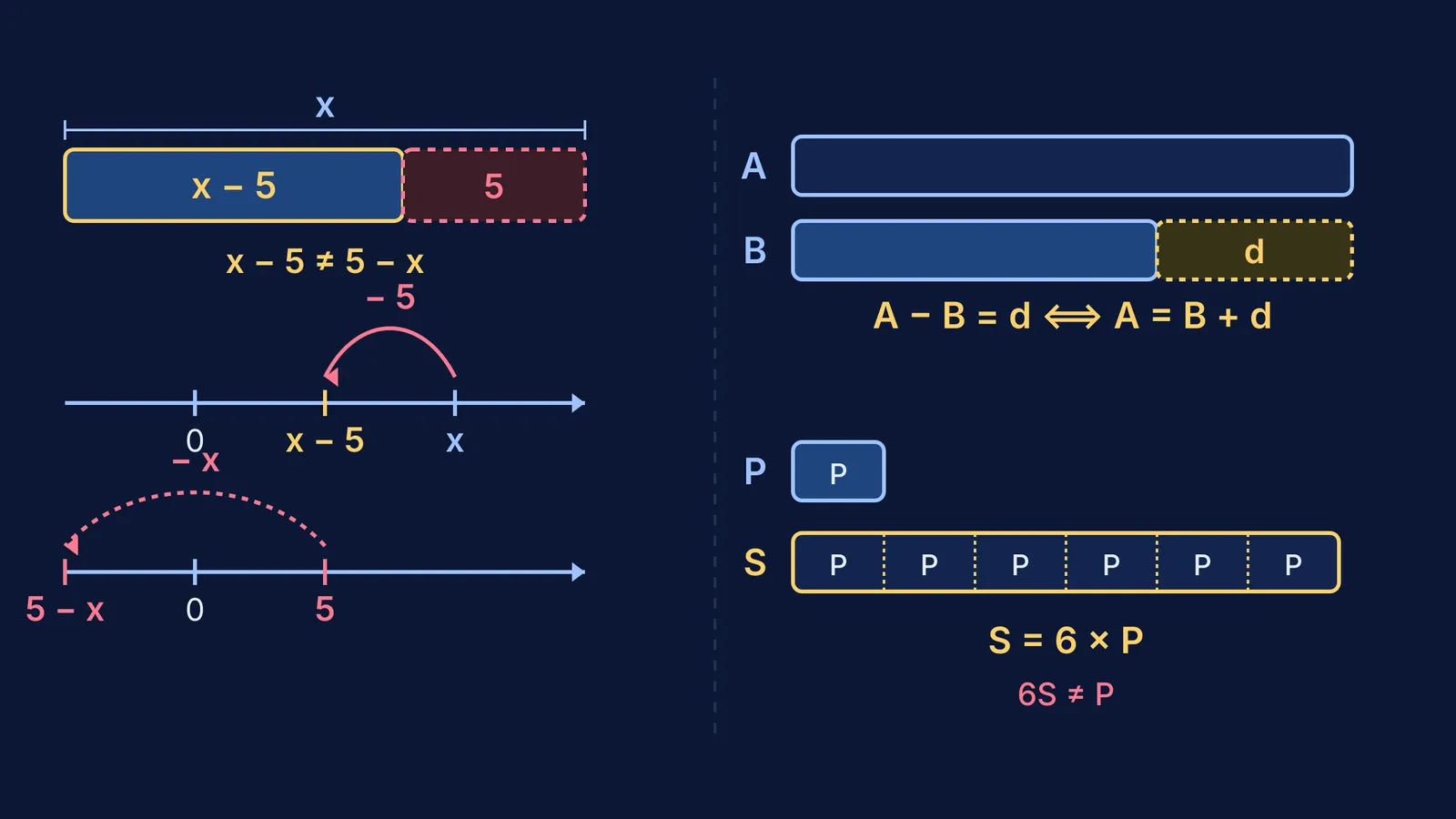
Translating language into algebra requires turning relational statements into symbolic equations. With addition or multiplication, students rarely notice reading-order slips because operations are commutative: a + b equals b + a. Subtraction, however, is non-commutative: a − b does not equal b − a. In English, phrases such as '5 less than x' or '5 subtracted from x' place the subtrahend—the amount removed—at the beginning of the clause, while the base quantity appears at the end. Translating words directly left to right produces 5 − x, reversing the sign of the intended result.
Cognitive psychologists Mary Hegarty, Richard E. Mayer, and Christopher A. Monk explored this breakdown in the Journal of Educational Psychology. Their research showed that struggling students rely on a 'direct translation strategy,' scanning for numbers and isolated keywords rather than constructing a mental model of the situation. When keywords conflict with the required mathematical sequence, direct translation triggers reversal errors. In the CBSE secondary mathematics curriculum, where students first encounter formal algebra in Class 7 and Class 8, mastering this syntactic shift separates mechanical calculation from relational reasoning.
How do you translate 'more than', 'less than', and 'exceeds'?
To avoid the reversal trap, identify the baseline quantity before choosing an operation. Every comparative statement defines a starting value, an adjustment, and a resulting quantity:
'Less than': 'b less than a' specifies a starting quantity a reduced by b, yielding a − b. Writing b − a reverses the relationship.
'Subtracted from': In 'b subtracted from a,' the word 'from' marks a as the base quantity, giving a − b.
'Exceeds': 'a exceeds b by d' means a is larger than b by difference d. This yields a − b = d, or equivalently, a = b + d.
'More than': 'd more than b' represents b + d. While addition is commutative, standardising on 'base plus change' builds consistent habits for subtraction.
As word problems grow in complexity, such as linear equations in one variable for Class 8 and quadratic word problems in Class 10, phrases combine adjustments with dimensions or rates. Spotting the structural anchor prevents sign errors that derail factorisation.
Why does 'times as many' cause reversal errors?
Multiplicative comparisons create an equally persistent misconception known as the relational reversal error. In a landmark 1982 investigation published in the Journal for Research in Mathematics Education, researcher John Clement tested 150 freshman engineering students on a classic university problem: 'There are 6 times as many students as professors at this university.' Despite strong mathematics backgrounds, 37% of the students wrote the reversed equation 6S = P instead of S = 6P.
Clement showed that students make this mistake by matching word order—placing 6 next to S—or by using letters as labels for groups rather than numerical variables. In their subsequent study in the Journal for Research in Mathematics Education, researchers Mollie MacGregor and Kaye Stacey analysed responses from 281 Grade 9 students and 1,048 students across grades 8 to 10. They confirmed that students construct mental models of unequal groups, but frequently attach the multiplier to the larger set. An equation is a balanced scale: to balance a larger group of students against a smaller group of professors, you must multiply the smaller number.
In multi-variable problems, such as linear equations in two variables in Class 10, statements often combine scaling with offsets, such as 'four less than three times a number.' Translating correctly requires following order of operations: scale first to 3x, then subtract 4 to obtain 3x − 4.
What is a reliable method to test algebraic expressions?
Rather than relying on linguistic intuition, verify any algebraic translation using a systematic three-step validation check:
Define variables explicitly as numbers: Write 'let x = number of rupees' or 'let L = length in metres,' ensuring each symbol represents a measurable count, not an object.
Apply the concrete number test: Choose a convenient test value. For '6 less than a number,' test with 10. Six less than 10 is 4. Evaluating candidate expressions shows 10 − 6 = 4, while 6 − 10 = −4, immediately exposing the reversal error.
Check the balancing direction: For 'a exceeds b by 15,' test values like 20 and 5. Because 20 − 5 = 15, subtracting the smaller quantity from the larger confirms a − b = 15.
When practicing multi-step word problems, the Fermi Problem Library provides worked problems with a step-by-step solver that explains the reasoning rather than printing an answer. To strengthen core foundations across variables and functions, the Fermi Concept Library covers every concept in physics, chemistry, biology, mathematics and computing, each with its own lesson and its place in the map. If you get stuck formulating an equation, Fermi's AI tutor notices where a student is stuck, and decides whether to explain, ask, or show the next step.


