

On this page
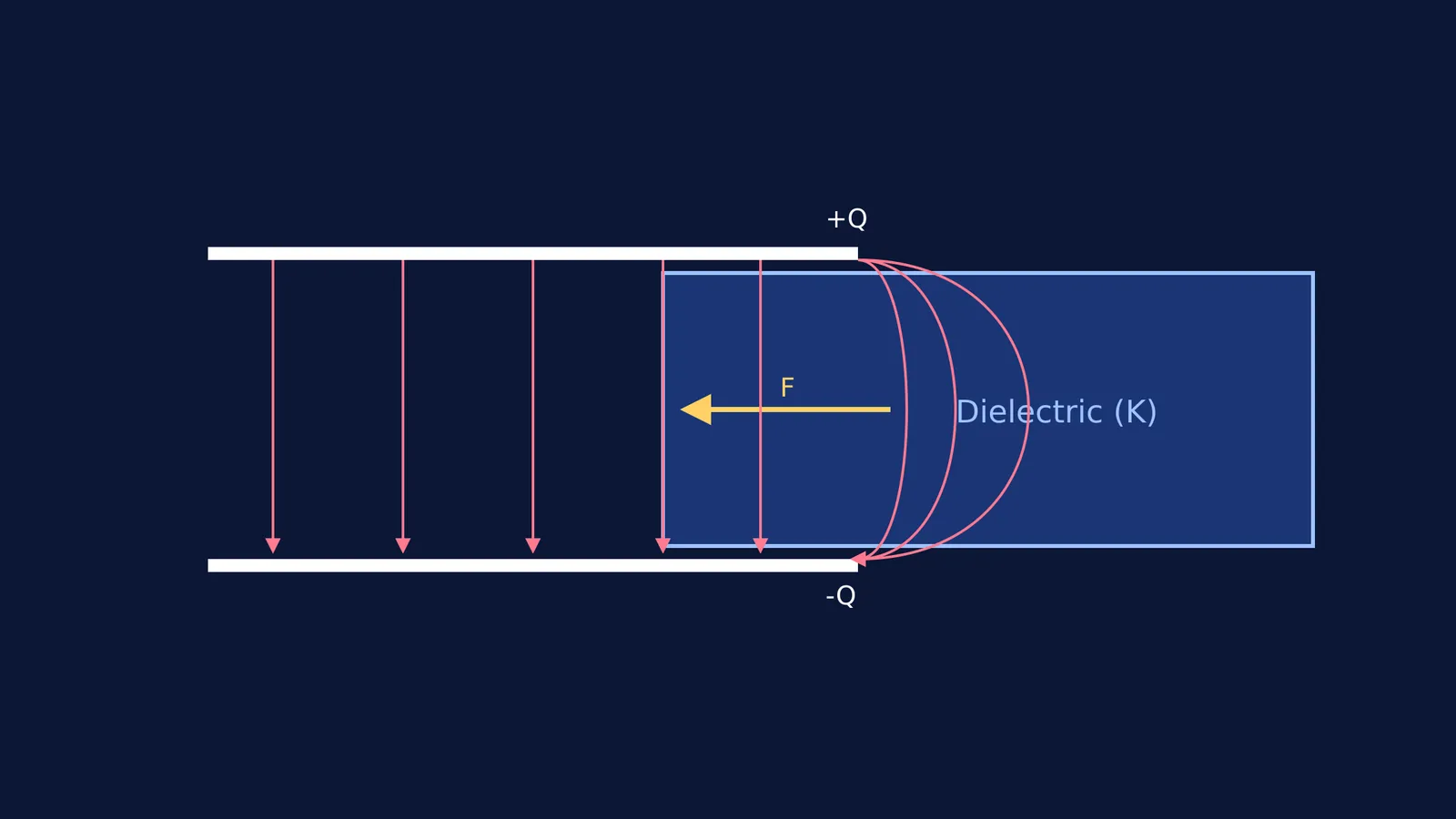
When you partially insert a dielectric slab into a parallel-plate capacitor, you will feel a force pulling it in. This is true whether the capacitor is disconnected or hooked up to a battery. The physical reason for this attraction is often glossed over in textbooks, but it comes down to the electric field curving at the edges of the plates.
Why is there a force on a dielectric slab being pulled into a capacitor?
Many students find the standard derivation confusing because the electric field between the plates is uniform and points straight across. A purely uniform field can only push bound charges up and down, never sideways.
The actual force comes from the fringing fields at the edges of the capacitor plates. As the field lines bulge outward, they gain a horizontal component. These fringing fields polarise the part of the dielectric slab that is still outside the plates, pulling the induced dipoles into the region where the field is stronger (Margulies 1984, American Journal of Physics). Even though we calculate the force using the energy stored in the uniform part of the field, it is this non-uniform fringe field doing the physical work.
How do you find the force with the battery off (constant charge)?
When the capacitor is charged to a charge Q and then disconnected, the charge has nowhere to go. Because the dielectric constant K is greater than 1, inserting the slab increases the total capacitance C.
The stored potential energy is U = Q² / (2C). Since Q is constant and C is increasing, the stored energy is decreasing. The system is moving to a lower energy state. The force is the negative gradient of this potential energy: F = −dU/dx
Since the capacitance of a partially filled capacitor of plate width b, length L and separation d is C = (ε₀b/d)[L + (K − 1)x], the derivative dC/dx is ε₀b(K − 1) / d.
Substituting this in gives: F = Q² / (2C²) × (dC/dx) = ε₀b(K − 1)V² / 2d
How do you find the force with the battery connected (constant voltage)?
If you leave the battery connected, the voltage V across the plates remains constant. As the slab enters and C increases, the battery must supply extra charge to maintain that voltage. The stored energy is U = ½CV². Because C increases, the stored energy actually increases as the slab is pulled in.
This seems to break the rule that systems move toward lower energy. But we must include the battery. The battery does work V dQ to move the extra charge, which equals V² dC. Half of this work goes into increasing the stored energy (½V² dC), and the other half does mechanical work on the slab.
Because the battery is doing the heavy lifting, the force equation has a positive sign: F = +dU/dx
Taking the derivative of ½CV² with V held constant gives: F = ½V² (dC/dx) = ε₀b(K − 1)V² / 2d
The magnitude and direction of the force are identical in both cases.
Inserting a dielectric slab: battery connected vs disconnected is a great next step to see how charge, field and energy change step by step. If you have a concept gap and need to trace the physical forces on bound charges, the Fermi Concept Library breaks down how polarisation creates the pull. You can also explore the Energy density in an electric field to understand why the field prefers to sit inside the dielectric.


