

On this page
A dam problem looks like a pressure problem, but it is really an integration problem. Pressure changes with depth, so no single value of p can be multiplied by the area. You split the wall into thin strips and add up the force on each.
Why does a dam wall need an integral at all?
The NCERT Class 11 chapter on mechanical properties of fluids derives that the pressure at depth h below an open surface is P = Pa + ρgh, and calls the excess P − Pa the gauge pressure. The same chapter notes that the force a fluid at rest exerts on a surface is always perpendicular to that surface.
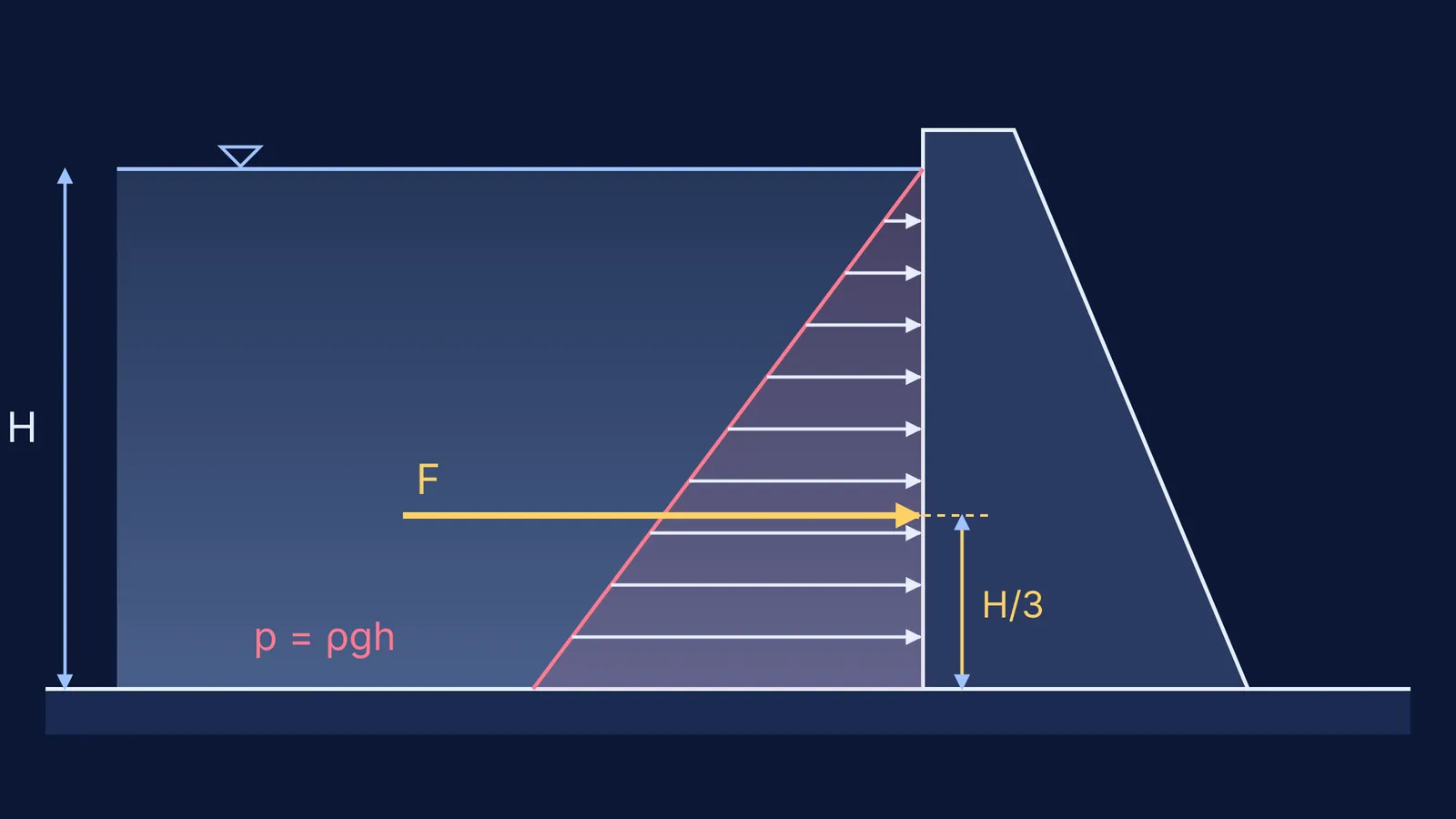
Atmospheric pressure Pa pushes on the dry side of the dam too, so it cancels and only ρgh matters. Because ρgh is zero at the surface and largest at the bed, the pressure on the wall is drawn as a triangle.
What is the total force of water on a dam wall?
Take a vertical wall of width w with water of depth H. Measure y downwards from the surface. A strip at depth y, thickness dy, has area w dy and feels pressure ρgy:
Force on the strip: dF = ρgy · w dy
Total force: F = ∫ from 0 to H of ρgw y dy = ρgwH²/2
Double the depth and the force quadruples. This is the same integral that OpenStax Calculus Volume 1 uses for hydrostatic force on a submerged plate, taking the weight density of water as 9800 N/m³.
Worked example. A wall 10 m wide holds water 20 m deep. Take ρ = 1000 kg/m³ (the NCERT density table) and g = 9.8 m/s². F = 1000 × 9.8 × 10 × 20²/2 = 1.96 × 10⁷ N.
Where does the force act, and what is the torque about the base?
The deeper strips push harder, so the resultant acts below the middle of the wetted wall. Penn State fluid mechanics notes by John Cimbala make the same point: the resultant equals the pressure at the centroid times the area, but it acts at the centre of pressure, which lies below the centroid.
To find it, take moments of each strip about the base. The strip at depth y is (H − y) above the base:
dτ = ρgwy(H − y) dy
τ = ρgw[H·H²/2 − H³/3] = ρgwH³/6
Height of the line of action above the base: τ/F = H/3
So the force acts 2H/3 below the surface, at the centroid of the pressure triangle. In the worked example, τ = 1000 × 9.8 × 10 × 20³/6 ≈ 1.31 × 10⁸ N·m, and 1.96 × 10⁷ N × 6.67 m gives the same number. This torque tries to tip the dam over its toe, the same balance of moments as in torque and equilibrium for ladders, beams and hinged rods.
How does the answer change for an inclined dam face?
Let the wet face make angle θ with the horizontal. As in the Cimbala notes on inclined plates, measure s along the face from the surface, so the depth is s sin θ and the wetted length is H/sin θ. The strip force is ρg(s sin θ)w ds, perpendicular to the face, which gives F = ρgwH²/(2 sin θ).
Horizontal component: F sin θ = ρgwH²/2, exactly the vertical-wall answer.
Vertical component: F cos θ, the weight of the wedge of water sitting on the sloping face.
With θ = 60° in our example, F = 1.96 × 10⁷ / 0.866 ≈ 2.26 × 10⁷ N, of which 1.13 × 10⁷ N presses down on the dam. The resultant still acts two-thirds of the way down the wetted face.
What about the sides and bottom of a tank?
The same integral works for each side. Using 9800 N/m³ for water, as OpenStax does, a cubical tank of side 1 m filled with water has 4900 N on each side and 9800 N on the bottom, so the four sides together carry twice the force on the bottom. If the tank accelerates, the depth at each wall changes; see liquid in an accelerating container. For depth-only practice first, try pressure at depth and gauge pressure problems.
A checklist for any hydrostatic force problem
Use gauge pressure unless air acts on one side only.
Choose strips parallel to the surface, so each strip has one depth.
Write the strip width as a function of depth if the wall is not a rectangle.
Integrate p × dA for force, and p × dA × lever arm for torque.
For inclined faces, resolve into horizontal (depth only) and vertical (weight of water above).
If you get stuck choosing strips or limits, the Fermi Problem Library has worked problems with a step-by-step solver that explains the reasoning rather than printing an answer. To revise pressure, centroids or moments, each has its own lesson in the Fermi Concept Library.


