

On this page
Four equal charges placed at the corners of a square repel one another. Left alone, the square would instantly fly apart. But by finding the exact net force pushing a corner charge outward, you can calculate the central charge needed to pull it back and hold the entire system in equilibrium.
Here is a complete worked example to calculate these forces and find the equilibrium charge. The method for finding the forces remains exactly the same whether you are calculating macroscopic forces or looking at atomic interactions. An elementary charge is defined to be exactly 1.602176634 × 10⁻¹⁹ C (Wikipedia). However, textbooks often simplify this by treating the objects as point charges with a generic value q.
If you struggle to break these vectors into components, the Fermi Problem Library provides a step-by-step solver that explains the reasoning for Coulomb's law problems, rather than just printing the final answer.
What is the net force on a charge at the corner of a square?
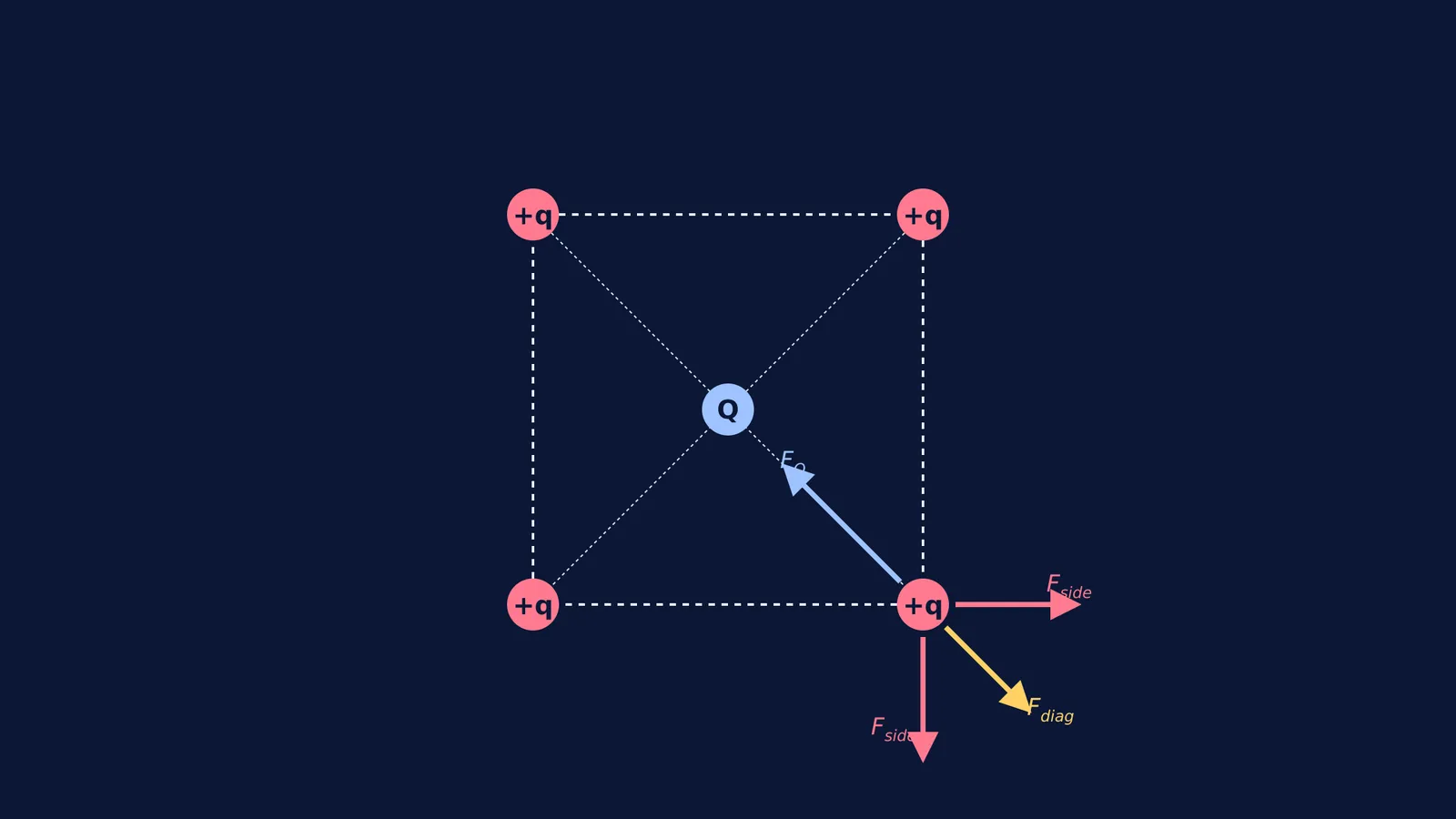
Imagine a square of side length a with a positive charge q at each corner. Let's isolate the charge at the bottom right. It feels a repulsive force from the three other charges: the one directly above it, the one directly to its left, and the one diagonally across from it.
By Coulomb's law, the force between any two charges is F = k q₁ q₂ / r².
For the two side charges, the distance is a. The force from the left charge pushes exactly to the right, and the force from the top charge pushes exactly downward. Each has a magnitude of F_side = k q² / a².
Because these two forces act at a 90° angle, you can find their resultant by using Pythagoras' theorem: F_resultant = √((k q² / a²)² + (k q² / a²)²) = √2 k q² / a²
This resultant force points precisely along the diagonal, directly away from the centre of the square.
How do you add the diagonal and side forces?
Now consider the third charge, sitting at the far top-left corner. The distance across the diagonal of a square is a√2.
Plugging this distance into Coulomb's law gives the diagonal force: F_diagonal = k q² / (a√2)² = k q² / 2a²
Because the side-force resultant and the diagonal force both point outward along the same line, you can simply add their magnitudes together to find the total net force: F_net = √2 k q² / a² + k q² / 2a² = (k q² / a²) × (√2 + 1/2) = (k q² / a²) × (1 + 2√2) / 2
If you find it difficult to picture how these forces stack up, bringing this problem to Fermi's AI tutor allows it to teach you through the geometry—drawing the figure and checking your understanding of vector addition as it goes.
What charge at the centre is needed for equilibrium?
To keep the square from flying apart, you must place a fifth charge Q at the exact centre of the square. This central charge must pull the corner charge inward with a force equal to F_net. Because it needs to attract the positive corner charges, Q must be negative.
The distance from the centre of the square to any corner is half the diagonal: r = (a√2) / 2 = a / √2.
The attractive force from this central charge is: F_Q = k q Q / (a / √2)² = 2 k q Q / a²
For equilibrium, the inward pull must match the outward push: 2 k q Q / a² = (k q² / a²) × (1 + 2√2) / 2
Cancel k / a² and one q from both sides: 2Q = q × (1 + 2√2) / 2 Q = q(1 + 2√2) / 4
Since the charge must be opposite in sign to attract the corners inward, the final answer is Q = −q(1 + 2√2) / 4.
What if the four corner charges are negative?
If the four charges at the corners of the square were all negative instead of positive, the calculation would look almost identical. Because like charges always repel each other, the force on any one corner would still push it directly outward. The net force F_net would have exactly the same magnitude, (k q² / a²) × (1 + 2√2) / 2.
To restore equilibrium in this scenario, the central charge Q would need to be positive to attract the negative corners inward. The required magnitude is unchanged, so the central charge would be +q(1 + 2√2) / 4. The key principle is that the central charge must always carry the opposite sign of the corner charges.
Is the central charge itself in equilibrium?
You might wonder if the central charge Q is stable. Because it sits exactly in the middle of a symmetrical square, the forces acting on it from the four corners perfectly cancel each other out. The top-left corner pulls it just as strongly as the bottom-right corner, and the top-right corner pulls it just as strongly as the bottom-left corner. Therefore, the net force on the central charge is strictly zero. The entire system—all four corners and the centre—remains in perfect equilibrium.
This vector-addition method applies to many electrostatics problems, whether you are calculating the work done to assemble point charges in a specific shape, finding where the potential is zero between two charges, or determining the forces on concentric spherical shells.


