

On this page
A classic problem in physics mechanics involves a block of mass m resting on a rough horizontal surface. You start pushing it, and your push gets stronger every second according to the formula F = kt. The question asks: when does it start moving, and what is its velocity after that?
This setup tests your understanding of friction's two phases. A 2021 review in *Physical Review Physics Education Research* explored possible misconceptions about solid friction (Kızılcık et al., 2021). The F = kt problem forces you to handle both phases correctly.
Here is how to set up the equations and find the block's motion step by step.
Force increasing with time on block: when does it start moving?
As long as the block is at rest, static friction (fs) simply grows to match your applied force. If you apply 2 Newtons, static friction is 2 Newtons. If you apply kt, static friction is kt.
But static friction has a strict upper limit: fs,max = μs N, where μs is the coefficient of static friction and N is the normal force (N = mg on a flat surface).
The block will stay put until your applied force exactly reaches this maximum limit. F = fs,max kt = μs mg
Solving for time, the block starts moving at: t₀ = μs mg / k
Before this time (t < t₀), the block's acceleration and velocity are both exactly zero.
What is its velocity after it starts sliding?
Once the block starts sliding (t > t₀), the opposing force is no longer static friction. It switches to kinetic friction, which remains constant: fk = μk mg.
Now there is a net force pushing the block forward: F_net = Applied Force - Kinetic Friction ma = kt - μk mg
Divide by mass to find the acceleration at any time t > t₀: a(t) = (k / m)t - μk g
Because the acceleration changes with time, you cannot use the standard kinematics equations like v = u + at. You must integrate the acceleration to find the velocity.
Since a = dv / dt, we write: dv = ((k / m)t - μk g) dt
Integrate both sides. The block starts from rest (v = 0) at the exact moment t = t₀.
v(t) = ∫ (from t₀ to t) ((k / m)τ - μk g) dτ
v(t) = [(k / 2m)τ² - μk g τ] evaluated from t₀ to t
v(t) = ((k / 2m)t² - μk g t) - ((k / 2m)t₀² - μk g t₀)
A worked example: what if F = 5t?
Let's put numbers to the letters. Suppose a 2 kg block rests on a floor where μs = 0.5 and μk = 0.4. We apply a force F = 5t (meaning k = 5 N/s). Take g = 10 m/s².
1. When does it start moving? First, find the maximum static friction: fs,max = μs mg = 0.5 × 2 × 10 = 10 N
The block moves when the applied force hits 10 N: 5t₀ = 10, which means t₀ = 2 seconds
2. What is its acceleration at t = 4 seconds? At 4 seconds, the block is already sliding. The constant kinetic friction is: fk = μk mg = 0.4 × 2 × 10 = 8 N
The applied force at 4 seconds is F = 5 × 4 = 20 N. The net force is 20 - 8 = 12 N. Acceleration a = F_net / m = 12 / 2 = 6 m/s².
3. What is its velocity at t = 4 seconds? We integrate the acceleration from t = 2 to t = 4. a(t) = (5t - 8) / 2 = 2.5t - 4
v(4) = ∫ (from 2 to 4) (2.5t - 4) dt v(4) = [1.25t² - 4t] evaluated from 2 to 4 v(4) = (1.25(16) - 16) - (1.25(4) - 8) v(4) = (20 - 16) - (5 - 8) = 4 - (-3) = 7 m/s
If you get stuck setting up the integral for problems like this, the Fermi Problem Library has worked problems with a step-by-step solver that explains the reasoning rather than printing an answer.
What do the graphs of this motion look like?
Examiners often ask you to identify the correct graph for this type of motion.
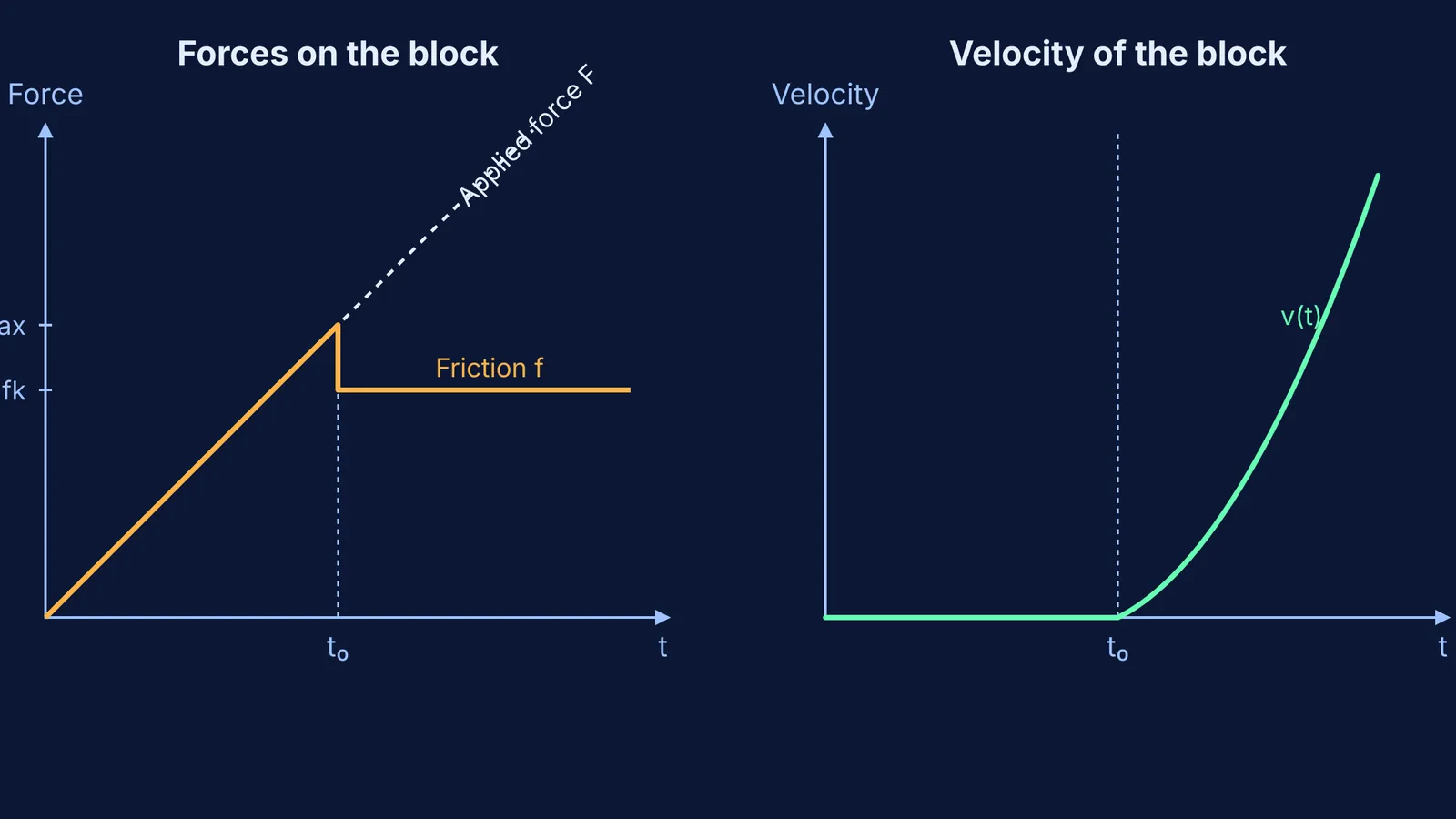
Friction vs time: It rises as a straight line from the origin (f = kt) until t₀. Then it drops vertically and stays perfectly flat horizontally at fk.
Acceleration vs time: It stays flat at zero until t₀. Then it jumps up to a positive value and continues as a straight line sloping upwards.
Velocity vs time: It stays perfectly flat at zero until t₀. After that, it curves upwards as a parabola, because integrating a linear acceleration gives a quadratic (t²) velocity.
Drawing these graphs out yourself is a great way to check that your equations make physical sense.
More on friction and mechanics
If you're revising mechanics, these related guides will help you handle friction in other standard setups:


