

On this page
If you are preparing for competitive exams like JEE Advanced or tackling classical electrodynamics, calculating the force between two halves of a charged spherical shell is a classic rite of passage. At first glance, finding the repulsive force pushing the two hemispheres apart looks like an exercise in heavy calculus. You might expect to set up a double integral of the electric field over the entire curved surface. However, you can bypass the complex mathematics entirely using two powerful concepts: electrostatic pressure and projected area.
What is electrostatic pressure?
When charges are distributed on the surface of a conducting shell, they naturally repel each other. This mutual repulsion creates an outward mechanical stress on every point of the surface. According to standard electromagnetic theory, this outward force per unit area on a conductor is numerically equal to the energy density of the electric field just outside it.
The electrostatic pressure P on a surface with a local charge density σ is defined as P = σ² / (2 ε₀), where ε₀ is the permittivity of free space (Wikipedia). Because the surface charge density term is squared in this formula, the resulting pressure is always positive. It always acts outwards along the normal vector to the surface, trying to expand the shell, regardless of whether the initial charge Q is positive or negative.
You can read more about how this pressure relates to stored potential energy in our guide on Energy density in an electric field: u = ε₀E²/2 worked.
How does projected area simplify the problem?
To find the total upward force acting on the top hemisphere, we only care about the vertical component of the electrostatic pressure. The horizontal components of the force vector at any point on the shell's surface point in opposite directions to the corresponding point on the other side. Due to the shell's perfect spherical symmetry, these horizontal forces completely cancel each other out.
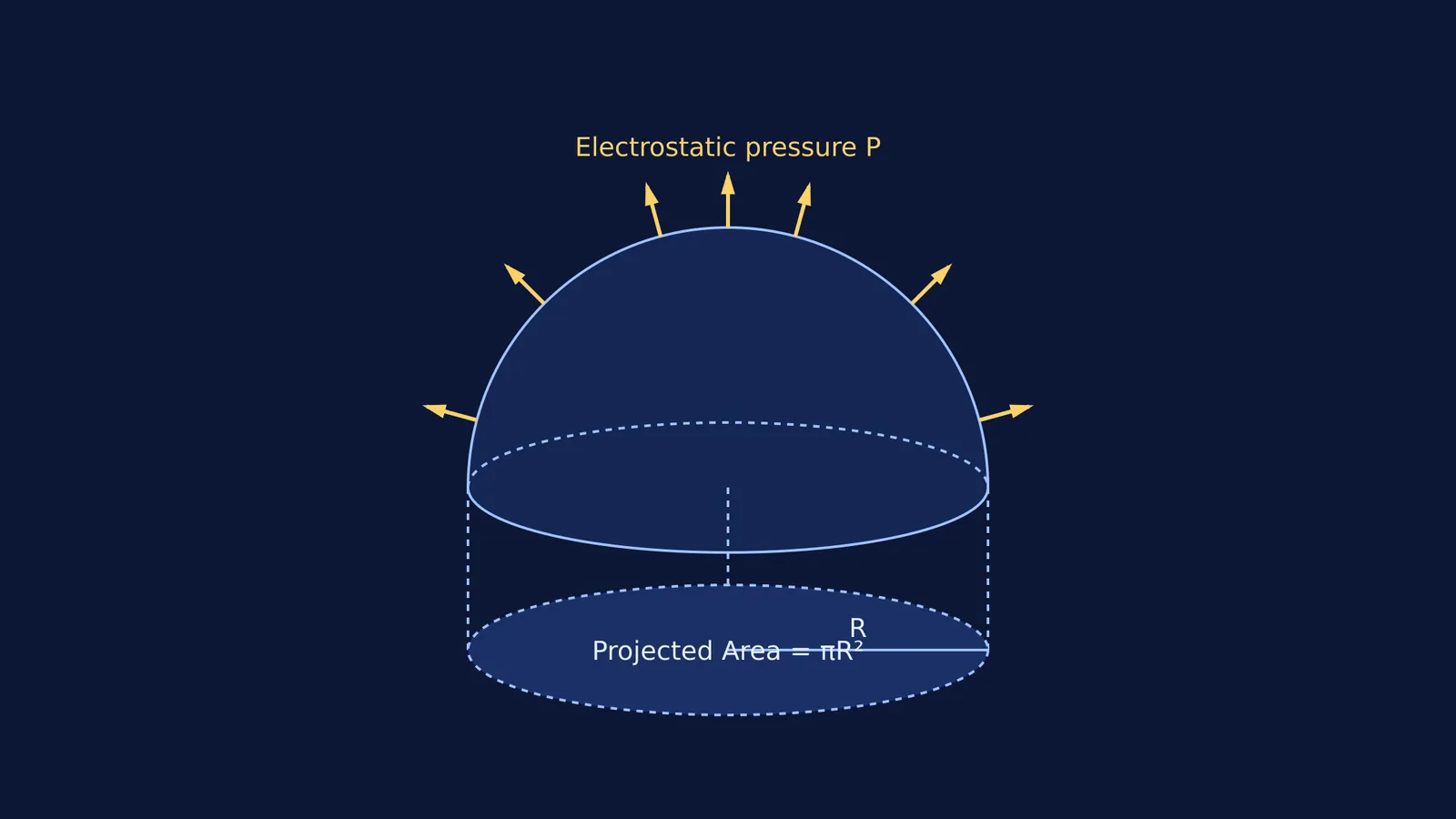
Instead of writing out the integral of P cos θ over the curved surface, you can use a geometric shortcut that is very common in fluid mechanics and physics. When a uniform pressure acts across a curved surface, the net force in a particular direction is simply the pressure multiplied by the object's projected area in that direction.
Think of the projected area as the two-dimensional shadow the object casts when light shines directly from above. For a hemisphere of radius R, the shadow it casts onto its flat equatorial base is a perfect circle. Thus, the projected area is simply π R².
What is the force between two halves of a charged spherical shell?
Now that we have both pieces of the puzzle, we can calculate the net repulsive force by multiplying the uniform electrostatic pressure by the circular projected area:
F = P × (Projected Area)
F = [σ² / (2 ε₀)] × (π R²)
We know that the total charge Q is spread uniformly over the entire surface area of the full spherical shell, which is 4 π R². Therefore, the uniform surface charge density σ is:
σ = Q / (4 π R²)
Substituting this density back into our original force equation gives:
F = [ (Q / 4 π R²)² / (2 ε₀) ] × (π R²)
Squaring the density fraction gives Q² / (16 π² R⁴). When we multiply the terms together, one π in the numerator cancels with one in the denominator, and the R² in the numerator cancels out two powers of R below. This yields the final, elegant result:
F = Q² / (32 π ε₀ R²)
This is the exact net force pushing the two hemispheres apart. The mathematical mechanics of this derivation share the same pairwise interaction logic you use when calculating the Work to assemble point charges: the pairwise kq₁q₂/r sum.
Where else can you apply this shortcut?
This technique is incredibly versatile. It applies to charged balloons, expanding soap bubbles, and even calculating the hydrostatic fluid pressure acting on curved dams. Recognizing when a symmetry shortcut applies is often the difference between a five-minute integration and a thirty-second solution on a timed exam.
If you want to build this specific intuition for your physics exams, you can practice similar electrodynamics problems in the Fermi Problem Library. Instead of just printing the final answer, Fermi's AI tutor explains the reasoning step by step, so you learn to spot these geometric shortcuts on your own. Mastering these core concepts will also help you analyze more complex related systems, such as Concentric spherical shells: charges, potentials and earthing one.
Next time you face a daunting surface integral involving uniform pressure, pause and visualize the geometry. Projecting the area onto a flat plane might just hand you the answer.


