

On this page
Suppose you are asked to find the number of words that begin and end with a vowel using the letters of "COMPUTE". It is a classic JEE Main permutations problem. A permutation is a bijective function of a finite set onto itself, amounting to rearranging its members into a sequence (Wikipedia). If you start this rearrangement by filling the middle five slots first, you will likely arrive at the wrong answer.
How do you count words that begin and end with a vowel?
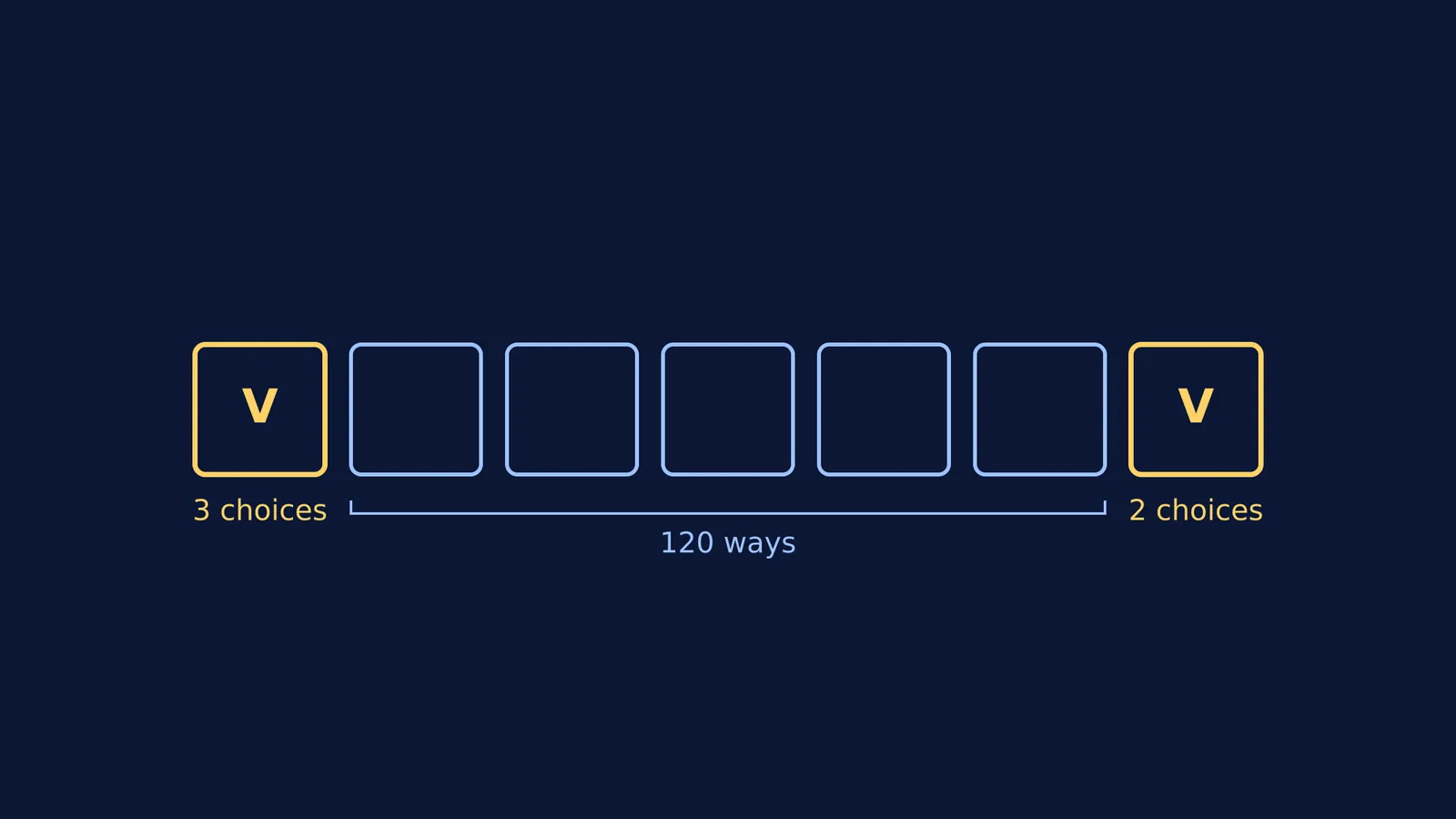
To get the correct number of arrangements, always fill the restricted positions first. In the word "COMPUTE", there are 7 letters in total: 3 vowels (O, U, E) and 4 consonants (C, M, P, T).
Because the first and last letters must be vowels, these two positions are restricted. The middle five positions are free for any of the remaining letters.
If you fill the two ends first, you are choosing 2 vowels out of the 3 available, and arranging them. This gives 3 × 2 = 6 ways to fill the ends.
Then, you have 5 letters left over (1 unused vowel and 4 consonants). These 5 letters can be arranged in the 5 middle slots in 5! = 120 ways.
Multiplying the choices together gives 6 × 120 = 720 total permutations.
Why does doing the free positions first give wrong counts?
What happens if you fill the middle first instead? You might reason: "There are 5 middle spots, and 7 letters. Let's put 5 letters there in 7 × 6 × 5 × 4 × 3 = 2,520 ways."
But then you reach the ends. You need two vowels for the ends. If your middle five letters happen to include all three vowels (O, U, E), you have zero vowels left for the ends, making it impossible to finish the word. If they include only two vowels, you have one left, which is still not enough.
The number of choices for the ends depends entirely on what you did in the middle. This breaks the fundamental principle of counting (the multiplication principle), which requires that the number of choices for a subsequent step remains the same regardless of which specific choice was made in the previous step.
By filling the restricted ends first, you ensure the condition is met and exactly 5 letters remain for the middle, no matter which vowels you chose. The middle slots have no special requirements, so any 5 leftover letters will work perfectly.
How do you arrange the letters of the word EQUATION?
Let us apply this logic to another common test word: "EQUATION". You want to find the number of arrangements that begin and end with a vowel.
First, identify the letters. There are 8 letters in total. The vowels are E, U, A, I, O (5 vowels). The consonants are Q, T, N (3 consonants).
Following the rule, you address the restricted ends first:
The first position: You can choose any of the 5 vowels.
The last position: You can choose any of the remaining 4 vowels.
This gives you 5 × 4 = 20 ways to set the ends.
Now you fill the free positions. You have placed 2 letters, leaving 6 letters (3 unused vowels and 3 consonants). These 6 letters can go into the 6 middle slots in 6! = 720 ways.
Finally, you multiply the independent steps together: 20 × 720 = 14,400 ways. If you had started with the middle 6 slots, you would have faced the exact same dependency trap you saw with "COMPUTE".
A framework for restricted arrangements
When a problem asks for arrangements with specific conditions, follow this three-step plan to avoid overcounting or running out of choices:
Identify the restrictions: Which positions must be filled by specific types of letters (like vowels, even numbers, or specific people)?
Fill the restricted slots: Calculate the number of ways to fill only those specific positions from the allowed pool.
Fill the free slots: Take all remaining items (including any unused items from the restricted pool) and arrange them in the remaining slots.
This systematic approach works whether you are arranging items so that no two are together or handling arrangements where certain letters must stay together.
If you are stuck on a case-splitting problem, the Fermi Problem Library has worked problems with a step-by-step solver that explains the reasoning rather than printing an answer. Working through the constraints one by one makes even the hardest combinatorics problems manageable.


