

On this page
When you study carbohydrate chemistry, you often need to translate an open-chain sugar into its ring form. A Fischer projection shows a sugar as a straight vertical chain, while a Haworth projection draws it as a flat ring viewed from a slight angle.
To bridge the gap between these two drawings, chemists use a consistent set of spatial rules, first introduced by Walter Haworth and the ring structures of sugars.
How to convert Fischer projection to Haworth projection?
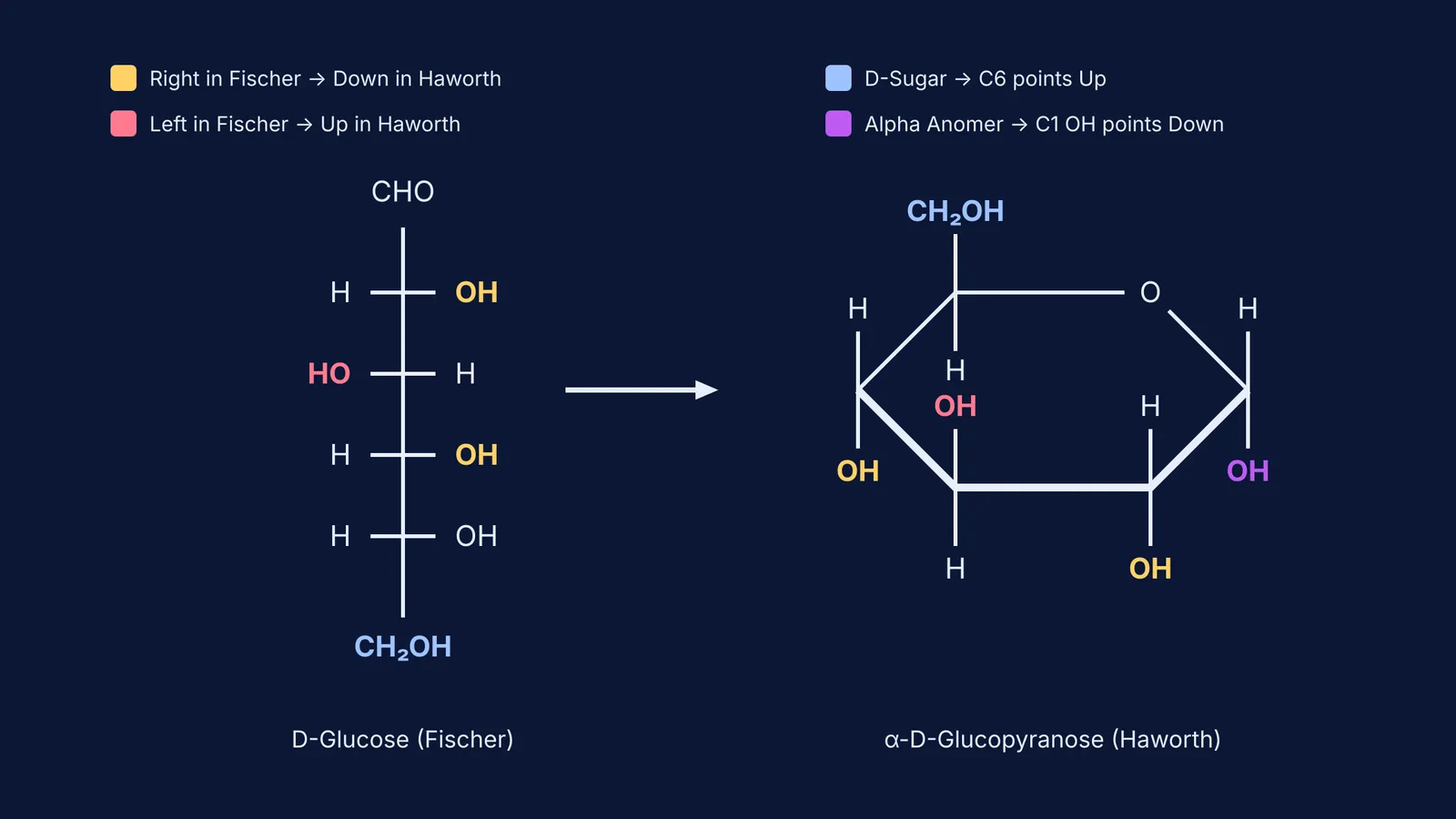
The transformation relies on the "right is down, left is up" rule. As the open-chain sugar folds into a ring, the groups attached to the chiral carbons (C2, C3, and C4 in a hexose) tilt into predictable positions.
Groups on the right in the Fischer projection point down in the Haworth projection.
Groups on the left in the Fischer projection point up in the Haworth projection.
For example, look at C3 in D-glucose. In the Fischer projection, its hydroxyl (–OH) group is on the left. In the Haworth projection, that same –OH group points straight up. At C2 and C4, the –OH groups are on the right, so they point down in the ring.
If you struggle to picture this rotation during an exam, the Fermi Concept Library maps out every concept in chemistry with its own lesson.
Where does the C6 group go?
The terminal carbon (usually C6) does not follow the standard right-down rule. When the molecule rotates around the C4–C5 bond to close the ring, its position becomes fixed by the sugar's overall D or L series.
Look at the highest-numbered chiral center (C5 in glucose):
If it is a D-sugar (the C5 –OH is on the right), the terminal –CH₂OH group points up in the Haworth projection.
If it is an L-sugar (the C5 –OH is on the left), the terminal –CH₂OH group points down.
Because most naturally occurring sugars are D-sugars, you will usually draw the C6 group pointing up.
Why does the straight chain fold into a ring?
The conversion from a Fischer projection to a Haworth projection is not just a drawing exercise; it represents a real chemical reaction happening in water. The open-chain form of a sugar contains both an alcohol (–OH) group and an aldehyde or ketone (carbonyl) group.
These two groups react with each other to form a cyclic hemiacetal. In D-glucose, the oxygen atom on the C5 hydroxyl group curves around to attack the C1 carbonyl carbon. This attack bends the straight carbon backbone into a cyclic shape. Because the C1 carbonyl carbon is flat (sp2 hybridized), the C5 oxygen can attack it from either the top face or the bottom face.
This two-sided attack is precisely why the ring closure creates two different anomers (alpha and beta) at the C1 position. The resulting six-membered ring containing oxygen is called a pyranose ring, named after the similar molecule pyran. Understanding this hemiacetal formation makes it much easier to see why the groups are locked into specific positions in the final Haworth projection.
How do you find the alpha or beta position at C1?
When the ring closes, the carbonyl carbon at C1 becomes a new chiral center, known as the anomeric carbon. The creation of this new center matters when counting stereoisomers from the number of chiral centres. The –OH group at C1 can lock into one of two positions, creating two distinct anomers.
To name the anomer, compare the C1 –OH group to the C6 group:
Alpha (α) anomer: The C1 –OH group is trans to the C6 group. For a standard D-sugar (where C6 is up), the alpha –OH points down.
Beta (β) anomer: The C1 –OH group is cis to the C6 group. For a standard D-sugar, the beta –OH points up.
Once you learn these three checks — the right/left groups, the D/L tail, and the alpha/beta anomeric carbon — drawing carbohydrate rings becomes mechanical. When sugars cycle back and forth through the open chain, their ability to open dictates their reactivity, which is the key to identifying reducing and non-reducing sugars. You can practice applying these drawing rules to other sugars like galactose or fructose in the Fermi Problem Library, a step-by-step solver that explains the reasoning.


