

On this page
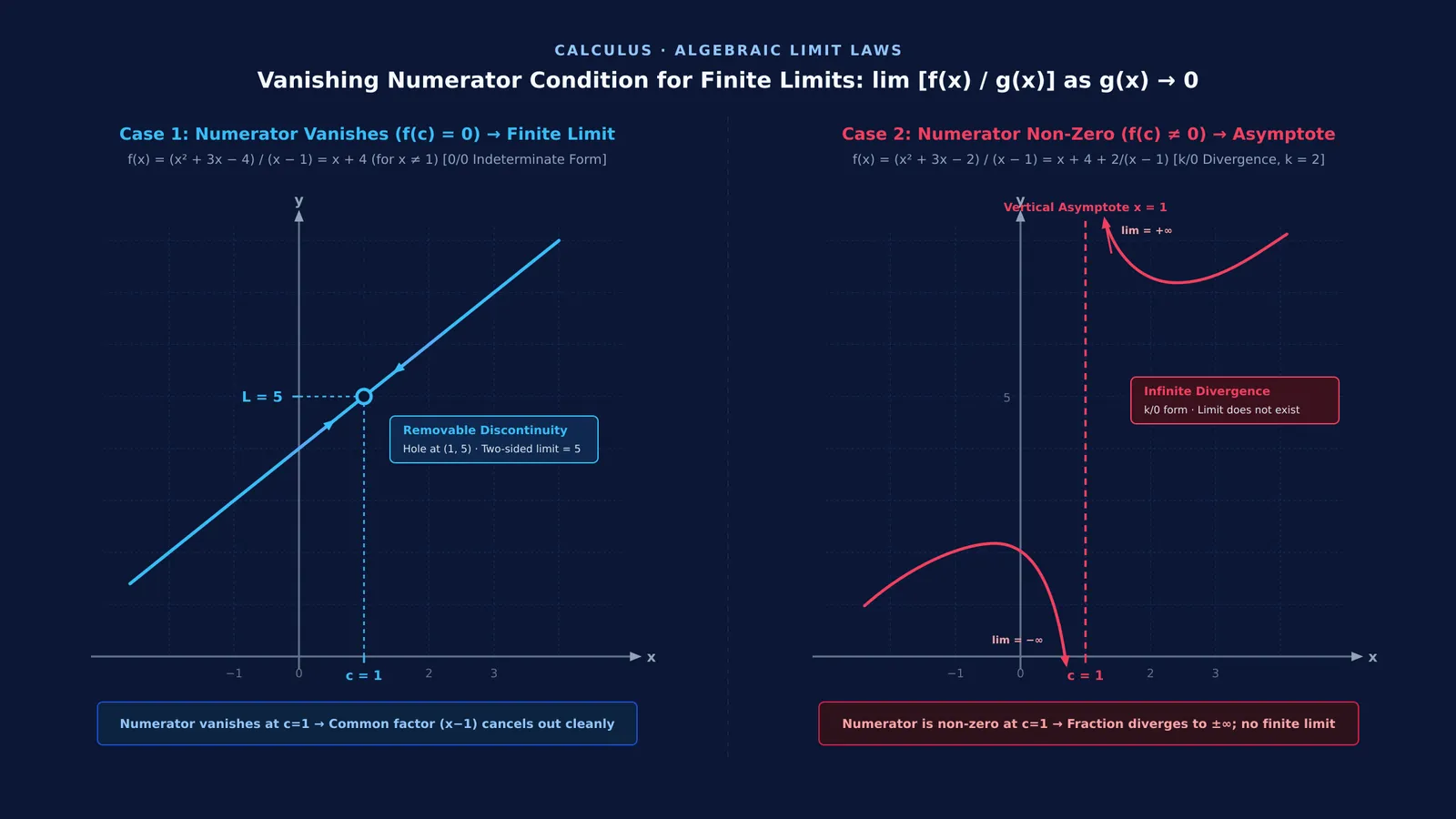
When calculus exams ask you to find unknown constants a and b such that a rational limit exists and is finite, many students feel stuck because the problem appears to give only one equation: the final value of the limit. However, whenever the denominator of a fraction approaches zero at the limit point, a second constraint is already hidden inside the problem. By applying the algebraic limit laws, you can force the numerator to vanish at that same point, establishing the first equation and turning a confusing puzzle into a straightforward linear system.
Why must the numerator approach zero if the denominator approaches zero?
Suppose you need to evaluate the limit of a quotient f(x) / g(x) as x approaches c, where the limit equals a finite real number L, and the denominator limit lim_{x → c} g(x) = 0. According to the Product Law of limits established in OpenStax Calculus Volume 1, the limit of a product equals the product of the individual limits whenever both limits exist:
lim_{x → c} f(x) = lim_{x → c} [ (f(x) / g(x)) × g(x) ] = (lim_{x → c} [f(x) / g(x)]) × (lim_{x → c} g(x)) = L × 0 = 0.
This mathematical identity proves that the numerator f(x) must approach zero as x approaches c. As explained in Wikipedia's guide to limits of functions, if the numerator approached any non-zero real number k ≠ 0 while the denominator approached zero, the fraction would take the form k / 0, which diverges to positive infinity, negative infinity, or fails to exist altogether due to conflicting one-sided limits.
Therefore, for the limit to remain finite, the expression must produce a 0/0 indeterminate form, as defined by Wolfram MathWorld. Forcing the numerator to vanish at x = c yields the first equation connecting the constants a and b.
How do you set up the two equations to find a and b?
Finding the constants follows an organized, four-step routine:
Confirm the denominator vanishes: Verify that substituting x = c makes the denominator equal to 0.
Force the numerator to vanish: Set the limit of the numerator as x approaches c equal to 0. For continuous expressions like polynomials, this means setting f(c) = 0. Solve this equation to express one constant in terms of the other, such as writing b in terms of a.
Eliminate the 0/0 indeterminacy: Substitute the expression for b back into the original limit. Because both numerator and denominator now evaluate to 0, cancel the common factor (x − c) through algebraic factoring, conjugate multiplication, or by applying Guillaume de l'Hôpital's 0/0 rule as detailed in Paul's Online Math Notes.
Equate to the finite limit value: Evaluate the simplified limit and set it equal to the given finite value L. This gives the second equation, which solves for a and immediately reveals b.
How do you solve for a and b in a worked example?
Consider a classic problem: find the real constants a and b such that lim_{x → 1} [ (x² + ax + b) / (x − 1) ] = 5.
First, check the denominator: as x → 1, the denominator x − 1 approaches 0. Because the overall limit is the finite number 5, the numerator must also approach 0 as x → 1. Setting 1² + a(1) + b = 0 gives 1 + a + b = 0, or b = −(a + 1). This is Equation 1.
Next, substitute b = −(a + 1) back into the numerator of the limit:
x² + ax − (a + 1) = (x² − 1) + a(x − 1) = (x − 1)(x + 1) + a(x − 1) = (x − 1)(x + a + 1).
Substitute this factored numerator back into the limit expression:
lim_{x → 1} [ (x − 1)(x + a + 1) / (x − 1) ].
For all x ≠ 1, the factor (x − 1) cancels out cleanly, leaving lim_{x → 1} (x + a + 1) = 1 + a + 1 = a + 2. Setting this evaluated limit equal to the target value 5 yields Equation 2: a + 2 = 5, which means a = 3.
Finally, substitute a = 3 back into Equation 1 to find b: b = −(3 + 1) = −4. To verify the result, substitute a = 3 and b = −4 into the original fraction: (x² + 3x − 4) / (x − 1) = (x − 1)(x + 4) / (x − 1) = x + 4, which approaches 1 + 4 = 5 as x → 1. Both equations are satisfied.
What if the denominator has higher powers of x?
In competitive examinations like the Joint Entrance Examination, problems frequently feature denominators with higher powers, such as x² or x³, often combined with trigonometric or exponential terms. In questions covered under limits and continuity for JEE and limits at infinity of rational functions, a single cancellation may not remove all vanishing factors from the denominator.
When using series expansions or repeated differentiation, every intermediate stage whose denominator tends to zero requires its numerator to vanish as well. Each vanishing stage provides an independent equation for the unknown coefficients until the lowest-order non-zero power in the numerator matches the power in the denominator.
Mastering multi-step calculus manipulations requires structured practice and immediate feedback when reasoning goes off track. The Fermi Problem Library offers worked problems with a step-by-step solver that explains the reasoning rather than printing an answer. To strengthen foundational theorems before tackling advanced limits, explore the Fermi Concept Library, which covers every concept in physics, chemistry, biology, mathematics and computing, each with its own lesson and its place in the map. When solving complex numericals, Fermi's AI tutor notices where a student is stuck, decides whether to explain, ask or show, and holds a line of reasoning across a session.


