

On this page
What does it mean for a function to have extrema?
An extremum is a point where a function reaches a local maximum or minimum. Think of it as the peak of a hill or the bottom of a valley on a graph. If a function is smooth and continuous, the slope of its tangent line at these peak and valley points is exactly zero. In the language of calculus, this means its first derivative, f'(x), equals zero.
According to mathematical history, Pierre de Fermat was one of the first mathematicians to propose a general technique, known as adequality, for finding the maxima and minima of functions (Wikipedia). His work laid the foundation for the derivative tests you use today.
When a test question asks you to "find a and b if a function has extrema at given points," you are simply working the standard derivative process in reverse. Instead of finding stationary points from a known function, you use them to deduce the missing coefficients.
How do you find a and b step by step?
To find the missing constants a and b, you need to build a system of equations. Here is the standard framework:
Find the first derivative: Differentiate the given function f(x) with respect to x to get the slope function, f'(x). Treat the unknown constants a and b just like ordinary numbers during the differentiation.
Substitute the given points: If the problem states that the function has extrema at x = x₁ and x = x₂, you know that the slope at these points must be zero. Set f'(x₁) = 0 and f'(x₂) = 0. Substitute the x values into your derivative.
Solve the equations: You will now have a pair of simultaneous linear equations written in terms of a and b. Solve them using substitution or elimination to find the values of the constants.
Classify the points (optional but recommended): Most questions also ask you to prove which point is the maximum and which is the minimum. Use the second derivative test by finding f''(x) and plugging in your x values. If f''(x) < 0, the point is a local maximum. If f''(x) > 0, the point is a local minimum.
If you are brushing up on calculus fundamentals, the Fermi Concept Library maps out every concept in mathematics, each with its own lesson and its place in the wider subject.
How does this work in a practical example?
Let's apply the framework to a typical exam problem involving a cubic polynomial.
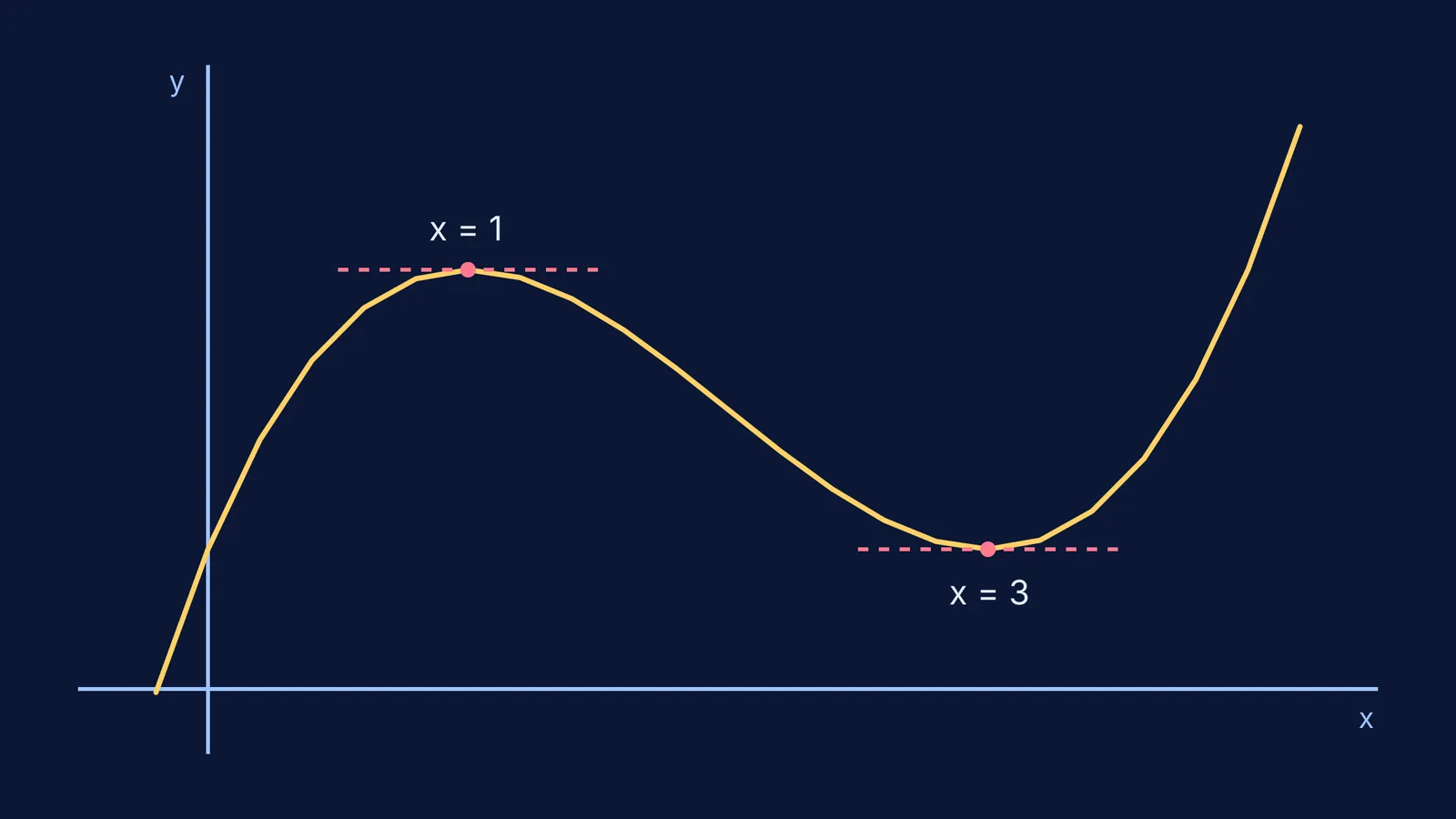
Problem: Find the constants a and b if the function f(x) = x³ + ax² + bx + 2 has extrema at x = 1 and x = 3. Then, determine which point is a local maximum and which is a local minimum.
Step 1: Differentiate the function The first derivative represents the slope of the curve at any point x. Using the power rule, differentiate f(x): f'(x) = 3x² + 2ax + b
Step 2: Set f'(x) = 0 at the given points Since you are told there is an extremum at x = 1, you know the derivative evaluated at 1 must be zero: 3(1)² + 2a(1) + b = 0 3 + 2a + b = 0 (Equation 1)
Since there is also an extremum at x = 3, the derivative evaluated at 3 must also be zero: 3(3)² + 2a(3) + b = 0 27 + 6a + b = 0 (Equation 2)
Step 3: Solve the simultaneous equations You now have two equations with two variables. You can solve them by subtracting Equation 1 from Equation 2 to eliminate b: (27 + 6a + b) - (3 + 2a + b) = 0 - 0 24 + 4a = 0 4a = -24 a = -6
Now, substitute a = -6 back into Equation 1 to find b: 3 + 2(-6) + b = 0 3 - 12 + b = 0 -9 + b = 0 b = 9
So, the unknown constants are a = -6 and b = 9. The full function is f(x) = x³ - 6x² + 9x + 2.
Step 4: Classify the points using the second derivative Now that you have the full function, you can check its second-order derivatives to see the curve's concavity at each stationary point. First, rewrite the first derivative with the known constants: f'(x) = 3x² - 12x + 9
Then differentiate it again: f''(x) = 6x - 12
Test the first extremum at x = 1: f''(1) = 6(1) - 12 = -6 Because the second derivative is negative, the curve is concave down, which means x = 1 is a local maximum.
Test the second extremum at x = 3: f''(3) = 6(3) - 12 = 6 Because the second derivative is positive, the curve is concave up, which means x = 3 is a local minimum.
Can this method be applied to other functions?
This algebraic method is highly versatile. It works for polynomials, exponential decay models, trigonometric functions, and even when you are differentiating parametric functions. As long as the function is differentiable at the given points, the core process of setting the derivative to zero remains exactly the same.
However, you should keep in mind that this technique only locates local extrema—the peaks and valleys within a specific neighbourhood on the graph. If a problem asks you to find the absolute maximum and minimum on a closed interval, you must also check the boundary endpoints of the given interval, because an absolute highest or lowest value can occur where the derivative is not zero.


