

On this page
Folding a filter paper takes seconds, but a cloudy filtrate usually comes from a small slip: a cone opened the wrong way, a dry paper, liquid over the edge, or a rush of solid. Here is the method from university chemistry lab guides.
How do you fold a filter paper into a cone?
The standard method is set out in the Harper College gravity filtration guide and in Oliver Seely's filter paper notes on LibreTexts:
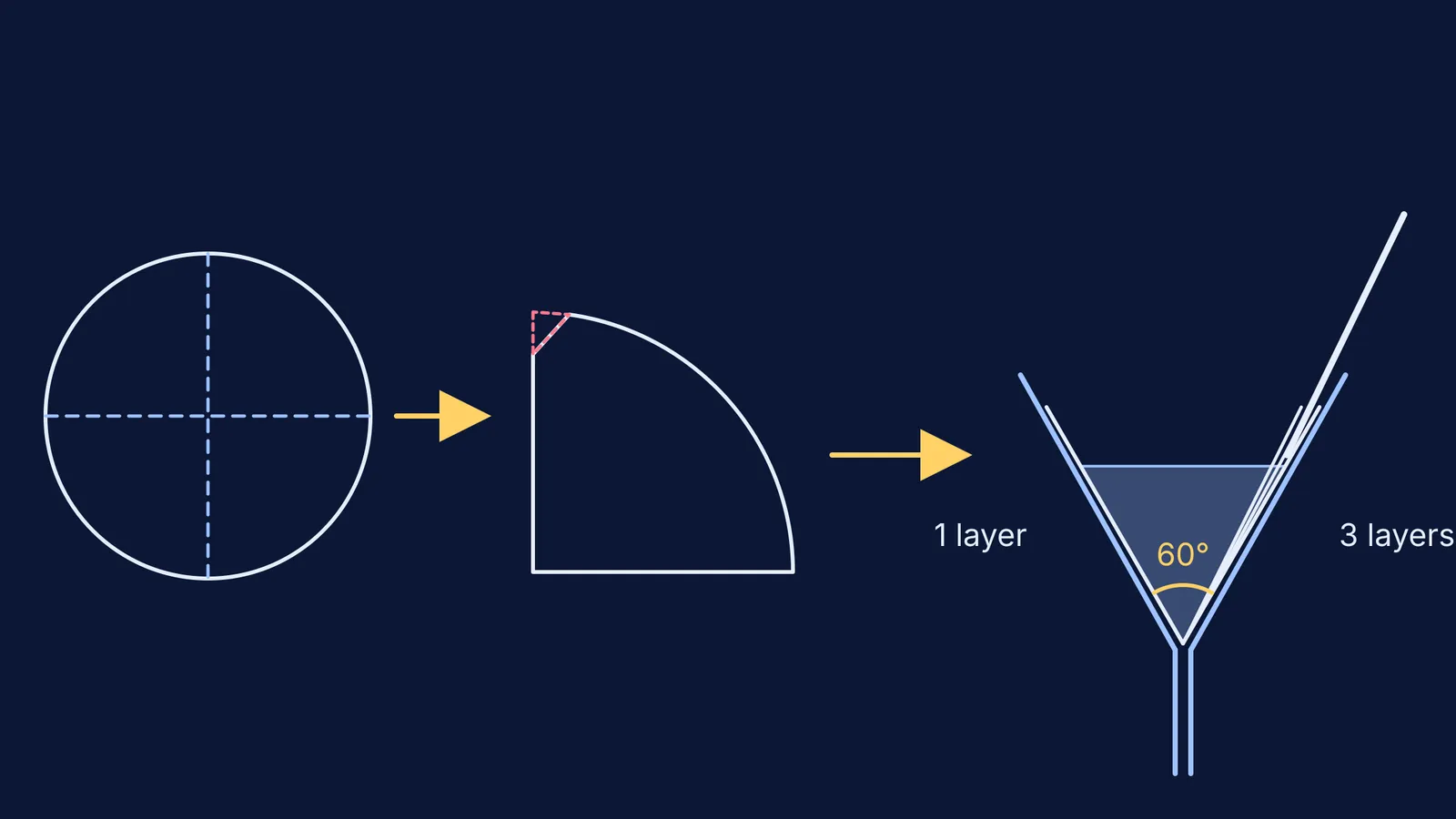
Fold the circle of paper in half and crease it.
Fold it again to make a quarter circle. Harper's guide says to leave an angle of 5 or 10 degrees between the two edges on this second fold, so one section is slightly smaller.
Tear the top corner off the smaller section. The Hope College filtration guide by Justin Shorb says tearing the corner lets the paper make a closed seal across the folded part.
Open the cone by separating one layer from the other three. Seely's notes stress one and three, "not two and two!"
Pick a paper size that sits a few millimetres below the rim of the funnel once folded, as the University of Colorado Boulder organic lab page advises.
Why one against three? Opened that way, the cone is made from half the circle: one layer on one side, three on the other. A semicircle rolled into a cone has a slant equal to the paper's radius and a base circumference half that of the original circle, so the base radius is half the slant and the tip angle works out to 60 degrees.
When should you use fluted filter paper instead?
A fluted filter is pleated back and forth like a fan. In the hot filtration chapter of Lisa Nichols's Organic Chemistry Lab Techniques/01:_General_Techniques/1.05:_Filtering_Methods/1.5E:_Hot_Filtration), fluted paper is used in place of the quadrant fold when a hot solution must pass through before it cools. Nichols explains that the extra bends add surface area for quicker filtration, and the folds leave space between paper and glass so displaced air can escape as liquid drains. The same chapter warns that crystals can form in the funnel stem, and recommends a short-stemmed or stemless funnel.
The Boulder page adds that fluted paper is often better with organic solvents. For sand from salt water at room temperature, the plain cone does the job.
Why do you wet the filter paper first?
A dry cone leaves gaps between paper and glass. The Boulder guide says to wet the paper with a few millilitres of the solvent you will use, because wetting "holds it in place against the glass funnel". Shorb's guide adds a step: press the top of the wet paper against the funnel all the way round to seal that space.
How do you pour using a glass rod?
Let the solid settle first. Nichols's gravity filtration page/01%3A_General_Techniques/1.05%3A_Filtering_Methods/1.5C%3A_Gravity_Filtration) says to pour as if decanting, keeping the solid in the flask as long as possible, because solid poured early can clog the paper's pores or slow filtration.
Hold a glass rod against the lip of the beaker and let the liquid run down it into the cone. Shorb's guide says the rod directs the flow and stops liquid running down the outside of the beaker when you pause.
Keep the level below the paper's edge. Shorb suggests keeping the paper about three-quarters full and never filling the cone completely, because many precipitates creep upward and may be lost. Harper's guide sets the limit at two-thirds of the funnel.
Rest the funnel's tip against the inside wall of the receiving beaker. Shorb says this prevents spattering and gives an unbroken stream.
Wash at the end. Rinse the beaker and rod with a little solvent into the funnel, then wash the solid with small portions, letting each drain, as Harper describes.
Which slips send solid through the filter?
Run this check whenever your filtrate comes out cloudy:
Liquid over the paper's rim. It runs between paper and glass, carrying fine solid. Pour in portions.
A torn or poked cone. Wet paper is weak, so use the rod to guide the pour rather than to stir inside the cone.
A dry or loose paper. Liquid finds the gaps. Wet it and press the rim.
The wrong opening. Refold a cone opened two and two so it opens one against three.
Pouring the slurry first. The paper clogs, the level rises and you overfill. Decant first.
Where does filtration fit in your syllabus?
Our explainer on mixtures and separation in Class 9 places filtration among separation methods, purifying organic compounds, from distillation to chromatography goes further, and salt analysis in the chemistry practical covers the practical exam. If the idea behind a separation is shaky, the Fermi Concept Library has a lesson for each chemistry concept, with its place in the map.


