

On this page
When you open a kitchen tap so a smooth column of water flows downward, the stream visibly tapers into a narrower thread as it descends.
This everyday observation is a direct consequence of the conservation of mass in fluid mechanics, formulated in the OpenStax University Physics curriculum as the equation of continuity. Water is practically incompressible under atmospheric conditions, so its density remains constant. Because no mass is added or lost between the tap nozzle and the sink, the volume of water exiting the tap per second must equal the volume passing through every cross section below.
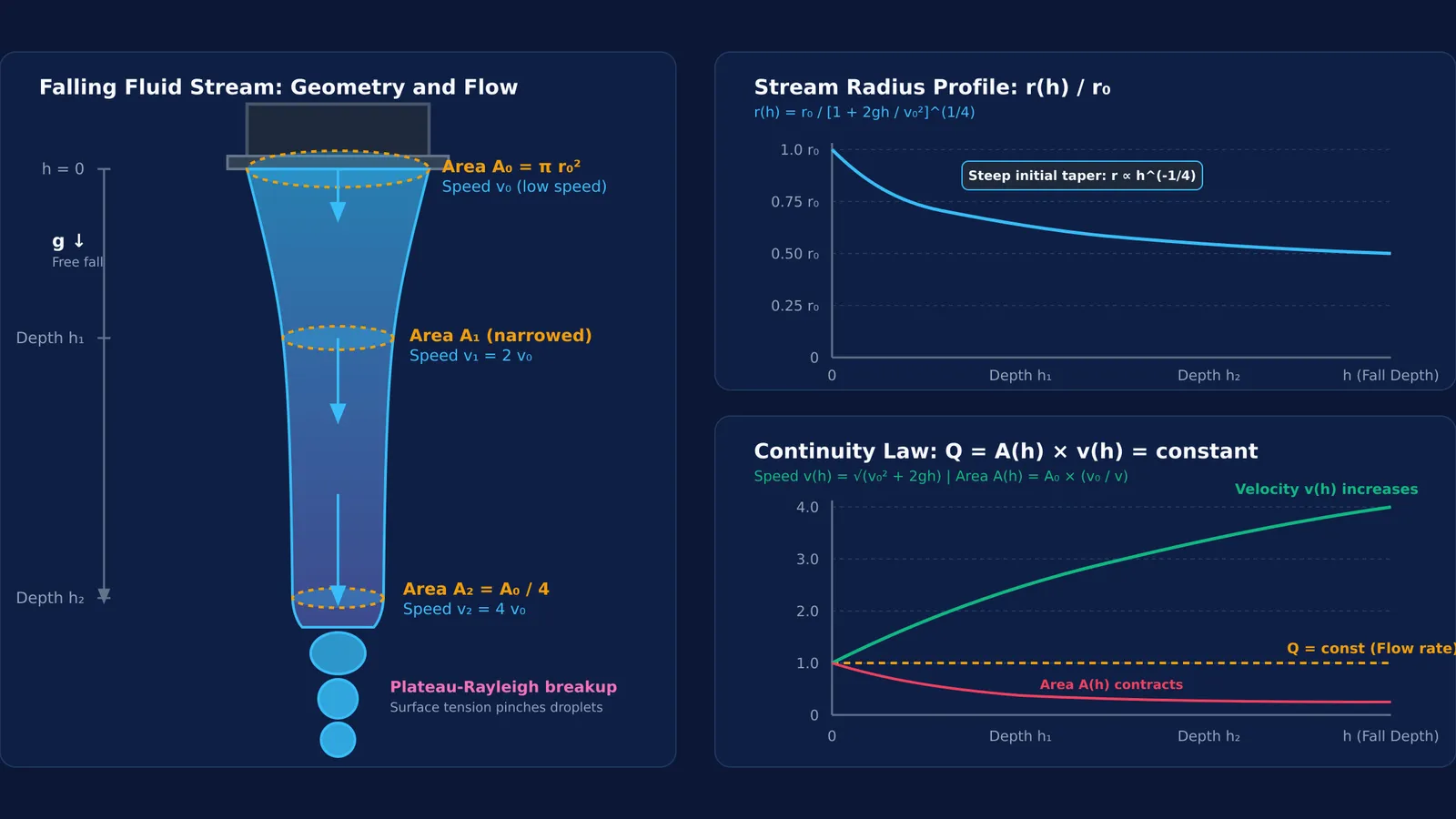
As gravity pulls the liquid downward, each packet of water accelerates in free fall. Because the downward velocity increases with depth, the stream's cross-sectional area must contract to keep total volume flow constant.
Why does tap water taper as it falls?
The narrowing occurs because water falls with increasing speed while maintaining uninterrupted continuity. If the stream did not contract as it sped up, successive parcels of water would separate from each other, leaving empty voids in the air.
Water molecules remain bound by cohesive forces, preserving a continuous, unbroken fluid column during laminar flow. Because the incoming mass per second from the faucet remains steady, any increase in speed must be matched by a corresponding decrease in the column's cross-sectional thickness.
How does the equation of continuity govern the flow?
In fluid dynamics, volume flow rate Q measures the volume of fluid crossing an area per unit time. For an incompressible fluid with cross-sectional area A and speed v, the flow rate is Q = A × v.
As outlined in Chapter 9 of the NCERT Class 11 Physics textbook, the equation of continuity states:
A₁ × v₁ = A₂ × v₂ = constant
Because the product A × v remains fixed along the steady stream, cross-sectional area is inversely proportional to speed: A ∝ 1/v. If downward speed doubles, the stream's cross-sectional area must halve. If speed quadruples, area contracts to one-fourth.
If you struggle to visualize how conservation laws translate into geometric constraints, the Fermi Concept Library covers every concept in physics, each with its own lesson and its place in the map.
How do you calculate the stream radius at depth h?
To derive the stream's profile, consider water issuing from a circular tap nozzle of radius r₀ with initial speed v₀.
Applying the conservation principles in OpenStax University Physics, let h be the vertical distance below the tap. In free fall under gravity g (approximately 9.8 m/s²), kinematics gives downward speed v:
v = √(v₀² + 2gh)
For a circular stream of radius r at depth h, the continuity equation gives:
π × r₀² × v₀ = π × r² × v
Solving for r yields:
r = r₀ × √(v₀ / v) = r₀ / [1 + (2gh / v₀²)]^(1/4)
Because the radius depends on the inverse fourth root of depth, the stream contracts rapidly over the first few centimetres, then narrows more gradually as velocity growth slows in percentage terms.
Worked example following the NCERT Class 11 Physics curriculum: water leaves a tap of radius r₀ = 5.0 mm at v₀ = 0.40 m/s. At depth h = 0.15 m, taking g = 9.8 m/s²:
Velocity at depth h: v = √[(0.40 m/s)² + 2 × (9.8 m/s²) × (0.15 m)] = √(3.10 m²/s²) ≈ 1.76 m/s.
Velocity ratio: v / v₀ = 1.76 / 0.40 = 4.4, meaning the stream moves 4.4 times faster.
Contracted radius: r = 5.0 mm / √4.4 ≈ 2.38 mm.
At just 15 cm below the tap, the radius shrinks by more than 52% to 2.38 mm, reducing the cross-sectional area by roughly 77%.
What happens when the stream falls further?
If water falls further into a deep sink, the stream does not narrow indefinitely into an infinitely fine filament.
Instead, the smooth column develops wave undulations, swells locally, and breaks into separate spherical droplets. In the *American Journal of Physics*, researchers Grubelnik and Marhl (2005) analyzed how a falling liquid stream transitions from smooth continuity narrowing to droplet breakup.
This transition is driven by the Plateau-Rayleigh instability. A cylinder of fluid has greater surface area than a series of equal-volume spheres. Once the stream becomes sufficiently slender, surface tension amplifies tiny surface perturbations, pinching the liquid necks into spherical drops. Furthermore, Massalha and Digilov (2013) in the *American Journal of Physics* demonstrated that incorporating interfacial energy and viscous losses into Bernoulli's equation refines the pure continuity profile right before breakup occurs.
How should students approach fluid continuity problems?
Fluid dynamics questions combining continuity and kinematics appear regularly in exams like JEE Main, JEE Advanced, and NEET, following the syllabus in the NCERT Class 11 Physics curriculum.
Follow this systematic checklist when tackling continuity problems:
Confirm incompressibility: check that fluid density is constant so mass conservation simplifies to A₁ × v₁ = A₂ × v₂.
Distinguish flow rate from speed: remember that volume flow rate Q in m³/s remains constant throughout the stream, while speed v changes.
Track quadratic area scaling: because area scales with radius squared (A = π × r²), a speed increase by factor k reduces radius by 1/√k, not 1/k.
Establish coordinates cleanly: set the tap outlet as origin and verify whether exit speed v₀ is non-zero, avoiding false divergence at h = 0.
When you face multi-step mechanics questions that connect fluid motion with energy conservation, the Fermi Problem Library provides worked problems with a step-by-step solver that explains the reasoning rather than printing an answer.


