

On this page
Expanding a determinant full of algebraic terms like a, b and c often results in a massive polynomial that is hard to simplify. Instead of doing the raw algebra and collecting dozens of terms, you can use the factor theorem to dramatically speed up the process. By checking exactly when the determinant vanishes, you can find its algebraic factors one by one.
What is the factor theorem for determinants?
The factor theorem states that if a polynomial evaluates to zero when you substitute x = a, then (x - a) is a guaranteed factor of that polynomial.
Because expanding a matrix determinant produces a polynomial with integer coefficients, the factor theorem applies directly to it (Wikipedia). If replacing one variable with another (for instance, setting a = b) makes the determinant evaluate to zero, then (a - b) must be a factor of the final expanded polynomial.
Why does the determinant become zero in the first place? If you substitute a = b and the matrix ends up with two identical rows or two identical columns, its determinant is guaranteed to be zero due to basic matrix properties.
How do you prove a cyclic determinant equals (a-b)(b-c)(c-a)?
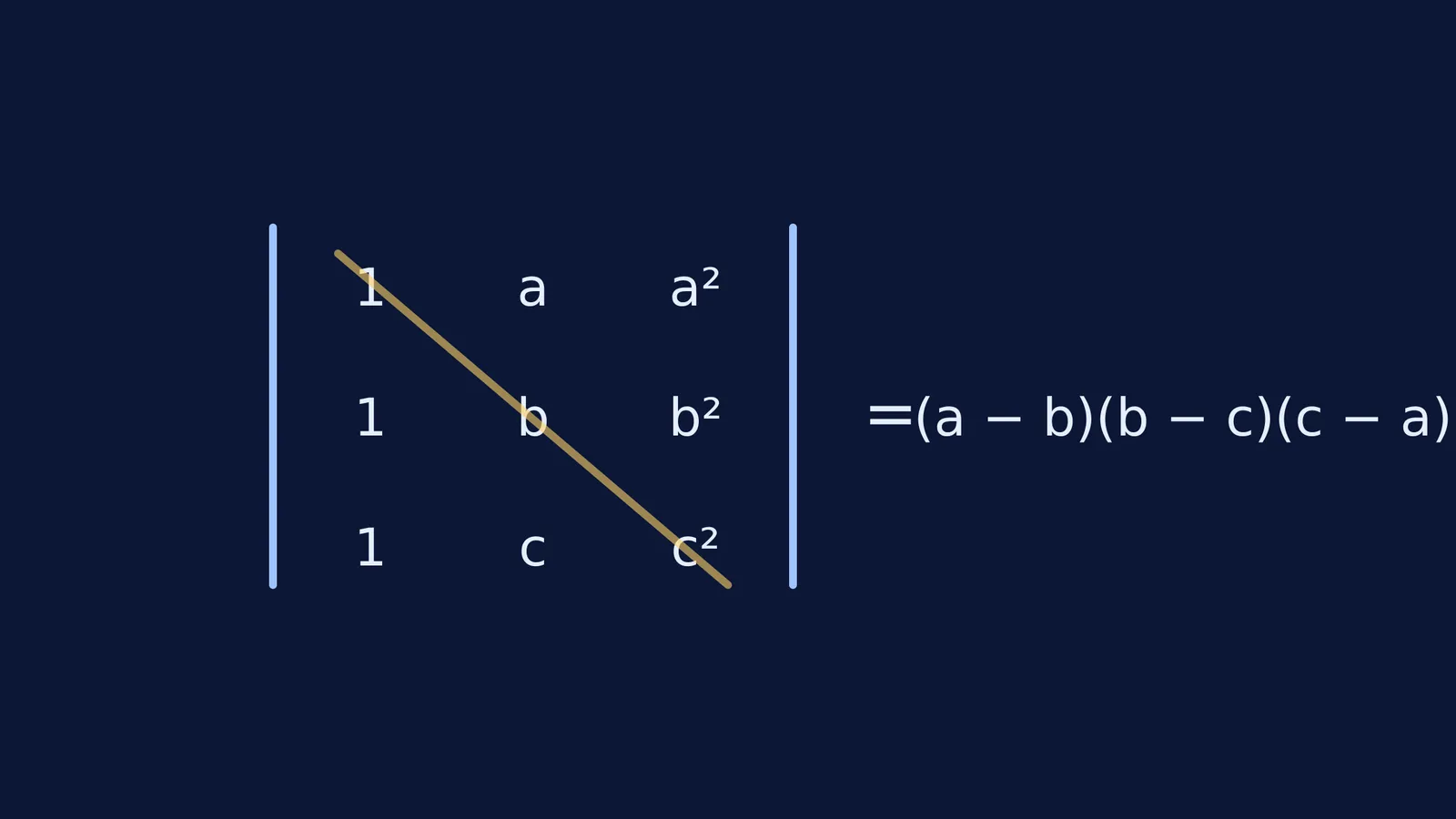
A classic problem asks you to evaluate the 3×3 Vandermonde determinant, which appears frequently in competitive exams:
| 1 a a² | | 1 b b² | | 1 c c² |
1. Find the factors If we substitute a = b, the first row (1, b, b²) and the second row (1, b, b²) become identical. Because a matrix with two identical rows always has a determinant of zero, we confidently know that (a - b) is a factor of the determinant.
By applying the exact same cyclic logic to the other variables:
Setting b = c makes the second and third rows identical, so (b - c) is another factor.
Setting c = a makes the third and first rows identical, so (c - a) is the third factor.
2. Compare the degrees We have identified the product (a - b)(b - c)(c - a) as a factor. If we expand this product, we get a polynomial of degree 3, since multiplying a × b × c yields a combined power of 3.
Now look at the main diagonal of the original matrix. The product of its entries is 1 × b × c² = bc². The degree of this leading diagonal term is 1 + 2 = 3.
Because the degree of the determinant (3) matches the combined degree of our found factors (3), the determinant can only differ from our product by a constant numerical multiplier, which we will call k: Determinant = k(a - b)(b - c)(c - a)
How do you find the missing constant?
To find the exact value of k, you simply compare a specific term on both sides of the equation.
The product of the leading diagonal in the matrix expansion yields +bc².
If we expand our factored expression k(a - b)(b - c)(c - a), we need to carefully locate the term with bc². Expanding (b - c)(c - a) gives bc - ab - c² + ac. Multiplying that result by (a - b), the bc² term comes entirely from multiplying -b by -c², which gives a coefficient of +1.
Since the coefficient of bc² is +1 on both sides of the equation, the constant k must be exactly 1. Therefore: Determinant = (a - b)(b - c)(c - a)
If you want to trace how polynomial degrees match matrix expansions on a deeper level, the Fermi Problem Library has worked problems with a step-by-step solver that explains the reasoning rather than printing an answer.
What if the polynomial degrees do not match?
Sometimes you evaluate a 4th-degree determinant but only find three cyclic factors. If the degree of the determinant's leading diagonal is 4, but your factors (a - b)(b - c)(c - a) only add up to a degree of 3, the missing factor is not just a constant. Instead, the remaining factor must be a symmetric linear polynomial, which is usually written as k(a + b + c). You can then find the value of k by substituting simple numbers like a = 0, b = 1, and c = 2 into both sides.
To see how cyclic symmetry applies across different branches of algebra, you can explore the Concept Library, which contains every concept in physics, chemistry, biology, mathematics and computing, each with its own lesson and its place in the map.


