

On this page
When facing a fractional integrand, many students reach for lengthy partial fractions or integration by parts. Yet many problems collapse into one line when the numerator is the exact derivative of the denominator: the integral yields the natural logarithm of the denominator.
What is the integral of f dash x by f x?
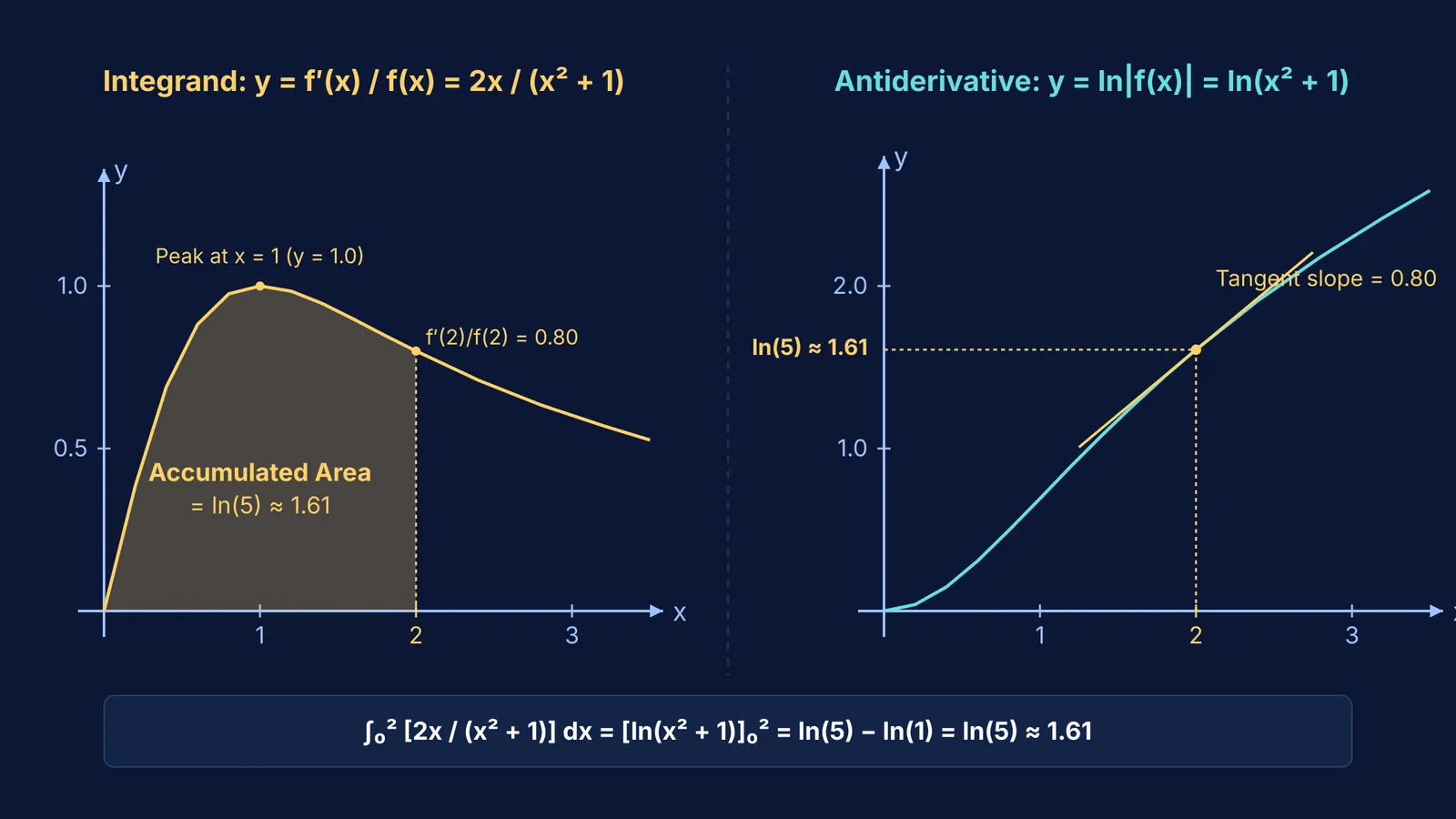
The integral of f′(x) / f(x) evaluates directly to the natural logarithm of the absolute value of the denominator:
∫ [f′(x) / f(x)] dx = ln|f(x)| + C
This identity reverses the chain rule. Differentiating y = ln|f(x)| with respect to x gives (1 / f(x)) × f′(x) = f′(x) / f(x). In competitive examinations governed by the National Testing Agency and standard syllabi in OpenStax Calculus, recognizing this quotient structure is taught as the foundation of integration by substitution.
How do you spot the hidden pattern in 1/(x ln x)?
Textbooks rarely display f′(x) directly over f(x). Instead, examiners disguise the derivative inside algebraic products, as in the classic integral ∫ [1 / (x ln x)] dx.
The denominator appears to be a product of x and ln x, but dividing both numerator and denominator by x exposes the structure:
Rewrite the fraction:
1 / (x ln x) = (1 / x) / ln x
Identify the derivative:
Set f(x) = ln x. Its derivative is f′(x) = 1 / x, matching the numerator.
Evaluate directly:
∫ [1 / (x ln x)] dx = ∫ [(1 / x) / ln x] dx = ln|ln x| + C
In a 1983 study in *Educational Studies in Mathematics* (DOI: 10.1007/BF00704699), researcher A. Orton analyzed calculus comprehension across 110 students aged 16 to 22. Orton observed that while students memorize integration routines, they frequently stumble when intermediate algebraic restructuring is needed to match a standard form. When an integral seems opaque, the Fermi Problem Library provides worked problems with a step-by-step solver that explains the reasoning rather than printing an answer, making structural rearrangements visible before calculations begin.
How do you integrate 1/(1 + eˣ) by dividing by eˣ?
Another disguised derivative appears in exponential fractions like ∫ [1 / (1 + eˣ)] dx. Differentiating the denominator gives eˣ, but the numerator contains only 1. Dividing numerator and denominator by eˣ reveals the pattern:
Divide top and bottom by eˣ (or multiply by e⁻ˣ):
1 / (1 + eˣ) = e⁻ˣ / (e⁻ˣ + 1)
Identify the derivative:
Let g(x) = 1 + e⁻ˣ, so g′(x) = −e⁻ˣ.
Account for the negative sign:
Because the numerator is e⁻ˣ = −g′(x), inserting −1 inside and outside yields: ∫ [1 / (1 + eˣ)] dx = − ∫ [−e⁻ˣ / (1 + e⁻ˣ)] dx = −ln(1 + e⁻ˣ) + C
Because 1 + e⁻ˣ > 0 for all real x, you can drop the absolute value bars. In positive exponents, −ln(1 + e⁻ˣ) = −ln((eˣ + 1) / eˣ) = x − ln(1 + eˣ) + C. When solving definite integrals of this form, applying u-substitution with bounds lets you convert limits directly and skip algebraic back-substitution.
Why does structural pattern recognition beat rote substitution in exams?
In timed tests like JEE Main and CBSE board exams, writing out repetitive substitutions wastes critical minutes. Under the CBSE Class 12 Mathematics curriculum, Unit III (Calculus) accounts for 35 out of 80 marks in the theory paper—more than 43% of the total. Writing out u = f(x) and back-substituting for standard logarithmic forms wastes time needed for multi-step problems.
Spotting mathematical structures is active learning in practice. A landmark 2014 meta-analysis by Scott Freeman and colleagues in *Proceedings of the National Academy of Sciences* (DOI: 10.1073/pnas.1319030111) examined 225 STEM studies, finding that failure rates under traditional lecturing increased by 55% over active learning (33.8% compared to 21.8%). Categorizing the structure of an expression before writing mirrors recognizing [integrals of the form eˣ[f(x) + f′(x)]](https://news.fermi.ai/academic-success/integrals-ex-f-plus-f-prime), where spotting the product derivative resolves the problem in seconds.
For students mapping calculus prerequisites across functions, derivatives, and anti-derivatives, the Fermi Concept Library covers every concept in physics, chemistry, biology, mathematics and computing, each with its own lesson and its place in the map.
What is the 3-step checklist for spotting logarithmic integrals?
Before applying lengthy methods to any fraction, run through this three-point inspection:
Test the direct derivative:
Differentiate the denominator. If it equals the numerator, or scales by a constant k, the integral evaluates to (1 / k) ln|denominator| + C.
Test reciprocal division:
If the denominator contains products or exponentials like x ln x or 1 + eˣ, divide numerator and denominator by the dominant term (x or eˣ) to check whether the new numerator mirrors the denominator's derivative.
Check sign and domain:
Account for negative signs from exponential terms and confirm whether the denominator requires absolute value bars or remains strictly positive for all real x.


