

On this page
When you study vectors in mathematics and physics, you often need to break a vector down into parts. Rather than just using standard x and y axes, you might need to express it using a different set of directions.
What is a linear combination of vectors?
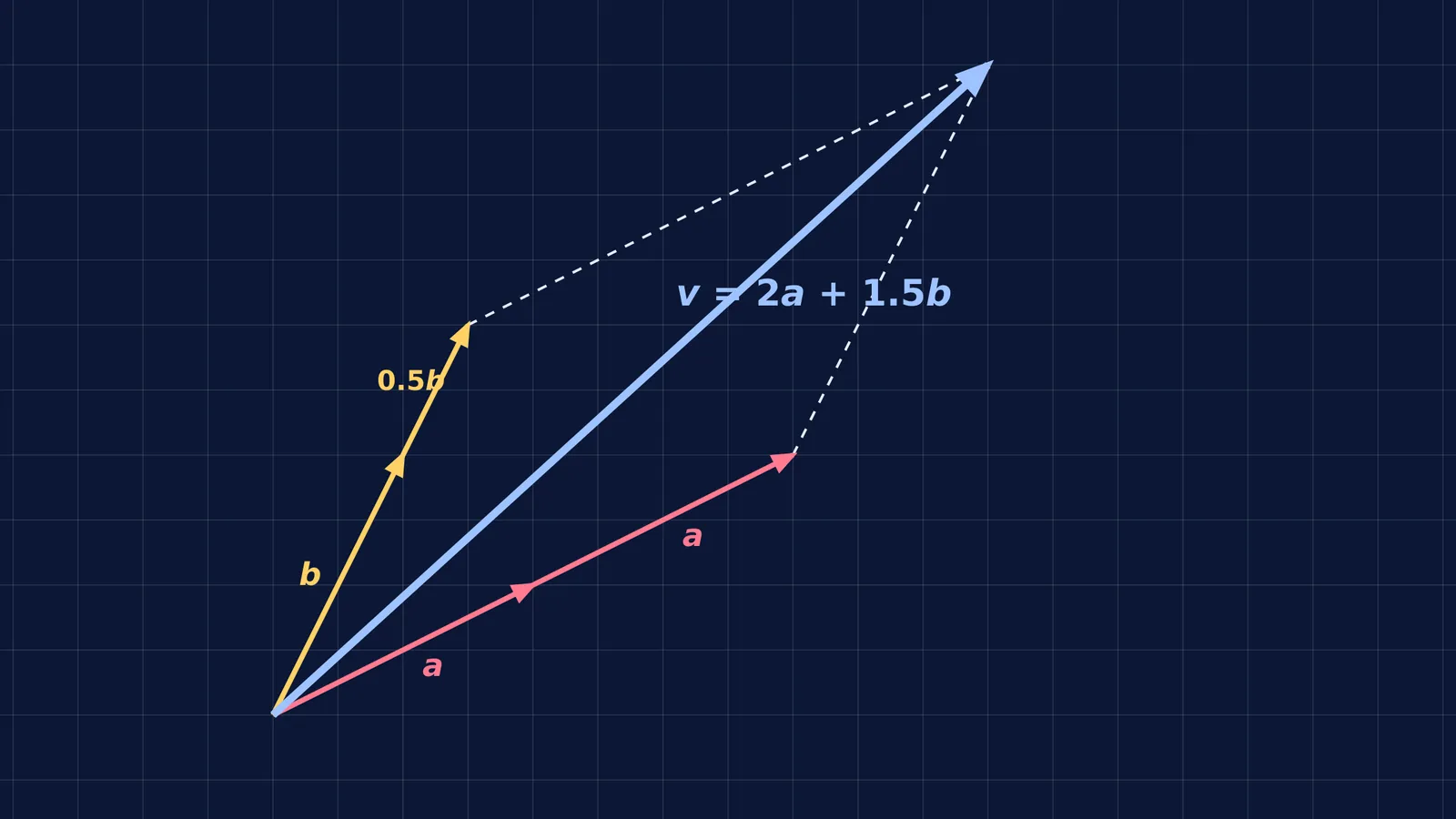
In mathematics, a linear combination is an expression constructed from a set of terms by multiplying each term by a constant and adding the results (Wikipedia). For vectors, this means scaling two or more vectors by some numbers (called coefficients or scalars) and adding them together to form a new vector.
If you have two vectors, a and b, any vector v that can be written in the form v = xa + yb (where x and y are numbers) is a linear combination of a and b. To find the unknown scalars x and y, you equate the components of the vectors and solve the resulting simultaneous equations. If you want to explore the structure of vector spaces, the Fermi Concept Library maps out how these ideas connect.
How do you express a 2D vector as a linear combination?
In two dimensions, you can express any vector as a linear combination of two non-parallel vectors.
Suppose you want to express the vector v = (9, 8) as a linear combination of a = (2, 1) and b = (−1, 3).
Set up the equation by letting v = xa + yb.
Expand into components: (9, 8) = x(2, 1) + y(−1, 3).
Distribute the scalars: (9, 8) = (2x, x) + (−y, 3y).
Combine the right side: (9, 8) = (2x − y, x + 3y).
Equating the x and y components gives you a system of two equations: 2x − y = 9 x + 3y = 8
To solve this system, you can multiply the second equation by 2 to get 2x + 6y = 16. Subtracting the first equation from this new equation eliminates x: (2x + 6y) − (2x − y) = 16 − 9 7y = 7 y = 1
Substitute y = 1 back into the second equation: x + 3(1) = 8 x = 5
The solution is x = 5 and y = 1, so the linear combination is v = 5a + b.
Can you express a 3D vector as a linear combination of two vectors?
You can set up the same equations for 3D vectors, but a linear combination of two vectors always lies in the plane spanned by those two vectors. Therefore, you can only express a 3D vector as a combination of two others if all three vectors are coplanar.
Let's test if v = (2, 3, 5) is a linear combination of a = (1, 0, 1) and b = (0, 1, 1).
Set up the equation: (2, 3, 5) = x(1, 0, 1) + y(0, 1, 1)
Equate the x-components: x = 2
Equate the y-components: y = 3
Equate the z-components: x + y = 5
The first two equations immediately give x = 2 and y = 3. Substitute these into the third equation to check for consistency: 2 + 3 = 5. Since the third equation is satisfied, the system is consistent.
The vector can be expressed as v = 2a + 3b. If the z-component of v had been anything other than 5, the third equation would fail, meaning v does not lie in the same plane as a and b. When working with points rather than pure vectors, you can use similar logic to test if they lie on the same line; see Collinear points with vectors: the position vector test for how that works, or apply the Section formula in 3D: dividing a segment internally and externally when finding points along those lines.
What is the general method for any dimensions?
Whenever you face a linear combination problem, follow this reliable sequence:
Write the vector equation v = c₁v₁ + c₂v₂.
Expand the vectors into their individual directional components.
Group the components to form a system of simultaneous equations (one equation for each dimension).
Solve the system using substitution or elimination.
Verify that your solution satisfies every equation in the system.
If the system has no solution, the vector cannot be formed from the given set. If you get stuck balancing equations or checking consistency, the step-by-step solver in the Fermi Problem Library explains the reasoning behind each algebraic move instead of just printing the final answer.


