

On this page
Calculus is full of patterns, but applying a pattern to the wrong type of function is a trap that catches many students. When differentiating x², the result is a neat 2x. But when faced with 2ˣ, students often apply the same rule and write x 2ˣ⁻¹ (or x times 2 to the power of x-1).
This is incorrect. The mathematical rules for differentiating power functions (where the base varies) and exponential functions (where the exponent varies) are completely different. Differentiating an exponential function requires understanding its unique rate of growth, which is deeply tied to the natural logarithm.
What is the derivative of x²?
The function y = x² is a power function. The variable (x) is in the base, and the exponent (2) is a constant.
To find its rate of change, you use the power rule. According to the rule, if f(x) = x^r for any real number r, the derivative is f'(x) = r x^(r-1) (source: https://en.wikipedia.org/wiki/Power_rule).
Applying this rule to x² is straightforward:
Bring the constant exponent (2) down to the front.
Subtract 1 from the exponent to get the new power (2 - 1 = 1).
The resulting derivative is 2x.
This rule works for any constant power. It applies to x³, x⁴, and even x to the power of 1/2 (which represents the square root of x). The mathematical foundation of this rule relies on the fact that the exponent is a fixed, unchanging number. You cannot apply this rule when the exponent itself is a changing variable.
What is the derivative of 2ˣ?
The function y = 2ˣ is an exponential function. Here, the roles are reversed: the base (2) is a fixed constant, and the variable (x) is located in the exponent.
Exponential functions grow in a fundamentally different way compared to power functions. Their rate of growth is always proportional to the function's own current value. For any exponential function of the form bˣ, where b is a positive constant, the derivative is given by the formula bˣ ln b (source: https://en.wikipedia.org/wiki/Exponential_function).
Applying this exponential rule to 2ˣ:
The derivative is 2ˣ ln 2.
Here, ln 2 represents the natural logarithm of 2, which is approximately 0.693. This means that the slope of the curve y = 2ˣ at any given point x is exactly ln 2 times the value of 2ˣ at that point. Because the base is constant and the exponent changes, the derivative scales with the function itself.
What is the derivative of logₐ x?
While discussing exponential functions, it is helpful to look at their inverses: logarithmic functions. They also follow a unique set of rules that students must memorise. The derivative of the natural logarithm ln x (which is logarithm base e) is simply 1/x.
For a general base a, the derivative of logₐ x is 1 / (x ln a). Notice that the constant factor ln a appears in the denominator, just as it appears as a multiplier in the derivative of the exponential function aˣ. This beautiful symmetry is a direct result of the inverse relationship between exponents and logarithms.
Why do students confuse the derivative of 2 power x vs x power 2?
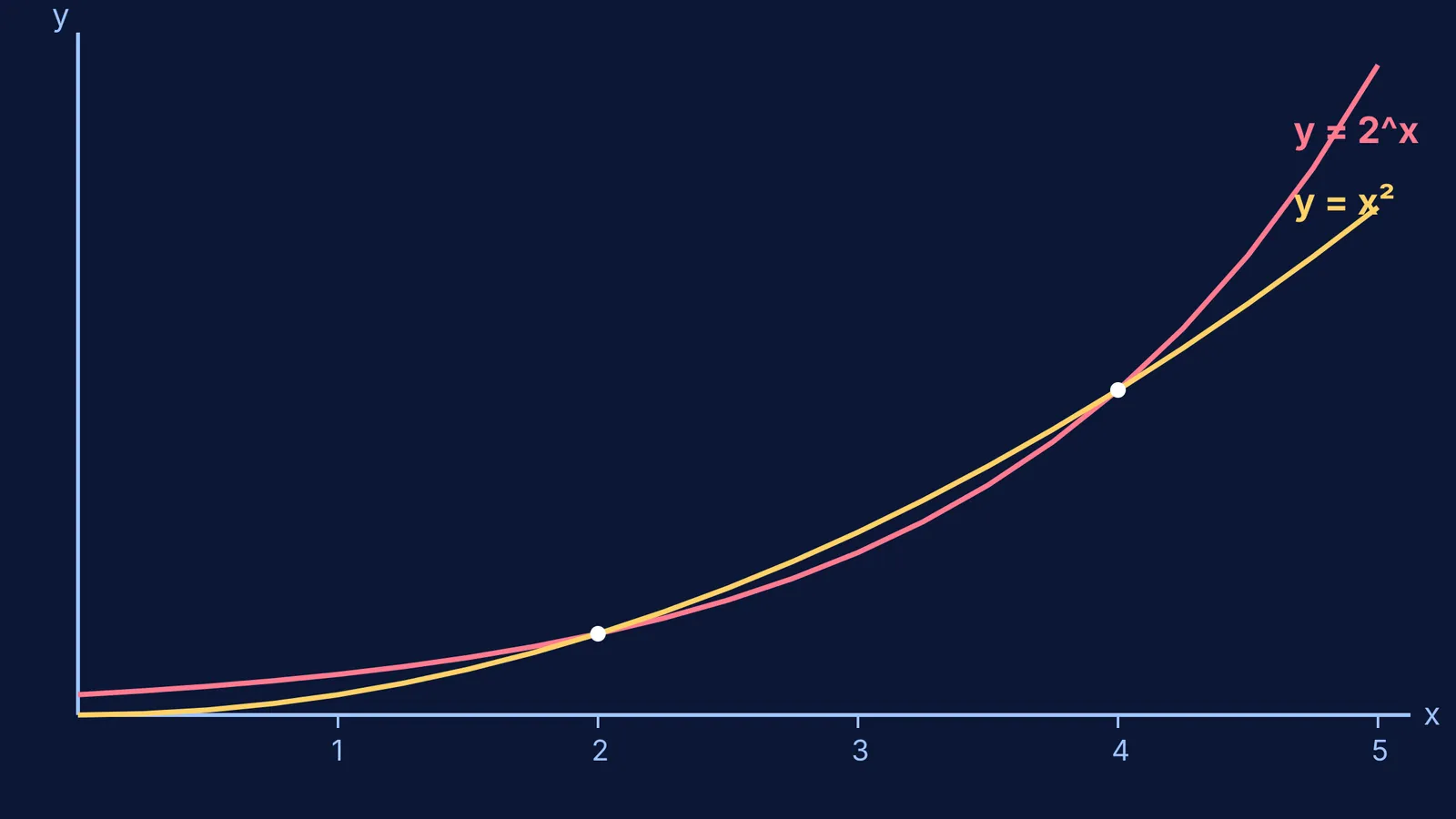
The confusion arises largely because x² and 2ˣ look visually similar on paper. They simply swap the positions of the variable x and the constant 2. When you first learn calculus, the power rule is drilled into your head as the primary tool for differentiation. It becomes incredibly easy to see a superscript and automatically drag it down to the front of the expression.
However, performing a quick numerical test reveals the magnitude of this error. Consider evaluating the slopes at x = 3.
The actual value of the function 2ˣ at this point is 2³ = 8.
The true slope is 8 × ln 2, which is roughly 5.5.
If you incorrectly applied the power rule (resulting in x 2ˣ⁻¹), you would calculate a slope of 3 × 2² = 12.
The incorrect rule gives a slope of 12, which is completely wrong and wildly overestimates the true rate of change.
How can you remember which rule to apply?
To build confidence and avoid these common pitfalls, check the core definitions in the Fermi Concept Library before you start differentiating. It organises the mathematical foundations step by step so you always know exactly which rule applies to which function type.
When solving mixed problem sets, you can test your reasoning and practice these rules in the Fermi Problem Library. If you repeatedly mix up the power and exponential rules during a study session, Fermi's AI tutor can help. The tutor teaches rather than answers: it works out what you know, notices where you are stuck, and builds a plan for the session to guide you through the reasoning. It will help you spot the subtle but critical difference between a variable base and a variable exponent.
Once you have mastered these foundational rules and can reliably tell them apart, you are ready for more complex mathematical applications, such as Differentiating parametric functions: dy/dx and d²y/dx² or Differentiating one expression with respect to another, worked.


