

On this page
Light behaves like a wave when it travels through space, but it acts like a particle when it interacts with matter. This dual personality puzzled physicists for centuries. Isaac Newton argued that light was a stream of tiny particles (corpuscles), while Christiaan Huygens argued it was a wave. It took a series of landmark experiments over a hundred years to prove that both models are correct, leading to the birth of quantum mechanics.
Here is a detailed breakdown of the classic experiments that show the wave nature and the particle nature of light, and how you can spot the difference in your exams.
Which experiments show the wave nature of light?
The defining features of a wave are its ability to bend around obstacles and overlap to form patterns. Light does both flawlessly when travelling through space.
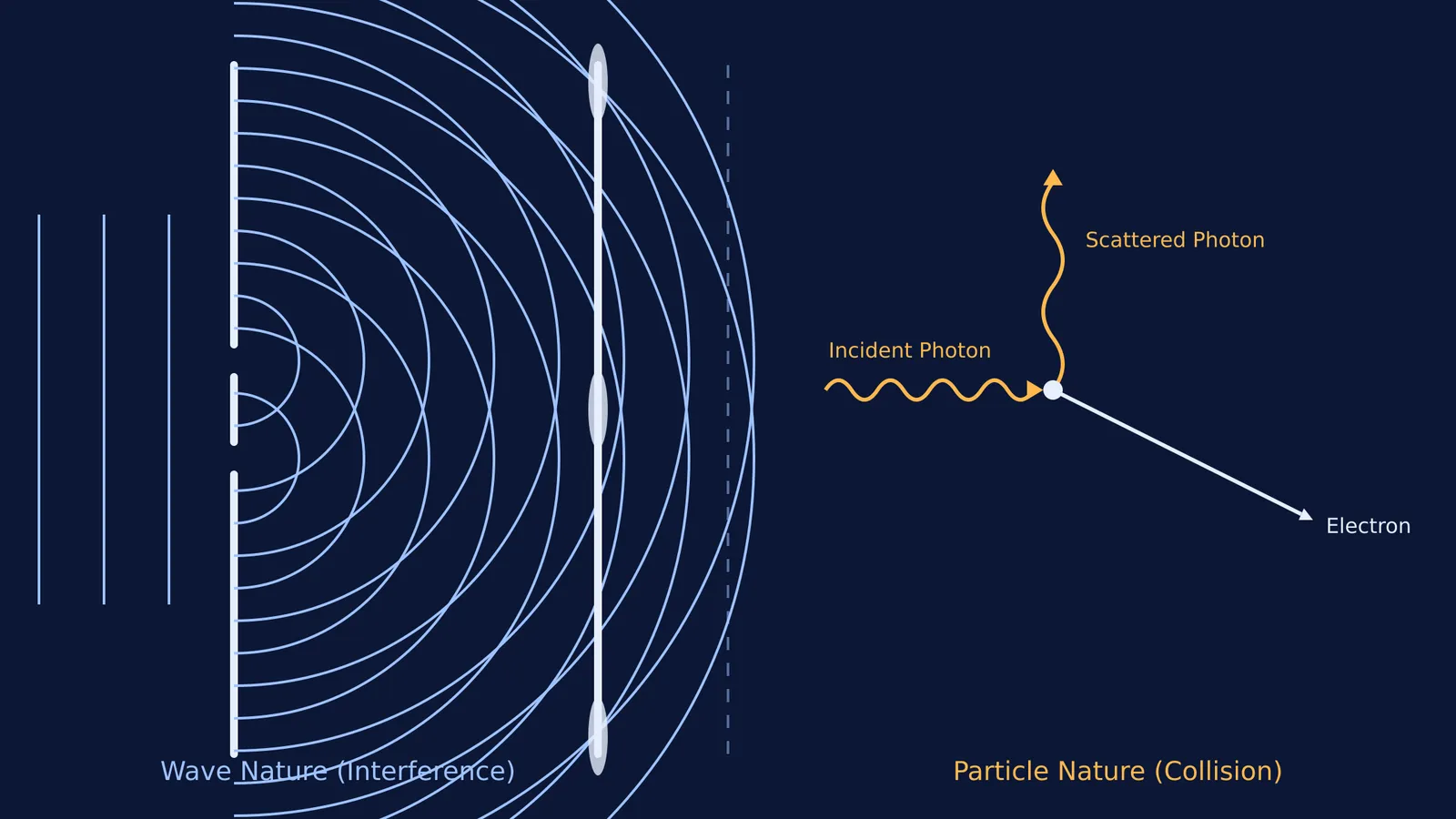
Young's double-slit experiment (1801) The most famous proof of light's wave nature is Thomas Young's double-slit experiment, performed in 1801. Young shone a single source of light through two narrow, closely spaced parallel slits onto a screen. If Newton's particle theory were correct, the light would simply pile up in two bright lines directly behind the slits, like bullets passing through two windows.
Instead, Young saw a pattern of alternating bright and dark bands on the screen, known as interference fringes. This happens because the light waves spreading out from each slit overlap. Where two wave crests meet, their amplitudes add up to form a bright band (constructive interference). Where a crest meets a trough, they cancel each other out, leaving a dark band (destructive interference).
Diffraction experiments When light passes through a single narrow opening or brushes past a sharp edge, it spreads out rather than travelling in a perfectly straight geometric line. This bending into the geometric shadow is called diffraction. Because diffraction is a property unique to waves—just like ocean waves bending around a breakwater—observing light spread into the shadow region of an obstacle confirmed that it travels as a wave.
Which experiments show the particle nature of light?
While the wave model flawlessly explains how light travels, it completely fails to explain how light is absorbed or emitted by matter. For that, we need the particle model, where light exists as discrete, indivisible packets of energy called photons.
The photoelectric effect (1905) When you shine high-frequency light on a metal surface, the metal ejects electrons. Classical wave theory predicted that energy is spread continuously across the wave. This meant that if you made the light bright enough (increasing the wave's amplitude), it should eventually knock electrons out, regardless of the light's colour.
However, experiments showed something entirely different: light below a certain "threshold frequency" could never eject an electron, even if you shone a blindingly bright spotlight on the metal. Furthermore, electrons were ejected instantly, with no time delay for energy to build up.
Albert Einstein explained this in 1905 by proposing that light hits the metal in indivisible chunks, or quanta. A single photon of low-frequency red light does not have enough energy to free an electron. But a single photon of high-frequency ultraviolet light does. The energy of the ejected electron depends entirely on the frequency of the individual photon that hit it, proving light interacts as a particle.
Compton scattering (1923) Arthur Compton provided the ultimate proof that photons carry momentum, just like solid particles. In 1923, he published the results of an experiment where he fired X-rays at stationary electrons in a carbon target.
Compton found that when an X-ray photon struck an electron, it scattered at an angle and emerged with a longer wavelength. Because a longer wavelength means lower energy, the photon had transferred some of its energy and momentum to the electron. This interaction behaved exactly like two billiard balls colliding on a table. The collision obeyed the classic laws of conservation of energy and momentum, cementing the particle nature of light.
How do you tackle duality questions in exams?
When you face a wave-particle duality problem in JEE Main, JEE Advanced or NEET-UG, your first step is deciding which model to use.
Use the wave model when light travels through space, passes through slits, or hits a diffraction grating. Your key variables will be wavelength (λ), frequency (f), and phase difference vs path difference.
Use the particle model when light interacts with matter, such as photons hitting a metal surface, atoms emitting radiation, or calculating the number of photons emitted per second by a bulb. Your key formulas will be the momentum of a photon (p = h/λ) and E = 1240/λ for energy in electron-volts.
Knowing when to apply which formula is the hardest part of quantum mechanics. The Fermi Concept Library gives each concept its own lesson and its place in the map, so you never try to use a wave equation for a photon collision.


