

On this page
Which row or column should you choose to expand a determinant?
In school and competitive exams, evaluating a determinant of order 3 often feels like an invitation to make arithmetic slips. Many students automatically expand along the first row out of habit, regardless of what the numbers look like. However, the official NCERT Class 12 Mathematics curriculum highlights a fundamental rule in its chapter on determinants: expand along whichever row or column contains the maximum number of zeros.
Every determinant of order 3 can be expanded along any of its three rows or three columns with identical results. Pierre-Simon Laplace established this general expansion theorem in 1772, documented in Thomas Muir's historical review. When you choose a line containing zeros, each zero entry multiplies its cofactor to zero. The entire 2×2 sub-determinant drops out immediately, eliminating cross-multiplication and subtraction before you begin.
How do position signs work across rows and columns?
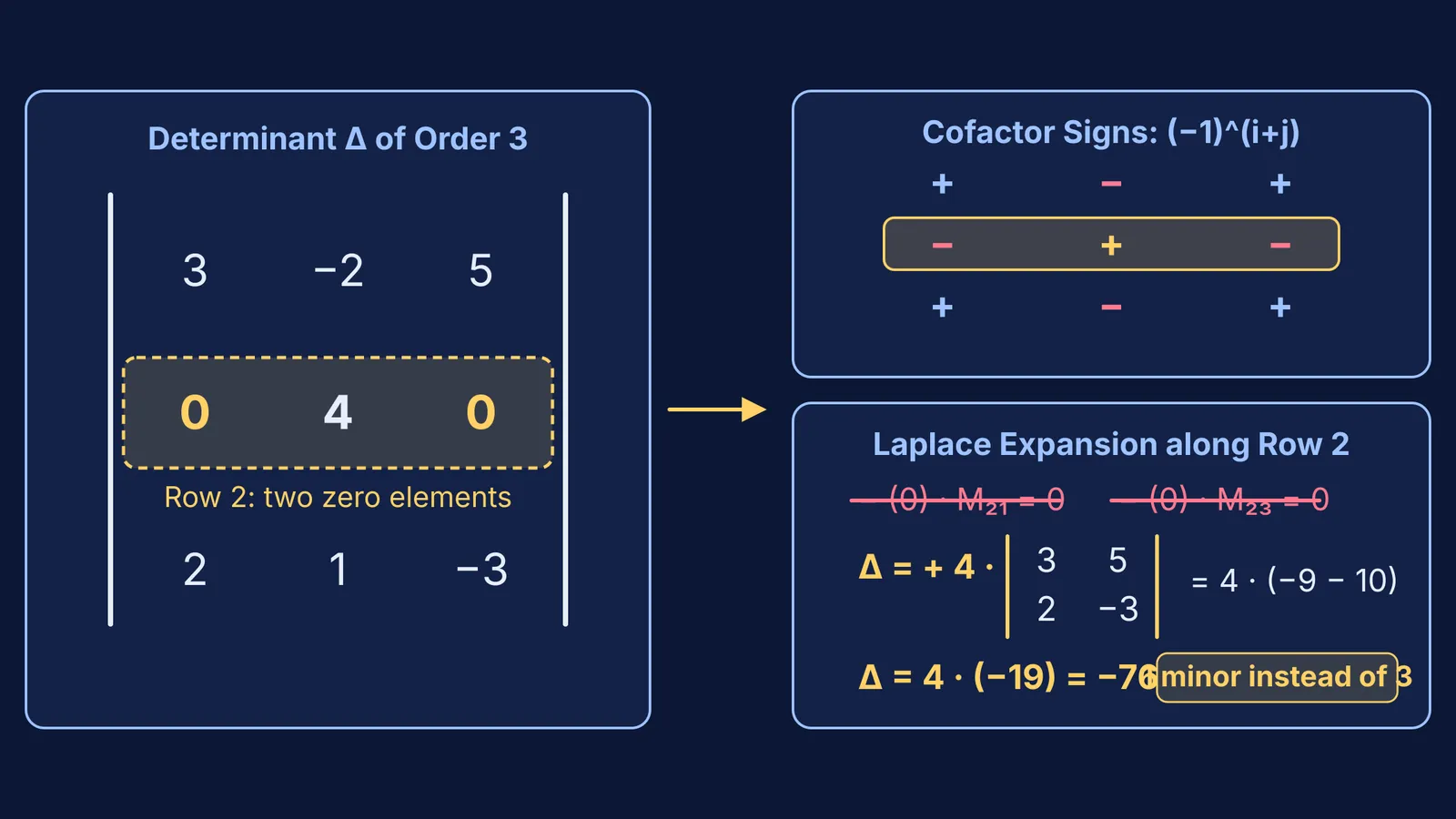
Once you pick the row or column with the most zeros, you must attach the correct algebraic sign to each non-zero element. The sign of an element in row i and column j is given by the cofactor factor (-1)^(i+j). This creates an alternating checkerboard pattern:
Row 1: (+), (−), (+)
Row 2: (−), (+), (−)
Row 3: (+), (−), (+)
A reliable geometric shortcut helps you avoid calculating powers during timed tests: the four outer corners (positions 1,1; 1,3; 3,1; 3,3) and the exact center (position 2,2) always carry a positive (+) sign because the sum of their row and column indices is an even number. The four diamond edge positions (1,2; 2,1; 2,3; 3,2) always carry a negative (−) sign.
The single most frequent mistake in determinant expansion is conflating the position sign with the sign of the matrix entry itself. If entry a₂₁ equals -3, the negative position sign from row 2 column 1 produces -(-3) × M₂₁ = +3 × M₂₁. Always write down the position sign explicitly before writing the element in brackets.
How does expanding along zeros cut arithmetic steps in half?
Evaluating a general 3×3 determinant requires computing three 2×2 minors. As detailed in the NCERT Class 12 Mathematics textbook, each minor requires two multiplications and one subtraction (ad − bc). Scaling the three minors by their respective row elements and summing them totals 14 distinct arithmetic operations.
In a 1988 study in Cognitive Science, John Sweller demonstrated in research on cognitive load that human working memory is easily overwhelmed during multi-step procedures. Tracking intermediate signs while calculating products causes frequent arithmetic slips.
Consider the determinant Δ: | 3 -2 5 | | 0 4 0 | | 2 1 -3 |
Expanding along Row 1 requires three separate 2×2 minors:
Term 1: +3 × [4 × (-3) − 0 × 1] = 3 × (-12) = -36
Term 2: -(-2) × [0 × (-3) − 0 × 2] = +2 × 0 = 0
Term 3: +5 × [0 × 1 − 4 × 2] = 5 × (-8) = -40
Sum: -36 + 0 − 40 = -76
Expanding along Row 2 targets the two zeros directly:
Term 1: -(0) × M₂₁ = 0
Term 2: +4 × M₂₂ = +4 × [3 × (-3) − 5 × 2] = 4 × (-19) = -76
Term 3: -(0) × M₂₃ = 0
Choosing Row 2 collapses the workload from 14 operations down to 4: two products and a subtraction in M₂₂, followed by one scaling step. That cuts manual operations by 71%. In questions involving finding the area of a triangle using determinants, skipping redundant minors prevents early errors from spoiling the entire solution.
The Fermi Problem Library provides worked problems with a step-by-step solver that explains the reasoning rather than printing an answer, allowing students to verify each expansion line and catch sign slips early.
What should you do if a determinant has no zeros?
When every entry in a matrix is non-zero, you can create zeros before expanding. In the NTA JEE Main syllabus, determinant questions reward recognizing where elementary transformations simplify the matrix:
Use row operations like R₂ → R₂ − k × R₁ to generate zeros in a target column.
Use column operations like C₂ → C₂ − k × C₁ to generate zeros in a target row.
Once a row or column has two zeros, expand along that line in a single step.
If two lines become identical or proportional, the determinant is zero without further calculation.
Pairing this zero-targeting strategy with elementary transformations saves critical minutes during exams. To connect determinant properties with linear systems and Gabriel Cramer's determinant rule, the Fermi Concept Library maps every concept in mathematics so you can trace how determinants connect to systems of equations and geometric transformations.


