

On this page
Every chemical reaction involves energy. When old bonds break in the reactants, energy is absorbed. When new bonds form to create the products, energy is released. The balance between these two steps decides whether a reaction heats up its surroundings or cools them down.
In Class 10 chemistry, identifying these energy changes is just as important as mastering Balancing chemical equations in Class 10: a method that always works. Here is how to tell the two main types of energy changes apart, with the key examples you need to know.
What are exothermic reactions?
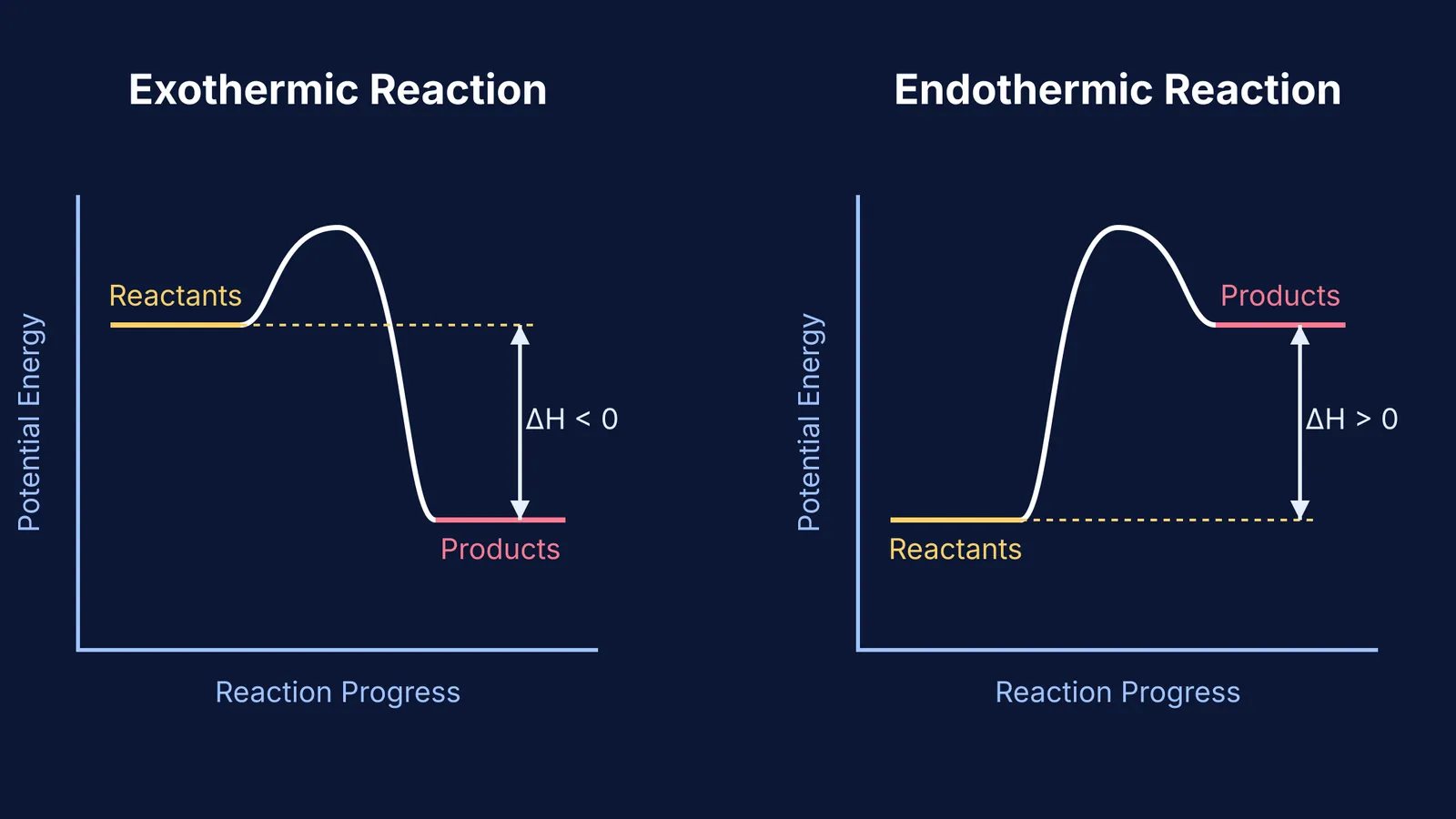
An exothermic reaction is a chemical process where heat is released along with the formation of products. Because the energy released by forming new bonds is greater than the energy required to break the old ones, the excess energy spills into the surroundings, raising their temperature.
The most common textbook example is the slaking of lime. When water is added to quicklime (calcium oxide), it reacts vigorously to form slaked lime (calcium hydroxide), releasing a large amount of heat.
CaO(s) + H₂O(l) → Ca(OH)₂(aq) + Heat
This reaction releases 63.7 kJ of heat per mole of calcium oxide (Wikipedia). The mixture can become hot enough to boil the water. Burning natural gas, which is mostly methane, is another classic exothermic reaction because it releases heat and light.
Why is respiration considered an exothermic reaction?
Respiration is the process by which living things generate energy, covered in detail when studying Class 10 life processes: nutrition, respiration, transport, excretion. It is considered an exothermic reaction because energy is released during the breakdown of glucose.
Inside our cells, glucose combines with oxygen to produce carbon dioxide and water.
C₆H₁₂O₆(aq) + 6O₂(g) → 6CO₂(g) + 6H₂O(l) + Energy
The oxidation of one mole of glucose releases 2880 kJ of energy (Wikipedia). This energy, rather than just heating up the cell, is captured to form ATP (adenosine triphosphate), the molecule that powers biological work.
What are endothermic reactions?
An endothermic reaction absorbs energy from its surroundings to proceed. In these reactions, more energy is required to break the bonds of the reactants than is released when the new bonds of the products form. You will often see this energy supplied as heat, light, or electricity.
A prime example is the thermal decomposition of calcium carbonate (limestone). When heated, it breaks down into quicklime and carbon dioxide gas.
CaCO₃(s) + Heat → CaO(s) + CO₂(g)
This process is highly endothermic, requiring an input of 178 kJ per mole of calcium carbonate to drive the reaction forward (Wikipedia).
Other common endothermic examples include photosynthesis—where plants absorb solar energy to build glucose—and photolytic decomposition, such as silver chloride turning grey when exposed to sunlight. To revise how these fit into the broader chemistry syllabus, review the Types of chemical reactions in Class 10: balancing and examples.
If concept gaps make it hard to predict whether a reaction will absorb or release heat, the Fermi Concept Library contains every concept in physics, chemistry, biology, mathematics and computing, each with its own lesson and its place in the map.
Exothermic and endothermic reactions examples class 10?
When you face a new chemical equation, use this simple checklist to classify it:
Look for the energy term. If "Heat" or "Energy" is written on the product (right) side, it is exothermic. If it is on the reactant (left) side, or above the arrow (like a small triangle Δ for heat, or "sunlight"), it is endothermic.
Check the reaction type. Most decomposition reactions are endothermic because breaking a single substance apart requires an energy input. Most combustion and neutralisation reactions are exothermic.
Observe the temperature change. If a test tube feels hot, the reaction is exothermic. If it feels noticeably cold, it is endothermic.


