

On this page
Nucleases are the biological scissors of the microscopic world. They are enzymes that break the strong phosphodiester bonds holding the nucleotides of DNA and RNA together. But not all scissors work the same way. The main difference between these two classes of enzymes comes down to exactly where they make their cut along the polynucleotide chain.
What is an exonuclease?
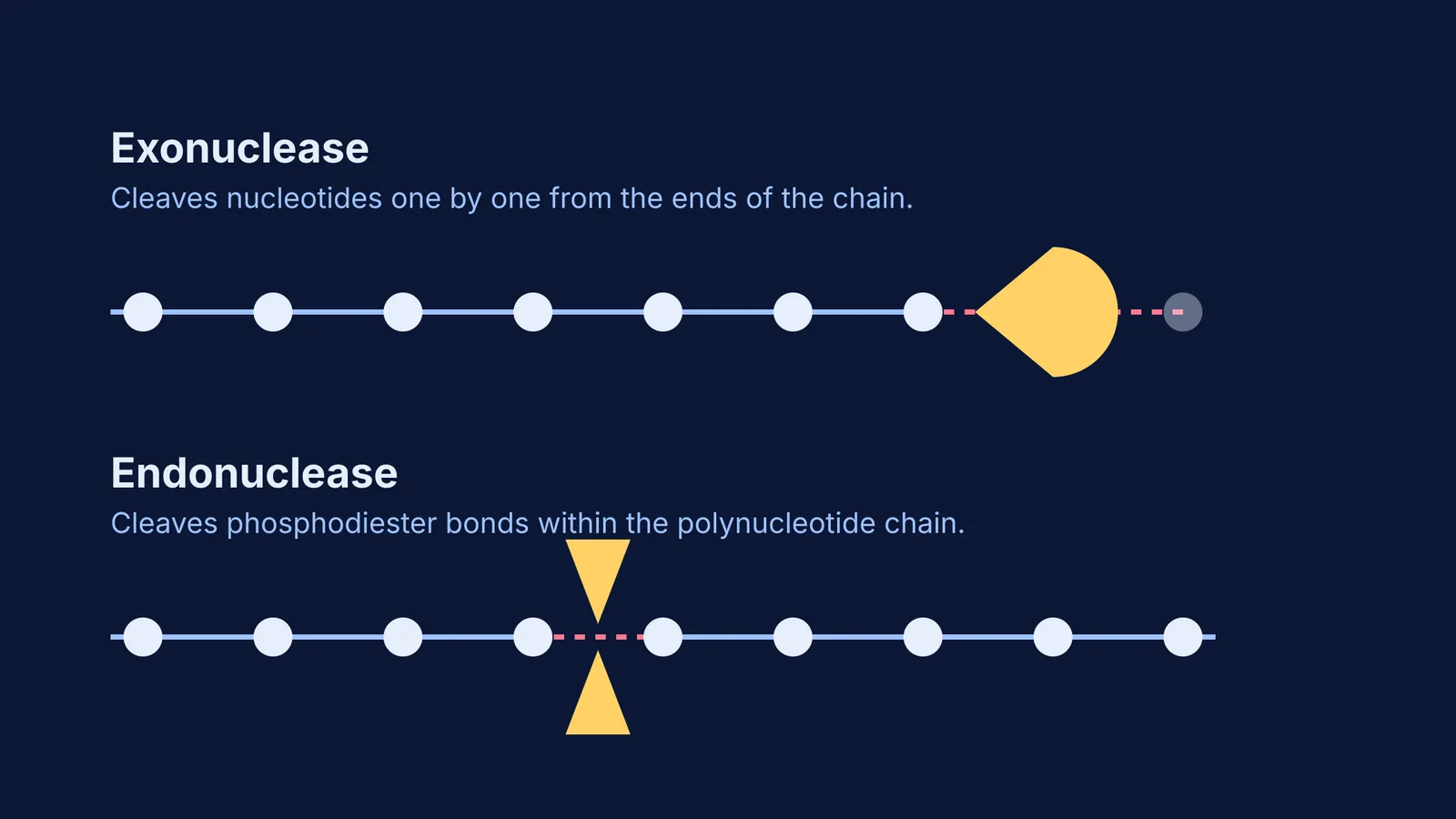
An exonuclease works strictly from the outside in. Exonucleases are enzymes that work by cleaving nucleotides one at a time from the end of a polynucleotide chain (Wikipedia).
Because they need a free 3' or 5' end to start working, they nibble away at a strand rather than breaking it in half. You can picture this like someone unravelling a long, knitted sweater by pulling the yarn continuously from the sleeve.
In your cells, this mechanism is crucial for survival and accurate cell division. During DNA replication, DNA polymerase occasionally makes a mistake and inserts the wrong base. When this happens, its built-in 3' to 5' exonuclease activity acts like a chemical backspace key, removing the incorrect nucleotide from the end of the growing strand so the correct one can take its place. Furthermore, they play a major role in cellular housekeeping. After RNA processing is complete and an mRNA transcript has served its purpose, a multi-protein exosome complex uses exonucleases to break it down, recycling the nucleotides for future use.
What is an endonuclease?
An endonuclease works from the inside out. Endonucleases are enzymes that cleave the phosphodiester bond within a polynucleotide chain (Wikipedia).
Unlike exonucleases, they do not need a free end to begin their work. This means they can cut closed, circular DNA loops—like bacterial plasmids—or slice right through the middle of a large, linear chromosome. If an exonuclease carefully unravels a sweater, an endonuclease takes a pair of heavy shears directly to the middle of the fabric, leaving you with two separate pieces.
Why are restriction enzymes endonucleases?
Restriction enzymes (often called restriction endonucleases) are a specific, highly specialised group of endonucleases. A restriction enzyme cleaves DNA into fragments at or near specific recognition sites within the molecule (Wikipedia).
This inner-cutting action is what categorises them as endonucleases. They do not just cut randomly; they scan the DNA double helix for highly specific palindromic sequences (usually four to eight base pairs long, according to Wikipedia) and cleave the strand right at that exact location.
These enzymes originally evolved in bacteria and archaea as an ancient immune system. They provide a critical defence mechanism against invading viruses. When a bacteriophage virus injects its DNA into a bacterial cell, the restriction enzyme scans the sequence, finds its specific recognition site, and chops the viral DNA from the inside. This destroys the virus before it can hijack the cell. To prevent the bacteria from cutting its own genome, a companion modification enzyme adds methyl groups to the host DNA, blocking the restriction enzyme from binding.
Today, there are more than 3,600 restriction endonucleases known, representing over 250 different specificities (Wikipedia). Because they cut at precise internal locations to create complementary "sticky" or "blunt" ends, scientists use them to isolate specific genes. This predictable precision makes them the key tool for modern genetic engineering, from making human insulin by rDNA to getting DNA into cells for advanced molecular cloning.
If you find it hard to memorise which enzyme does what in biotechnology or genetics, the Fermi Concept Library has every concept in physics, chemistry, biology, mathematics and computing, each with its own lesson and its place in the map. And if you are practising for an exam and keep mixing up the enzymes in a complex metabolic pathway, the Fermi Problem Library has worked problems with a step-by-step solver that explains the reasoning rather than printing an answer. Fermi's AI tutor works out what you already know, builds a plan for the session, and teaches through it.
Exonuclease vs endonuclease difference: the exam checklist
When you see a question about nucleases in a competitive biology exam like NEET, use this decision framework to identify which one is at work:
Where is the cut located? If the enzyme is releasing single nucleotides from the 3' or 5' end of the chain, it is an exonuclease. If it is breaking the main strand into two large fragments, it is an endonuclease.
Does it work on circular DNA? Circular plasmids do not have free 3' or 5' ends. Therefore, an exonuclease cannot initiate a cut on them. An endonuclease, however, can easily slice open a circular plasmid.
What is the resulting product? Exonucleases typically leave behind individual nucleotide monomers. Endonucleases leave behind shorter, intact chains of oligonucleotides.
Is there a specific recognition site? While some endonucleases cut randomly, many (like restriction enzymes) hunt for a specific 4-to-8 base pair sequence. Exonucleases generally just attach to a free end and degrade the strand sequentially.


