

On this page
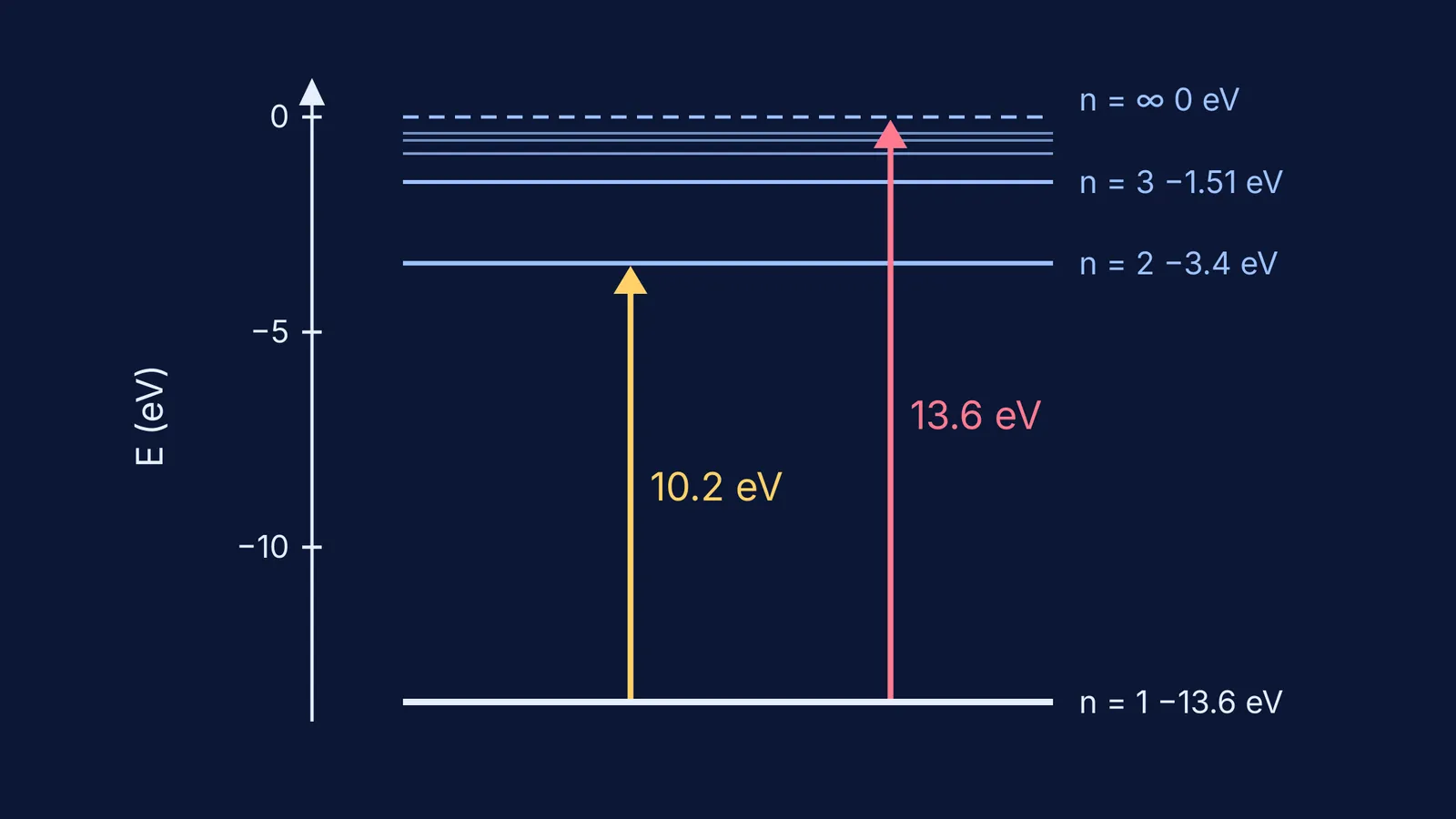
Two numbers turn up again and again in atomic physics questions: 10.2 V and 13.6 V. Both come from the same ladder of energy levels in hydrogen (OpenStax), and once you can draw it, these questions become subtraction.
What is excitation potential and ionisation potential?
Ionisation energy is "the energy that is needed to remove the electron from the atom", and for hydrogen in its ground state it is 13.6 eV (OpenStax University Physics, Bohr's model of the hydrogen atom). The measured value for hydrogen is 13.598433 eV (NIST Atomic Spectra Handbook).
Excitation energy is the energy needed to lift the atom from its ground state into a higher allowed level without removing the electron.
The "potential" versions are the same numbers in volts: the accelerating voltage that gives an electron that much kinetic energy. An electron accelerated from rest through 10.2 V carries 10.2 eV.
What are the excitation and ionisation potentials of hydrogen?
Bohr's model gives the allowed energies as En = −13.6 eV/n², so E1 = −13.6 eV and E2 = −3.4 eV (OpenStax). Every value below is a difference on that ladder:
First excitation potential (n = 1 to n = 2): 13.6 − 3.4 = 10.2 V
Second excitation potential (n = 1 to n = 3): 13.6 − 1.51 = 12.09 V
Ionisation potential (n = 1 to n = ∞): 13.6 V
Ionisation from the first excited state (n = 2 to n = ∞): 3.4 V
Why does an atom absorb only certain energies?
The atom's allowed energies are discrete, so it can only gain an amount that carries it exactly from one level to another. OpenStax puts it plainly: atoms of an element "absorb radiation only at specific wavelengths and radiation that does not have these wavelengths is not absorbed" (OpenStax).
That rule applies to photons, which are absorbed whole or not at all, so a photon must match a gap exactly. The exception is above 13.6 eV, where the electron is freed and the extra becomes its kinetic energy.
A bombarding electron can hand over just part of its kinetic energy. Below the first gap the collision is elastic: it bounces off with its speed unchanged. With at least the gap energy, the atom takes exactly the gap and the electron keeps the rest.
How do you solve Franck-Hertz style questions?
James Franck and Gustav Hertz presented their electron-collision experiment to the German Physical Society on 24 April 1914. They shared the 1925 Nobel Prize in Physics "for their discovery of the laws governing the impact of an electron upon an atom" (Franck-Hertz experiment, Wikipedia). Here is how Franck and Hertz proved atoms have energy levels.
In mercury vapour, the collected current drops sharply at 4.9 V and again at multiples of 4.9 V, and the tube emits ultraviolet light at 254 nm (HyperPhysics, Franck-Hertz experiment). Questions test three readings of that graph:
The spacing between dips is the first excitation potential (4.9 V for mercury).
The light emitted has λ = 1240/4.9 ≈ 253 nm, which matches 254 nm within rounding. Our guide to the E = 1240/λ shortcut shows why this works.
A dip at 2 × 4.9 V means one electron excited two atoms in turn, not that it reached a higher level.
Worked example: 12.5 eV electron or 12.5 eV photon?
Electrons with 12.5 eV of kinetic energy strike ground-state hydrogen. Which levels are reached, and which lines appear? Levels from OpenStax.
List the gaps from n = 1: 10.2 eV (n = 2), 12.09 eV (n = 3), 12.75 eV (n = 4), 13.6 eV (ionisation).
Keep the gaps no bigger than 12.5 eV: n = 2 and n = 3.
An electron that excites n = 3 leaves with 12.5 − 12.09 = 0.41 eV. One that excites n = 2 leaves with 2.3 eV.
From n = 3 the atom can emit three lines: 3 → 1 (12.09 eV, about 102.6 nm), 2 → 1 (10.2 eV, about 121.6 nm) and 3 → 2 (1.89 eV, about 656 nm).
Now swap the electron for a 12.5 eV photon. No gap equals 12.5 eV and it is below 13.6 eV, so it passes through unabsorbed. Same number, opposite answer.
Before you write anything, run this checklist:
Convert every energy to eV.
Draw the ladder: −13.6, −3.4, −1.51, −0.85 eV.
Ask: photon (exact match) or electron (at least the gap)?
Count possible lines from level n with n(n − 1)/2, as in our hydrogen spectrum problems guide.
If you keep mixing up the photon and electron rules, the Fermi Problem Library has worked problems with a step-by-step solver that explains the reasoning rather than printing an answer. To rebuild energy levels from the start, the Fermi Concept Library gives each concept its own lesson.
Draw the ladder first, then subtract.


