

On this page
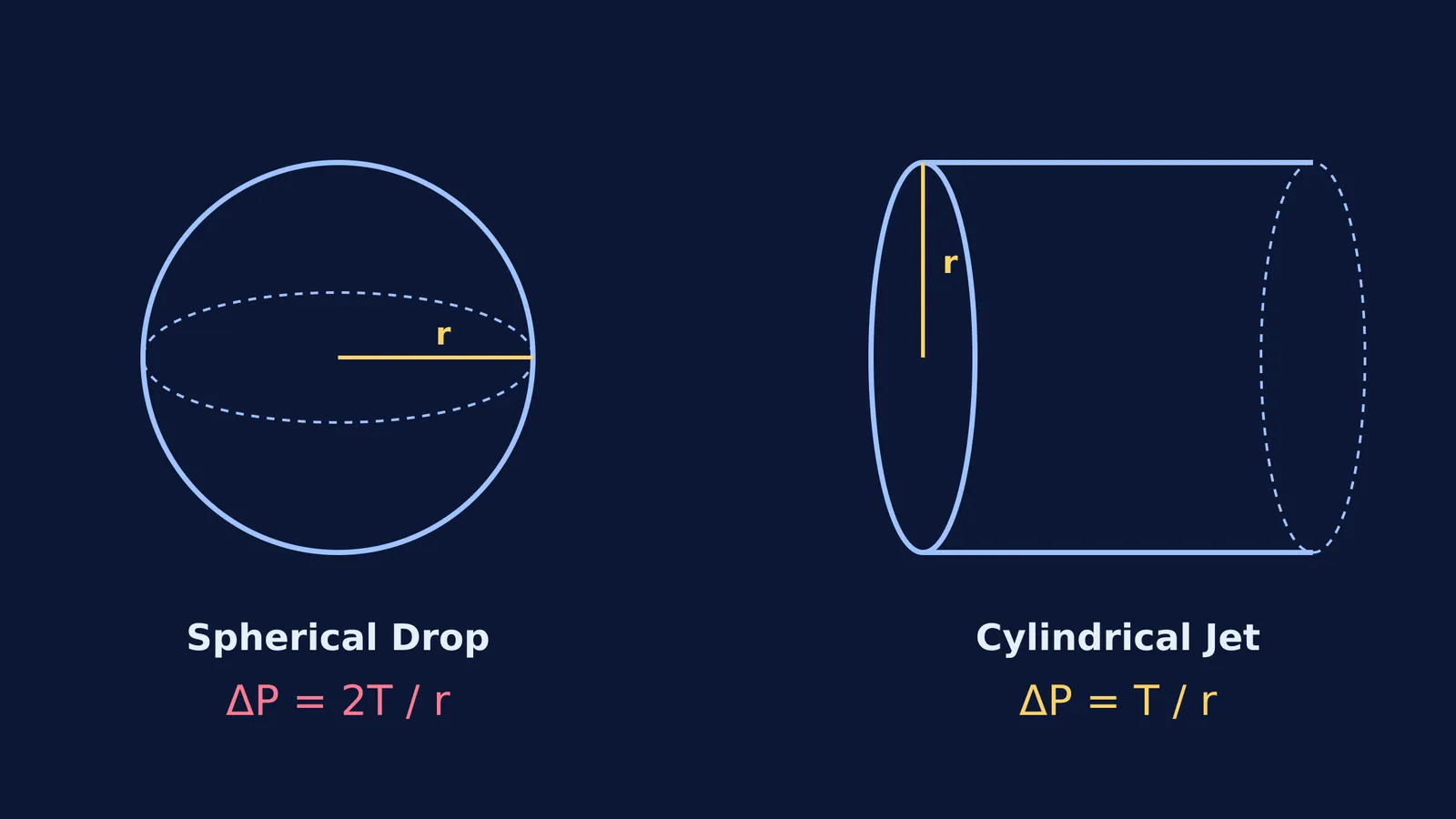
When water shoots out of a syringe, a hose, or a tap, it temporarily forms a continuous cylindrical jet before eventually breaking apart into individual drops. Inside that flowing jet, the liquid is under a specific pressure caused by the surface holding itself together. The excess pressure inside a cylindrical liquid jet is ΔP = T/r (where T is the surface tension and r is the radius of the cylinder).
This is exactly half the excess pressure found inside a spherical liquid drop of the exact same size. If you are preparing for competitive exams like JEE Main or NEET-UG, this distinction is a classic trap: students often memorize the formula 2T/r for a drop and mistakenly apply it to a cylinder.
What is the excess pressure inside a cylindrical liquid jet?
To understand where the formula comes from without advanced calculus, we can balance the forces acting on an imaginary half-cylinder of liquid of length L.
Imagine cutting the cylindrical jet in half down its entire length. The liquid pressure inside pushes the two halves apart. This outward force is equal to the excess pressure multiplied by the flat rectangular area of the cut, which is the diameter times the length (2r × L).
At the exact same time, surface tension acts like an elastic skin, pulling the two halves together. This tension acts along the two straight outer edges of the cut, each having a length L. Equating the outward pressure force (2rL × ΔP) to the inward surface tension force (2L × T) allows us to cancel out 2L from both sides, leaving ΔP = T/r.
This basic fluid mechanics principle—balancing pressure forces against surface forces—is a staple in physics, appearing alongside other classic static fluid topics like Pascal's law in hydraulic machines.
How does the Young-Laplace equation explain the difference?
The most formal and universal way to find the excess pressure across any curved liquid surface is by using the Young-Laplace equation. According to the equation, the pressure difference across a fluid interface depends directly on the two principal radii of curvature, R₁ and R₂ (Young-Laplace equation, Wikipedia). The formula is written as ΔP = T(1/R₁ + 1/R₂).
For a perfectly spherical drop or bubble, the surface curves equally in all possible directions. Therefore, both principal radii are equal to the sphere's radius (R₁ = R₂ = r). Plugging this geometry into the equation gives ΔP = T(1/r + 1/r) = 2T/r.
A cylindrical jet, however, is fundamentally different. It only curves around its circular cross-section (R₁ = r). Its second radius of curvature—measured along the perfectly straight length of the cylinder—is infinite (R₂ = ∞). Since 1/∞ = 0, the equation elegantly simplifies to ΔP = T(1/r + 0) = T/r.
Why is a cylindrical jet different from a spherical drop?
At a physical level, a drop is a closed, isolated shape. Surface tension pulls inward from every possible angle in three-dimensional space, squeezing the trapped liquid tightly from all sides and creating a relatively high internal pressure.
A cylindrical jet, on the other hand, is open and extended along its length. The surface "skin" only pulls inward around the circumference, like a tight rubber band wrapped around a tube. With tension acting in fewer directions, the liquid is squeezed much less, resulting in exactly half the excess pressure of a sphere.
If you are struggling to picture how curvature works in three dimensions, the Fermi Concept Library has every concept in physics, chemistry, biology, mathematics and computing, each with its own lesson and its place in the map.
A worked example: pressure in a water jet
Let's apply this mathematical difference to a real numerical problem you might see on a test.
Question: A cylindrical jet of water flowing from a nozzle has a radius of 1.0 mm. The surface tension of water at 20 °C is 0.0728 N/m (Surface tension, Wikipedia). What is the excess pressure inside the jet?
Identify the shape and formula: Because the problem specifies a cylindrical jet, we must use ΔP = T/r, not the spherical formula.
Convert to SI units: The radius r = 1.0 mm = 1.0 × 10⁻³ m.
Calculate: ΔP = 0.0728 / (1.0 × 10⁻³) = 72.8 Pa.
If a spherical drop of water had the exact same radius, the internal pressure would be double, at 145.6 Pa. Being incredibly careful with identifying shapes is just as critical here as it is when solving complex equilibrium problems involving a manometer with two immiscible liquids.
If you ever get stuck on fluid mechanics numericals, the Fermi Problem Library has worked problems with a step-by-step solver that explains the reasoning rather than printing an answer.


