

On this page
Most maths homework comes in blocks: ten quadratic equations after the quadratics lesson, ten slope problems after the slope lesson. Interleaved practice shuffles them. For maths, the research so far points clearly one way.
What is interleaved practice?
Interleaved practice means arranging problems so that no two consecutive problems need the same strategy, as defined by Rohrer, Dedrick, Hartwig and Cheung (2020). Blocked practice is the opposite: every problem in a set uses the method from the lesson just taught.
The difference matters because a block tells you the method before you read the question. In an exam, nothing tells you. The 2020 paper gives pairs that look alike but need different tools: x − 4x + 3 = 0 (collect the x terms) versus x² − 4x + 3 = 0 (factorise), or the length versus the slope of the segment from (1, 2) to (5, 5). Interleaving makes you practise choosing a method, not just carrying one out.
What did Rohrer and Taylor (2007) find?
In Experiment 2 of Rohrer and Taylor (2007), 18 university students learned to find the volumes of four unfamiliar solids, such as a wedge and a spheroid, then did two practice sessions a week apart. Both groups saw the same tutorials and the same problems; only the order differed.
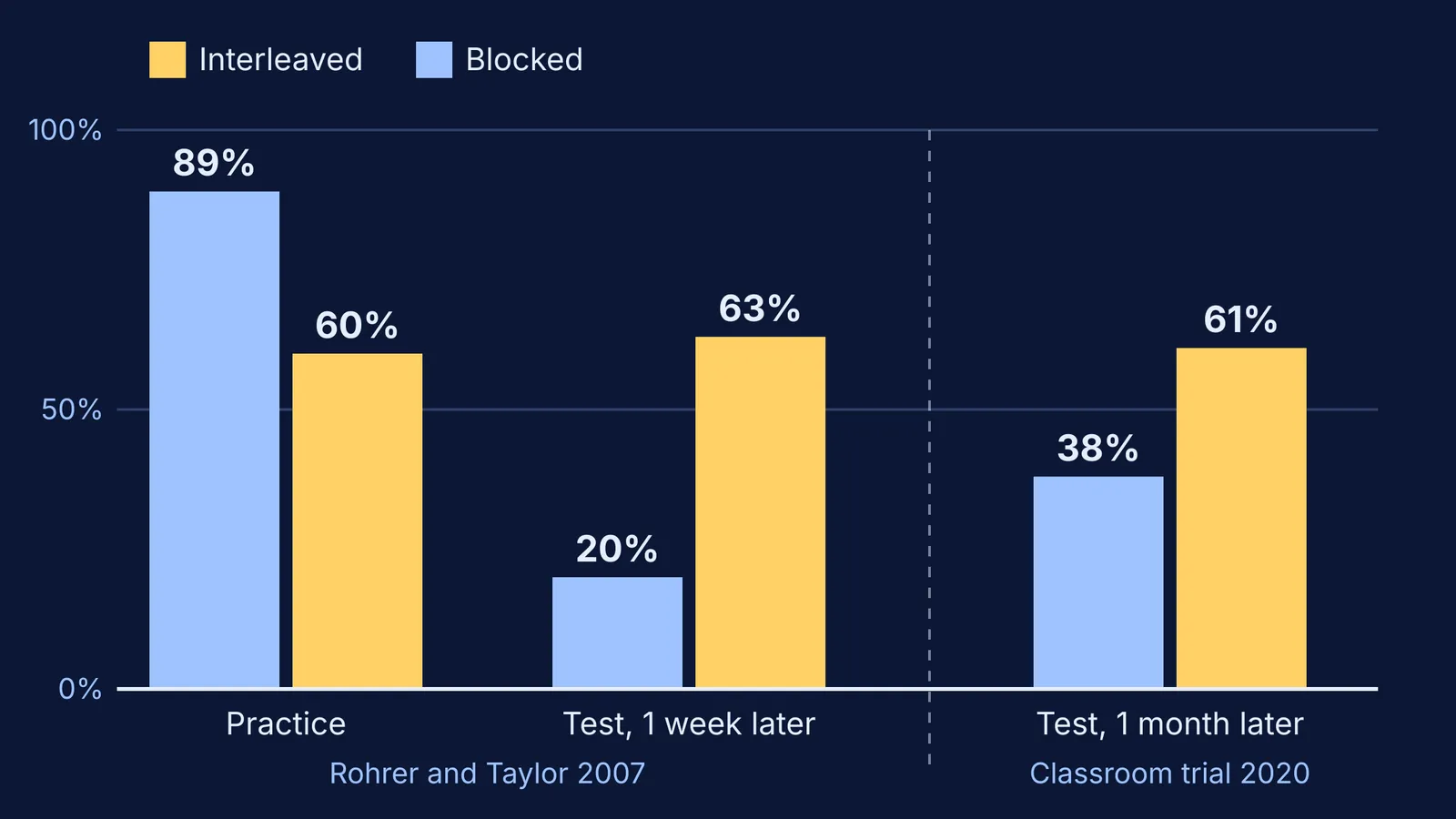
During practice, the blocked group got 89% right and the mixed group 60%.
On a test one week later, the mixed group scored 63% and the blocked group 20%.
The authors found that almost every test error came from picking the wrong formula, not from slips in the arithmetic. They also listed the limits: a small lab study, college students, and a test very close to the practice problems.
Does interleaving work in a real classroom?
The 2020 trial tested exactly that. Each of 54 seventh-grade maths classes completed mostly interleaved or mostly blocked assignments over four months, and teachers ran it without any training, according to the paper's abstract. One month later, on an unannounced test, the interleaved group scored 61% and the blocked group 38%, an effect size of d = 0.83.
The US Department of Education's What Works Clearinghouse review counts 787 students and rates the study as meeting its standards without reservations. The authors still note that important caveats remain, and it is a single trial in seventh-grade classes in Florida.
Is interleaved practice better for physics too?
The evidence is thinner, but it points the same way. Over 8 weeks, Samani and Pan (2021) gave students in an introductory university physics course homework that was either interleaved or arranged one topic at a time. On two surprise tests with new, harder problems, interleaved practice gave median improvements of 50% and 125%. Students still rated it harder and wrongly believed they had learned less.
A two-week interleaving plan for maths and physics
Interleave only topics you have already been taught, as the students in these studies had. Pick four maths and four physics types from finished chapters, for example quadratic equations, sequences, straight lines and trigonometric equations, then kinematics, Newton's laws, work-energy and circular motion.
Day 1: build a deck. Copy five problems of each type from your NCERT exercises or past papers onto numbered cards, forty in all.
Days 2 to 6: do twelve problems a day, six maths and six physics, shuffled so no two in a row share a type. Before solving, write one line: which method, and why.
Day 7: sit a 45-minute mixed test of problems you have not seen. Mark each error as "wrong method chosen" or "right method, slip".
Days 8 to 13: add one new type per subject, keep the daily twelve, and space each type's problems further apart.
Day 14: sit a second mixed test, then compare the two error logs.
If one chapter keeps landing in the "wrong method" pile, the gap is usually a concept, so revisit that idea in the Fermi Concept Library before shuffling it back in. If you chose the right method but got stuck halfway, the Fermi Problem Library has worked problems with a step-by-step solver that explains the reasoning rather than printing an answer.
To spread topics over a month, pair this with a 4-week spaced revision schedule, and use the same two error labels when you analyse a mock test. For calculus, see our four-week integration plan with mixed sets.
Start tonight: take yesterday's homework and today's, and shuffle them together.


