

On this page
If you are studying calculus, you might wonder why d of xy equals x dy plus y dx. Differential equations often hide this exact substitution in plain sight. This is not just a random algebraic trick; it is the direct result of the product rule for differentiation applied to differentials.
When you face a messy first-order differential equation, your first instinct might be to separate the variables or blindly search for an integrating factor. However, recognizing exact differentials—a technique often called the "method of inspection"—can save you pages of working out.
What does d of xy equals x dy plus y dx mean?
In mathematics, a differential expression of the form M(x, y) dx + N(x, y) dy = 0 is defined as an "exact equation" if there exists a potential function whose total differential equals that expression (Paul's Online Math Notes, Lamar University).
The simplest and most common of these is the product rule. If you take the derivative of the product xy with respect to x, you get x(dy/dx) + y. If you write this in terms of differentials rather than derivatives, it becomes exactly d(xy) = x dy + y dx.
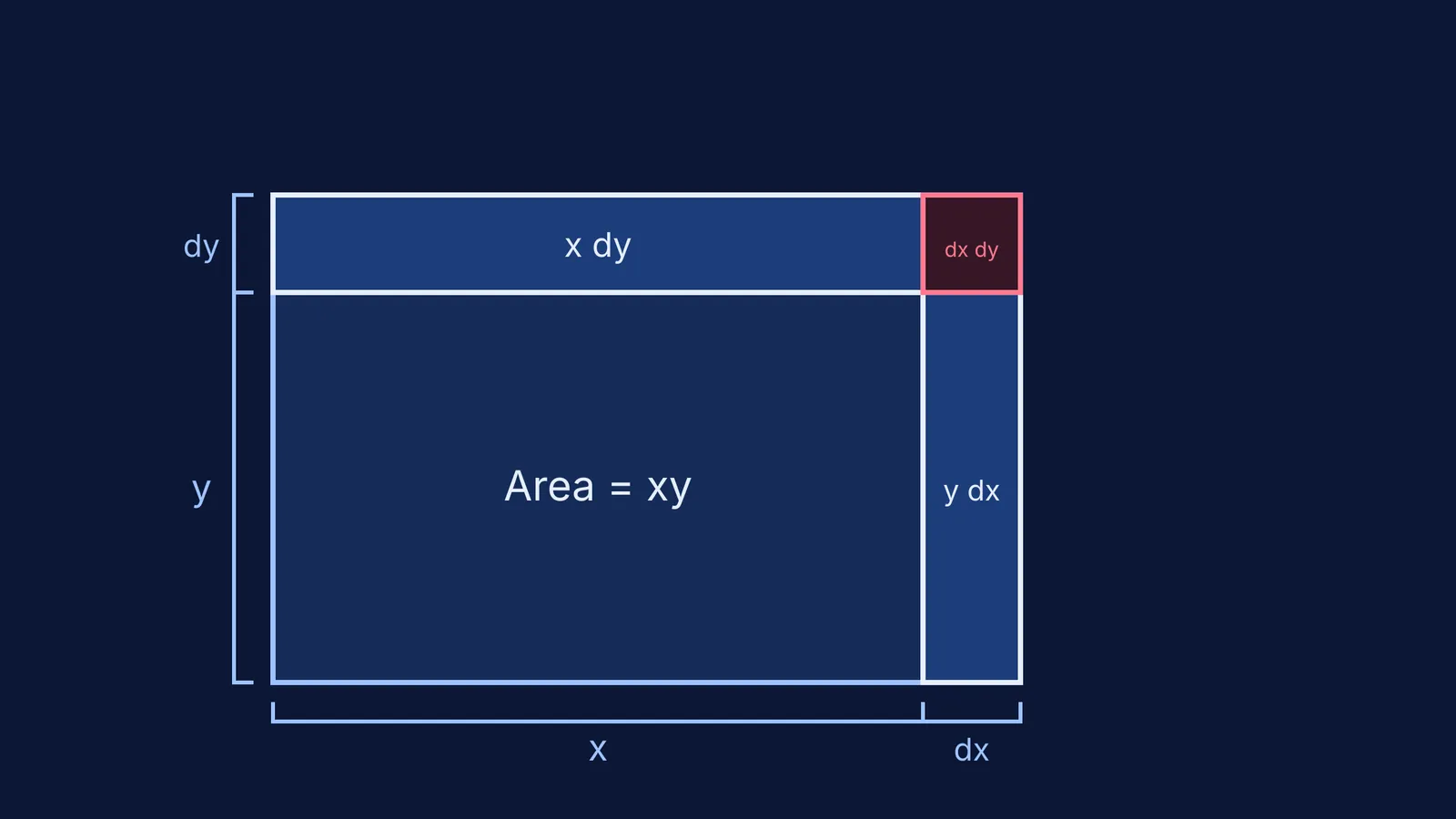
Geometrically, imagine a rectangle with width x and height y. If you stretch it by a tiny amount dx and dy, the new area added is a strip along the top (x dy) and a strip along the side (y dx). The microscopic corner piece (dx dy) is so small it vanishes, leaving exactly x dy + y dx.
How to use the method of inspection?
The method of inspection relies on grouping terms in your differential equation so that these exact differentials appear naturally. While you might use substitutions for homogeneous differential equations, exact equations rely on spotting reverse derivatives.
Imagine you are asked to solve y dx + (x + 2y) dy = 0.
Expand the brackets: y dx + x dy + 2y dy = 0.
Group the terms that belong together: (y dx + x dy) + 2y dy = 0.
Substitute the exact differential: d(xy) + 2y dy = 0.
Integrate both sides directly: xy + y² = C.
You have found the solution in three lines. Once simplified, the remaining terms are often basic polynomials or integrals of standard forms, making the final step trivial.
When you are stuck on an integration step or cannot see how to group the terms, the Fermi Problem Library has a step-by-step solver that explains the reasoning rather than just printing an answer. This helps you build the intuition for which terms belong together.
What are other common exact differentials?
The product xy is not the only combination you should memorize. When you divide expressions by x², y², or xy, other standard differentials emerge from the quotient rule.
Here is a checklist of the four most useful differentials to look for:
The Product Rule: x dy + y dx = d(xy)
The Quotient Rule (x over y): (y dx - x dy) / y² = d(x/y)
The Quotient Rule (y over x): (x dy - y dx) / x² = d(y/x)
The Logarithm Rule: (x dy - y dx) / (xy) = d(ln(y/x))
Notice how the numerator for the quotient rules is always x dy - y dx or y dx - x dy. The difference lies entirely in what divides them.
When to use an integrating factor?
Sometimes, you will spot an incomplete differential. For example, you might have x dy - y dx = 0. This is not an exact differential on its own.
To make it exact, you multiply the entire equation by an integrating factor. If you multiply x dy - y dx = 0 by 1/x², you get (x dy - y dx)/x² = 0, which is exactly d(y/x) = 0. Integrating this gives y/x = C, or y = Cx.
You could just as easily have divided by y² to get (x dy - y dx)/y² = 0, which is -d(x/y) = 0, giving x/y = C. Both methods lead to the identical family of straight lines passing through the origin. The skill in solving differential equations lies in choosing the integrating factor that simplifies the rest of the terms in the equation. If the rest of the equation contains x², dividing by x² is likely the right path.
How do you build a habit of inspection?
To build this habit during your exam preparation, follow this routine whenever you face a new first-order equation:
Clear the fractions: Write the equation in the standard form M dx + N dy = 0.
Expand everything: Break apart parentheses so every dx and dy has its own coefficient.
Hunt for pairs: Look for x dy and y dx. If they have the same sign, you are looking at d(xy).
Hunt for differences: If they have opposite signs, look at the other terms in the equation to decide whether to divide by x², y², or xy.
Integrate: Replace the grouped terms with their exact differential d(f) and integrate.


