

On this page
Evaluating powers such as 99⁵ or 102⁵ by long multiplication involves multiplying multi-digit numbers five times over, creating dozens of opportunities for carrying and alignment slips. In Class 11 mathematics under the CBSE Academic Curriculum and the official NCERT Textbook, the binomial theorem offers a far cleaner path. By rewriting 99 as (100 − 1) and 102 as (100 + 2), you transform five rounds of tedious arithmetic into structured place-value additions.
Why rewrite 99 as 100 − 1 instead of multiplying?
Direct multiplication of 99 × 99 × 99 × 99 × 99 demands keeping track of four intermediate products with progressively wider columns. Each line requires carries across multiple digits, making mental verification almost impossible during a timed exam.
Rewriting 99 as (100 − 1) anchors your calculation to base 100. Because 100 is 10², every power of 100 simply shifts the decimal digits to the left by two places:
100¹ = 100 (shifts by 2 places)
100² = 10,000 (shifts by 4 places)
100³ = 1,000,000 (shifts by 6 places)
100⁴ = 100,000,000 (shifts by 8 places)
100⁵ = 10,000,000,000 (shifts by 10 places)
This shift separates the terms into clean numerical blocks. Instead of messy column multiplication, the binomial theorem allows you to compute small coefficients multiplied by clean powers of ten, exactly as introduced when studying algebraic identities in Class 8.
How do you expand and evaluate 99⁵ step by step?
The general expansion for any power n = 5 comes from Pascal's triangle, where the combinatorial coefficients ⁵Cᵣ are 1, 5, 10, 10, 5, 1. For a difference of two terms, the formula alternates signs:
(a − b)⁵ = ⁵C₀ a⁵ − ⁵C₁ a⁴ b + ⁵C₂ a³ b² − ⁵C₃ a² b³ + ⁵C₄ a b⁴ − ⁵C₅ b⁵
Substitute a = 100 and b = 1 into each term:
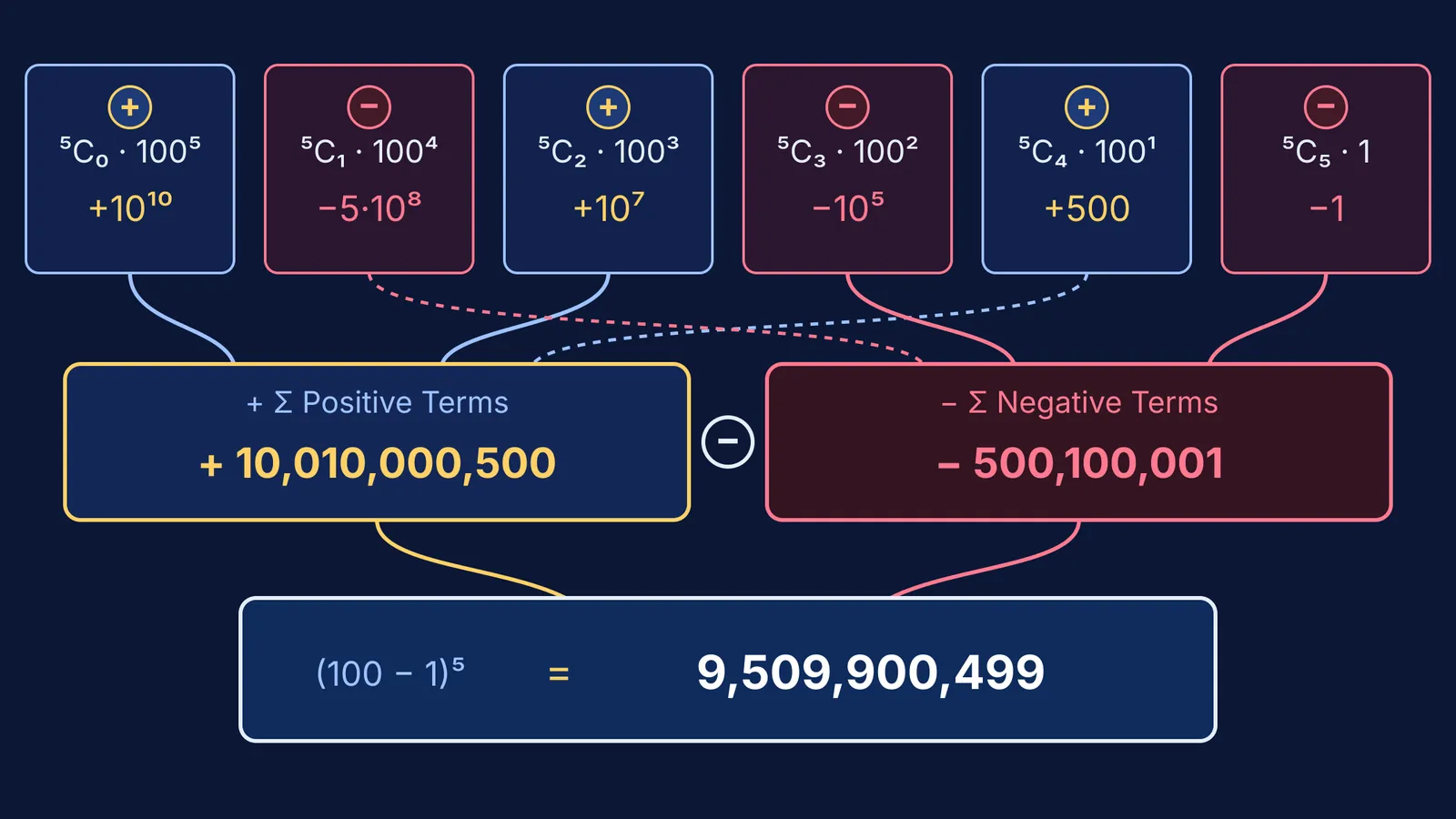
Term 0: ⁵C₀ × (100)⁵ = 1 × 10,000,000,000 = 10,000,000,000
Term 1: − ⁵C₁ × (100)⁴ × 1 = − 5 × 100,000,000 = − 500,000,000
Term 2: + ⁵C₂ × (100)³ × 1² = + 10 × 1,000,000 = + 10,000,000
Term 3: − ⁵C₃ × (100)² × 1³ = − 10 × 10,000 = − 100,000
Term 4: + ⁵C₄ × (100) × 1⁴ = + 5 × 100 = + 500
Term 5: − ⁵C₅ × 1⁵ = − 1 × 1 = − 1
To keep the arithmetic tidy, avoid computing left-to-right with alternating additions and subtractions. Instead, combine like signs first:
Sum of positive terms: 10,000,000,000 + 10,000,000 + 500 = 10,010,000,500
Sum of negative terms: 500,000,000 + 100,000 + 1 = 500,100,001
Now perform a single vertical subtraction: 10,010,000,500 − 500,100,001 = 9,509,900,499.
This two-step accumulation eliminates repeated borrows and gives you the exact result in seconds. To see how these coefficients generalize to algebraic variables, explore our guide on the binomial theorem for JEE.
How does 102⁵ work with positive binomial terms?
When the base is slightly above 100, such as 102 = 100 + 2, every sign in the expansion remains positive. Set a = 100 and b = 2:
(100 + 2)⁵ = ⁵C₀ (100)⁵ + ⁵C₁ (100)⁴(2) + ⁵C₂ (100)³(2)² + ⁵C₃ (100)²(2)³ + ⁵C₄ (100)(2)⁴ + ⁵C₅ (2)⁵
Calculate each term systematically:
Term 0: 1 × 10,000,000,000 = 10,000,000,000
Term 1: 5 × 100,000,000 × 2 = 1,000,000,000
Term 2: 10 × 1,000,000 × 4 = 40,000,000
Term 3: 10 × 10,000 × 8 = 800,000
Term 4: 5 × 100 × 16 = 8,000
Term 5: 1 × 32 = 32
Because every power of 100 creates two-digit shifts, notice how each term slots neatly into place without carries overlapping:
10,000,000,000 + 1,000,000,000 = 11,000,000,000
11,000,000,000 + 40,000,000 = 11,040,000,000
11,040,000,000 + 800,000 = 11,040,800,000
11,040,800,000 + 8,000 = 11,040,808,000
11,040,808,000 + 32 = 11,040,808,032
Reading the blocks from left to right yields 11,040,808,032 directly.
Why does grouping positive and negative terms prevent errors?
Alternating expansions frequently trip up students because interleaving addition and subtraction requires your working memory to juggle sign rules while executing column carries.
In a 2003 study on working memory in mental arithmetic published in *Memory & Cognition*, researchers Patricia L. Trbovich and Jo-Anne LeFevre demonstrated that formatting multi-step operations into structured, visual vertical blocks significantly reduces phonological working memory load compared to horizontal calculation (DOI: 10.3758/bf03196112). Similarly, educational psychologist John Sweller established in 1988 in *Cognitive Science* that standardizing problem-solving templates frees mental capacity for reasoning rather than clerical upkeep (DOI: 10.1207/s15516709cog1202_4).
When you group all positive terms into one pile and all negative terms into another, you replace five consecutive borrow operations with standard addition and a single concluding subtraction. This method also forms the backbone for solving remainder and divisibility problems with binomial expansion.
How can you practice binomial expansions effectively?
When practicing for school exams or entrance tests, use these three habits to check your work:
Check the unit digit first: 99⁵ must end in 9 (since 9 raised to an odd power ends in 9), and 102⁵ must end in 2 (since 2⁵ = 32 ends in 2).
Count the zeros in each power of 100: (100)ᵏ has exactly 2k zeros.
Verify symmetry in the coefficients: row 5 of Pascal's triangle always mirrors itself (1, 5, 10, 10, 5, 1).
If you want structured practice with algebraic problem-solving, the Fermi Problem Library provides worked problems with a step-by-step solver that explains the reasoning rather than printing an answer. To explore how binomial expansions connect across algebra, the Fermi Concept Library covers every concept in physics, chemistry, biology, mathematics and computing, each with its own lesson and its place in the map. When you encounter a challenging expansion, Fermi's AI tutor can work out what you already know and build a plan for the session, checking your understanding at every step.


