

On this page
In high school mathematics, triangle centres usually appear in isolation. You construct the centroid by connecting vertices to opposite midpoints, locate the orthocentre where altitudes meet, and find the circumcentre at the intersection of perpendicular bisectors. Because each point stems from a different construction, coordinate geometry curricula often introduce them as separate topics.
What is the Euler line of a triangle?
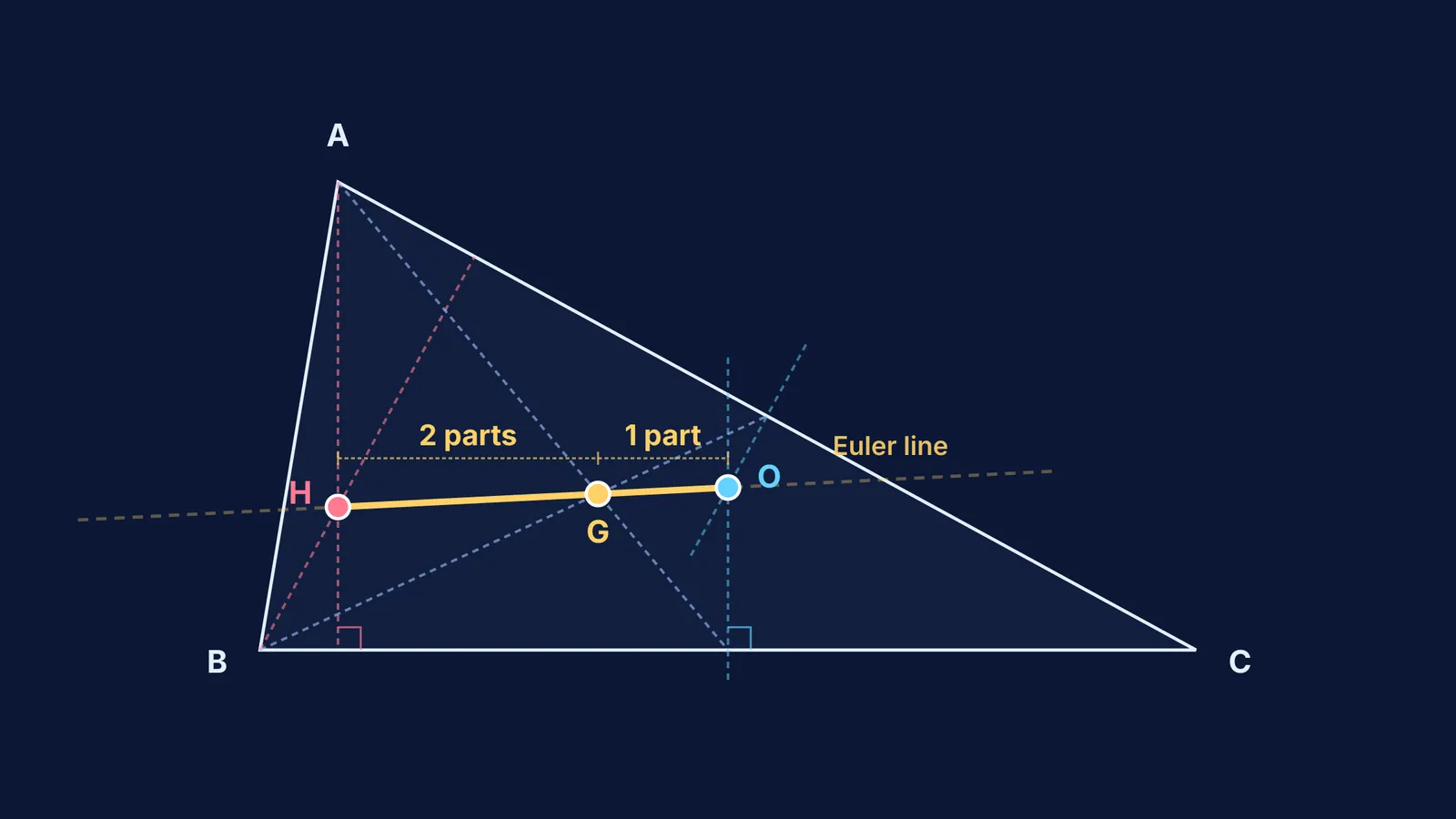
In 1765, Swiss mathematician Leonhard Euler presented a remarkable discovery, published in his 1767 paper *Solutio facilis problematum quorundam geometricorum difficillimorum* in Novi Commentarii Academiae Scientiarum Imperialis Petropolitanae. Euler proved that in any non-equilateral triangle, the orthocentre (H), centroid (G), and circumcentre (O) always lie on a single straight path, now celebrated as the Euler line.
As catalogued on Wolfram MathWorld, the Euler line also contains the nine-point centre (N), which bisects the segment between H and O. This collinearity unifies classical triangle centres in coordinate geometry into one coherent linear structure.
Why does the centroid divide the orthocentre and circumcentre in a 2 : 1 ratio?
Euler showed that the three centres maintain a fixed order, H — G — O, with the centroid sitting between the other two. As detailed on Wolfram MathWorld, the distance from the orthocentre to the centroid is always twice the distance from the centroid to the circumcentre: HG : GO = 2 : 1.
This proportion emerges naturally from vectors. Setting the origin at circumcentre O, the orthocentre H obeys Sylvester's relation, documented in Euler line geometry: vector(OH) = vector(OA) + vector(OB) + vector(OC). Because the centroid G is the average of the three vertices: vector(OG) = (1/3) × (vector(OA) + vector(OB) + vector(OC)) = (1/3) × vector(OH). Since vector(OH) equals 3 × vector(OG), H, G, and O are collinear, with OH = 3 × OG. Subtracting vectors yields: vector(HG) = vector(OG) − vector(OH) = −2 × vector(OG). In scalar distance, HG = 2 × GO, confirming the 2 : 1 ratio.
How do you use the Euler line in coordinate geometry problems?
In competitive tests like JEE Main, finding an orthocentre or circumcentre from three vertices often requires lengthy algebraic calculations—computing perpendicular slopes and solving linear equation systems, as outlined in our guide to straight lines in coordinate geometry. But when two centres are already known, the Euler line bypasses the triangle's vertices entirely.
Applying the internal section formula to the collinear segment HO in the ratio 2 : 1, as documented on Wolfram MathWorld, gives: G = (H + 2O) / 3. Rearranging this relationship yields quick formulas for any missing centre: H = 3G − 2O O = (3G − H) / 2.
Consider a standard problem: a triangle has orthocentre H(−3, 5) and centroid G(3, 3). Find its circumcentre O.
Apply the rearranged section formula: O = (3G − H) / 2.
Calculate the x-coordinate: O_x = (3 × 3 − (−3)) / 2 = 12 / 2 = 6.
Calculate the y-coordinate: O_y = (3 × 3 − 5) / 2 = 4 / 2 = 2.
The circumcentre is O(6, 2). You find the point in seconds without determining vertices or calculating a circle through three given points.
The Fermi Problem Library has worked problems with a step-by-step solver that explains the reasoning rather than printing an answer, helping students practice identifying section shortcuts under timed exam conditions.
What happens to the Euler line in equilateral and right-angled triangles?
Symmetric and right-angled triangles present notable special cases, as noted on Wolfram MathWorld:
Equilateral triangles: Altitudes, medians, and perpendicular bisectors coincide. The centroid, orthocentre, circumcentre, and incentre merge into a single point (H = G = O = I). Because one point cannot define a unique line, the Euler line is undefined.
Right-angled triangles: The legs act as altitudes, placing orthocentre H at the right-angled vertex. Circumcentre O lies at the midpoint of the hypotenuse. The Euler line is the median to the hypotenuse, with centroid G dividing it 2 : 1 from the vertex.
Isosceles triangles: The symmetry axis serves as altitude, median, and perpendicular bisector simultaneously, so all four centres lie along it.
In the Fermi Concept Library, every concept in physics, chemistry, biology, mathematics and computing has its own lesson and its place in the map, giving students a clear path from foundational geometry definitions to advanced exam applications.


